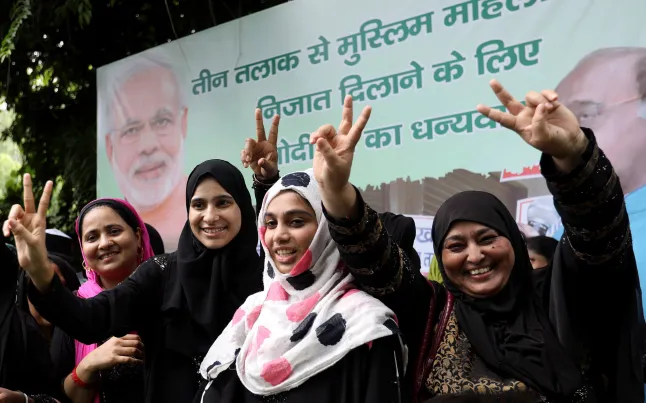
Beyond Borders: How India’s Muslim Women Are Shaping South Asia’s Gender Diplomacy

Indian Muslim women are beginning to shape South Asia’s diplomatic landscape through regional collaborations, cultural exchanges, and academic partnerships.
India’s Muslim women are increasingly becoming central figures in shaping South Asia’s emerging framework of gender diplomacy. Their influence is rooted in constitutional literacy, legal engagement, political participation, and regional cooperation — all of which together create a multidimensional presence that extends far beyond national borders.
As South Asia navigates shared challenges such as climate vulnerability, regional economic disparities, digital transitions, and institutional reforms, the leadership of Indian Muslim women offers a model of stable, inclusive, and reform-oriented diplomacy. Their rise is defined not by confrontation but by strengthening democratic values and the rule of law, making their role exceptionally significant in contemporary regional discourse.
Constitutional Democracy and the Legal Foundations of Diplomacy
A distinctive aspect of their growing influence lies in their engagement with India’s constitutional order and legal system. Muslim women across universities, civic forums, and professional spaces have become consistent advocates for constitutional guarantees under Articles 14, 15, 19, and 21 — rights ensuring equality, freedom, and dignity.
This constitutional awareness enables them to articulate domestic challenges in a language that aligns seamlessly with international legal norms, including CEDAW, the Universal Declaration of Human Rights, and the UN Sustainable Development Goals.
Their familiarity with major national laws further elevates their presence in public discourse. They actively engage with key legislation such as the Protection of Women from Domestic Violence Act, the Muslim Women (Protection of Rights on Marriage) Act, the Juvenile Justice Act, and the Right to Education Act.
Through legal-awareness programs, community dispute-resolution initiatives, and university research forums, they demonstrate how national laws can be implemented effectively to strengthen community well-being and institutional accountability. In a region where legal reform and gender justice are pressing issues, their rights-based approach offers South Asia a stable and non-controversial model for progress.
Political Representation and Strengthening Democratic Institutions
Indian Muslim women are also gradually reshaping political participation in India. Their increasing presence in panchayats, municipal bodies, state development boards, legislative research institutions, and administrative services underscores a growing acceptance of inclusive governance. Through these roles, they contribute to policymaking on public health, digital governance, education reforms, women’s safety, and welfare delivery — all crucial components of modern governance.
Their participation reinforces democratic decentralization and demonstrates how diverse perspectives can strengthen institutional decision-making. By contributing to legislative reviews, policy consultations, governance audits, and development monitoring, they support India’s broader commitment to pluralism and democratic continuity. For international observers, their political engagement signals a strengthening of India’s institutional credibility and reflects a governance culture rooted in transparency, procedural fairness, and rule of law. This enhances India’s diplomatic standing in regional and global forums concerned with governance, gender equality, and institutional resilience.
Cross-Border Collaboration and Rights-Based Regional Engagement
Beyond national boundaries, Indian Muslim women are beginning to shape South Asia’s diplomatic landscape through regional collaborations, cultural exchanges, and academic partnerships. Their participation in international conferences on public policy, gender rights, climate adaptation, peacebuilding, and sustainable development enables them to contribute perspectives that resonate with shared South Asian priorities.
They also engage in civil-society partnerships that focus on humanitarian cooperation, youth leadership, and interfaith dialogue — spaces that play an increasingly important role in long-term regional diplomacy. Their involvement in research initiatives related to comparative constitutional studies, migration policy, health equity, and education access allows them to connect India’s domestic experiences with regional development frameworks.
This rights-based regional engagement supports people-to-people diplomacy, creating a foundation for trust and cooperation that complements formal state-level diplomatic efforts.
Education, Economic Leadership, and Expanding Global Influence
Education remains one of the strongest pillars of their diplomatic influence. With growing access to higher education, global scholarships, exchange programs, and leadership training, Indian Muslim women are participating in global intellectual networks that shape governance and development debates.
Their academic work in law, political science, economics, sociology, and public administration contributes to regional knowledge systems and strengthens South Asia’s presence in global policy spaces.
Economically, they play an increasingly significant role as entrepreneurs, legal professionals, technologists, healthcare specialists, and educators. Their involvement in microenterprise initiatives, financial inclusion programs, digital-skills training, and innovation ecosystems adds an economic dimension to their diplomatic footprint.
These contributions support regional economic cooperation, especially in areas such as women’s workforce participation, digital access, and community development. Their work aligns with South Asia’s broader goals of economic connectivity and sustainable development, making them key contributors to regional diplomatic progress.
India’s Muslim women are thus crafting an impactful and sophisticated model of gender diplomacy — one that integrates constitutional values, legal reasoning, political participation, educational advancement, and cross-border collaboration. Their leadership reinforces India’s democratic commitments while helping create a more stable, inclusive, and cooperative South Asian region.
For international audiences, their role offers an insightful example of how law-grounded, people-centered, and non-controversial leadership can reshape diplomatic discourse in a diverse and rapidly evolving region. By transforming constitutional ideals into regional cooperation frameworks, India’s Muslim women are redefining the future of South Asian diplomacy and contributing to a vision of shared progress, institutional stability, and gender-responsive governance.
Disclaimer: Views expressed by writers in this section are their own and do not reflect Milli Chronicle’s point-of-view.