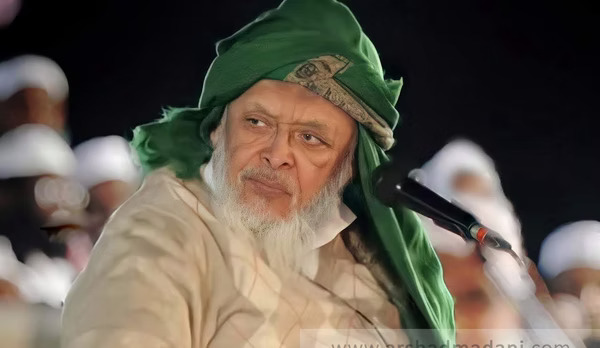
Muslim Vice-Chancellors in India: A Direct Rebuttal to Arshad Madani

This is why rhetoric like Madani’s troubles me personally! it erases achievements like mine.
India’s prominent Islamic scholar Arshad Madani’s recent claim that Muslims “cannot become Vice-Chancellors in India” and that even if they do, “they will be put in jail,” has triggered substantial debate. His remarks, framed in response to the Al-Falah University investigation, were intended to foreground discrimination faced by Muslims in higher education.
Yet, instead of sparking constructive discussion, his statement amplified communal anxieties and reinforced a narrative of permanent marginalization.
For many, it revived a familiar political tactic — invoking collective helplessness to mobilize community sentiment, while eclipsing real issues such as internal inequalities, socio-economic deprivation, and the lack of investment in education.
What stirred the public reaction was not merely the content of Madani’s statement, but the sweeping finality with which he made it. Instead of critiquing specific institutional failures, he suggested that Indian Muslims, by virtue of their identity, are categorically barred from academic leadership. This framing, as argued in the recent ThePrint column critiquing his rhetoric manufactures a sense of fatalism, almost instructing young Muslims to believe that aspiration itself is futile!
It transforms a complex structural issue into a communal indictment, and in doing so, shifts blame externally while ignoring the reforms needed internally.
Contradictions Between Rhetoric and Reality
Madani’s statement, when examined against historical and contemporary facts, quickly becomes contradictory. India’s educational landscape has not been uniformly inclusive, there is undeniable under-representation of Muslims, especially from marginalized sub-groups like Pasmanda Muslims. But the claim that “no Muslim can become a Vice-Chancellor” is factually untrue.
Muslim scholars have held VC positions across Indian universities. From early examples like Ross Masood of AMU, to contemporary appointments such as Mazhar Asif at Jamia Millia Islamia (2024), the record clearly contradicts Madani’s absolutes. Recent data compiled across central and state universities shows that over the decades, more than 280 Muslims have held Vice-Chancellorships. This number is small in proportion to population share, but it proves possibility, not impossibility.
By ignoring these facts, Madani’s narrative has collapsed into contradiction: on one side, he claims Muslims are entirely excluded; on the other, the evidence shows that despite structural limitations, Muslims have risen within academic leadership.
This contradiction matters because it exposes the underlying flaw in his rhetoric. Instead of highlighting systemic barriers, he paints the system in itself as permanently closed. Instead of empowering young Muslims to aim for academic leadership, he inadvertently discourages them. Instead of demanding reforms, he encourages resignation. A rhetoric meant to defend the community ends up weakening it.
Communal Divisions Are Real, But They Cannot Be the Only Lens
No one can deny that communal divisions persist in India. Biases, sometimes subtle, sometimes overt do influence public perception. Yet, to treat communal identity as the only motive or determinant of success risks flattening the story of Indian Muslims into a permanent victimhood model.
Such a model erases internal diversity within the community, overlooks socio-economic inequalities that often matter more than religion, ignores class privilege among the elites who often deploy the language of victimhood, discourages women and young Muslims from pursuing leadership roles, prevents collaboration and bridge-building with other communities.
Critiques of Madani’s statement emphasize this point precisely: when leaders repeatedly recycle narratives of helplessness, they “kill aspiration before discrimination even gets a chance to operate.” The voice of the ordinary Muslim who wants opportunity, dignity, and progress is overshadowed by a rhetoric that prioritizes grievance over growth.
Muslim Vice-Chancellors: A Factual Rebuttal
To provide clarity, several notable Muslim scholars have served as Vice-Chancellors across major Indian universities. Early figures include Ross Masood, who led Aligarh Muslim University (AMU), followed by Abdul Aleem, who served as AMU’s Vice-Chancellor from 1968 to 1974.
More recent appointments further illustrate this legacy: Mazhar Asif was appointed Vice-Chancellor of Jamia Millia Islamia in 2024, while Mohammad Miyan previously headed Maulana Azad National Urdu University (MANUU). The list also includes distinguished leaders such as Zakir Hussain, who not only served as Vice-Chancellor of Jamia Millia Islamia but went on to become the President of India; Talat Ahmad, who held Vice-Chancellorships at both Jamia Millia Islamia and the University of Kashmir; A.R. Kidwai, another former AMU Vice-Chancellor; and Saqib Raza Khan, who served as Vice-Chancellor of Ranchi University.
This is not an exhaustive list, it simply illustrates that Madani’s categorical claim is false. Structural under-representation needs reform, but erasing Muslim academic leadership altogether is misleading and harmful.
Despite structural challenges and undeniable gender disparities, Muslim women have also risen to top academic leadership positions, a fact that directly contradicts the narrative that Muslims, or Muslim women in particular, are entirely excluded from India’s higher education leadership.
The most historic example came in 2024, when Prof. Naima Khatoon became the first woman Vice-Chancellor of Aligarh Muslim University (AMU) in its 100-year history. Her appointment was not gestural, rather it reflected long academic experience, administrative capability, and scholarly merit. AMU, an institution often portrayed as conservative or resistant to women’s leadership unanimously endorsed her, signalling a substantive shift in institutional imagination.
Another important name is Prof. Najma Akhtar, who served as the first woman Vice-Chancellor of Jamia Millia Islamia (2019-2024). Under her tenure, Jamia rose among top-ranked Indian universities and secured major research and accreditation milestones. Her leadership demonstrated that Muslim women can shape academic institutions at the highest level, steering them through public scrutiny, political pressure, and administrative complexity.
Though few in number, these Muslim women Vice-Chancellors represent real, powerful precedents. Their achievements stand as evidence that the barriers are not absolute and that Muslim women, given space and opportunity, can lead some of India’s most influential universities.
My Journey as a Muslim Woman in Public Institutions
My own experience stands as quiet proof that institutional spaces in India are not permanently closed to Muslims, nor to Muslim women. Working in the South-India’s Karnataka Legislative Assembly, I witnessed firsthand that entry into governance and public service is possible, attainable, and often shaped more by merit, initiative, and opportunity than by identity.
I was not limited by my hijab, my name, or my background. Instead, I was entrusted with responsibility, seriousness, and professional respect. My experience disrupts the narrative that Muslims, especially Muslim women, cannot enter corridors of power or influence. It demonstrates that while biases exist, they do not define every institution or individual. More importantly, it shows that portraying Muslims exclusively as victims denies the lived realities of those who are breaking barriers every day.
This is why rhetoric like Madani’s troubles me personally! it erases achievements like mine. It tells young Muslim girls that no matter how hard they try, the system will reject them.
The Community Deserves Better Than Recycled Helplessness
Arshad Madani’s statement may hold concerns, but by presenting it as discrimination in absolute, fatalistic terms, it harms rather than helps. It narrows Muslim identity to a single narrative of exclusion, discourages young achievers, and obstructs the introspective reforms the community urgently needs.
The future of Indian Muslims cannot be shaped by grievance alone. It must be shaped by educational upliftment, internal social reform, women’s empowerment, merit-based achievement, and cooperative engagement with the wider society.
We deserve leaders who inspire aspiration, not those who extinguish it.
Disclaimer: Views expressed by writers in this section are their own and do not reflect Milli Chronicle’s point-of-view.