American-Saudi Scientist Omar Yaghi Honored with 2025 Nobel Prize in Chemistry in Stockholm
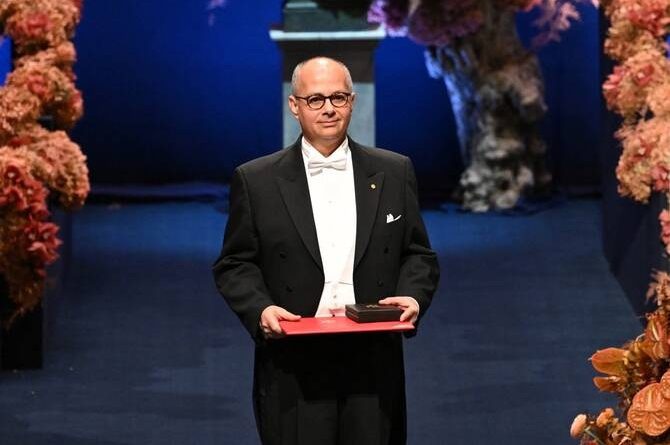
Stockholm – American-Saudi chemist Omar Yaghi received global recognition in Stockholm as King Carl XVI Gustaf of Sweden awarded him the 2025 Nobel Prize in Chemistry. The honor celebrated his pioneering work on metal-organic frameworks, a breakthrough with profound potential for climate solutions and sustainable technologies.
The ceremony highlighted Yaghi’s collaborative achievement alongside British-Australian chemist Richard Robson and Japanese chemist Susumu Kitagawa. Together, the three laureates spent decades advancing MOF science, leading to scalable models capable of capturing carbon dioxide, storing gases and harvesting water from arid air. Their shared prize of $1.2 million marked a formal acknowledgment of their long-standing scientific contributions.
Yaghi’s recognition is historic, as he becomes the first Saudi national ever to receive a Nobel Prize. His achievement also makes him the second Arab-born scientist to win the chemistry prize since Ahmed Zewail’s groundbreaking recognition in 1999. The milestone drew regional and international admiration, particularly for its scientific and cultural significance.
Born in Jordan to a Palestinian family, Yaghi’s early experiences shaped his scientific vision. Growing up in an environment where water was delivered to homes only once every two weeks, he developed a deep awareness of resource scarcity. This personal history guided his lifelong focus on technologies that help arid communities access clean water and clean air.
At UC Berkeley, Yaghi holds the prestigious James and Neeltje Tretter Chair in Chemistry. He also founded the Berkeley Global Science Institute, an initiative promoting scientific innovation across global communities. His laboratory became a leading center for MOF development, producing models that are now recognized as one of the most promising material technologies for environmental sustainability.
His work extended far beyond academia. In recent years, Yaghi founded Atoco, a company focused on water harvesting and carbon capture solutions. He also co-founded H2MOF for hydrogen storage and WaHa Inc. for water harvesting technologies, helping bridge cutting-edge research with real-world applications in the Middle East and beyond.
Yaghi’s MOF-303 model, designed to harvest water from desert air, emerged from early experiments in the Arizona desert. The technology demonstrated how even extremely dry environments could yield usable water, offering hope for regions facing severe water scarcity. The Nobel Committee noted that MOFs have wide-ranging uses, from storing toxic gases to catalyzing important chemical reactions.
His recognition arrives at a moment of increasing global urgency around climate change, making his contributions especially meaningful. Scientists worldwide praised Yaghi’s achievement as a catalyst for renewed innovation in climate technology and sustainable chemistry.
The Nobel Prize presentation was part of Nobel Week in Stockholm, a series of events showcasing global excellence across science, literature and economic sciences. Laureates participated in public discussions, exhibitions and educational programs. Meanwhile, in Oslo, the Nobel Peace Prize was awarded in a parallel ceremony.
Displays at the Nobel Prize Museum also reflect the evolving history of scientific achievement. Ahmed Zewail’s original femtochemistry apparatus—donated to the museum in 2001—remains one of its most admired exhibits. Curators noted that each year’s laureates traditionally bring a symbolic item that represents their life, work or inspiration. Yaghi’s contribution is expected to join a collection that bridges history, innovation and personal stories.
The celebration of Omar Yaghi’s accomplishment marks an inspiring chapter for Arab and Saudi scientists, reinforcing the growing global impact of research emerging from the region. His work continues to influence environmental innovation and scientific collaboration around the world, building a legacy that will inspire future generations.