Maduro Faces U.S. Drug Charges in New York as Venezuela Adjusts to Power Shock
New York – Former Venezuelan leader Nicolas Maduro appeared in a New York federal court to face serious U.S. drug trafficking charges, marking a dramatic new phase in a crisis that has shaken Latin America and reverberated across global diplomacy.
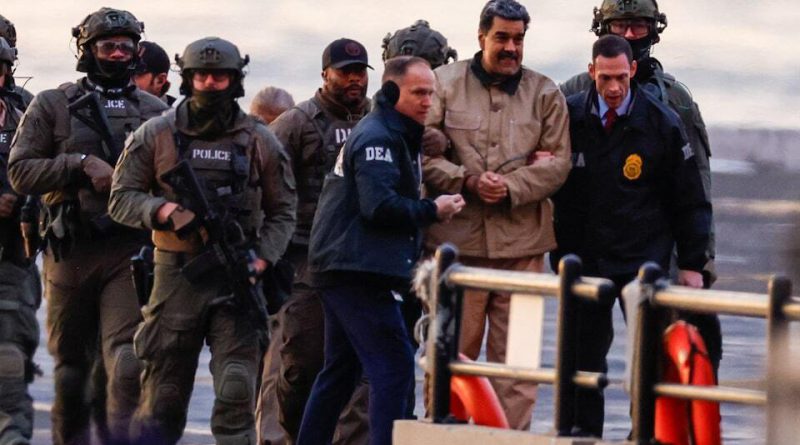
Maduro was transferred under heavy security from detention to a Manhattan courtroom, his arrival symbolizing the unprecedented capture of a sitting head of state by U.S. forces and the start of a legal battle with far-reaching political consequences.
The charges accuse Maduro of overseeing an international cocaine trafficking network that allegedly linked Venezuelan officials with armed groups and powerful criminal organizations across the region.
Prosecutors argue that these activities spanned decades, beginning with his early political career and continuing through his presidency, embedding illicit networks within state structures.
Maduro has long rejected these accusations, framing them as politically motivated and driven by foreign interest in Venezuela’s vast energy resources.
As legal proceedings unfold in the United States, Venezuela itself remains in a fragile state, with senior officials still controlling key institutions and security forces maintaining order in major cities.
Authorities in Caracas issued emergency directives aimed at suppressing dissent and targeting those accused of supporting the foreign intervention, underscoring fears of instability and retaliation.
Despite tensions, daily life has slowly resumed in parts of the country, with markets reopening and transport services restarting under close supervision.
The capture has sparked intense international debate, with questions raised about sovereignty, international law, and the precedent set by such an operation.
Global powers including Russia and China condemned the action, while several Western allies urged restraint, dialogue, and adherence to legal norms.
The issue is expected to be debated at the United Nations, where concerns about regional stability and escalation dominate diplomatic discussions.
In Washington, the operation has triggered political controversy, with lawmakers demanding clarity on its legal basis and long-term strategy.
Supporters of the move hail it as decisive action against alleged narco-terrorism, while critics warn it undermines international order and risks prolonged conflict.
Economic implications are already visible, particularly in global energy markets, where the prospect of changes in Venezuela’s oil sector has fueled investor optimism.
U.S. officials have openly stated ambitions to revive Venezuela’s oil industry with American participation, framing it as both economic recovery and restitution.
Venezuela holds the world’s largest proven oil reserves, yet years of sanctions, mismanagement, and underinvestment have sharply reduced production.
Markets reacted swiftly, with energy stocks rising amid speculation that sanctions could be eased and infrastructure rebuilt under new political arrangements.
Meanwhile, Venezuela’s interim leadership has shifted tone, moving from outright condemnation toward cautious calls for dialogue and cooperation.
Statements emphasizing peace and regional stability suggest an attempt to balance domestic legitimacy with international engagement.
Uncertainty remains over how a post-Maduro political order could emerge, especially as opposition groups appear sidelined and the military remains publicly loyal to current authorities.
Inside Venezuela, celebrations among opponents have been muted, tempered by awareness that real power structures have not yet shifted.
Analysts note that the coming weeks will be critical in determining whether the episode leads to negotiated transition, prolonged instability, or deeper international confrontation.
The case against Maduro now moves into the U.S. judicial system, where outcomes could reshape relations across the Americas and redefine approaches to transnational crime and sovereignty.