New technologies uncover forgotten Silk Road landscapes
Dubai – Across vast deserts and rugged mountain valleys, new technologies are transforming how archaeologists explore the ancient Silk Road and its surrounding regions.
Tools such as drones, satellite imagery, laser scanning, and digital mapping are revealing landscapes once thought empty but now known to be rich in human history.
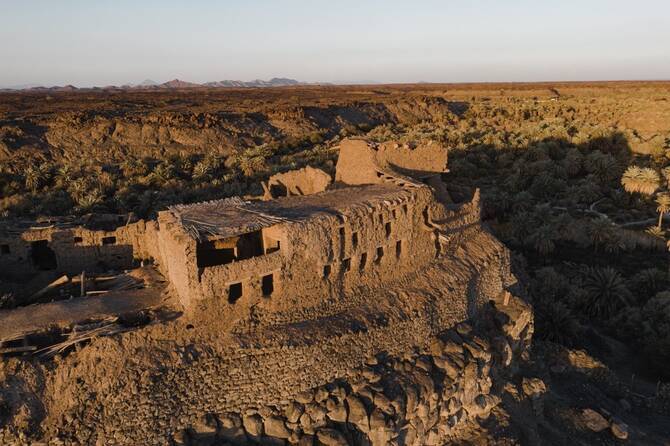
In northern Saudi Arabia, aerial surveys are allowing researchers to map entire ancient settlements in a matter of minutes rather than months.
Faint traces of walls, pathways, and dwellings hidden beneath the sand are becoming visible through high-resolution aerial imaging.
These discoveries are helping scholars reconstruct how ancient communities lived, traded, and moved across Arabia.
The data collected from the air is later transformed into detailed three-dimensional models that preserve sites digitally for further study.
Much of this research is connected to renewed global interest in the Silk Road and its complex networks.
Rather than a single route, the Silk Road was an interconnected web of land and sea corridors stretching across continents.
For more than 1,500 years, these routes linked East Asia with the Middle East, North Africa, and Europe.
They enabled the exchange of silk, spices, metals, and textiles, as well as ideas, technologies, and belief systems.
Arabia played a crucial role within this network, acting as a bridge between Asia, Africa, and the Mediterranean world.
Caravan routes crossed deserts and oases, connecting ports, cities, and inland settlements across the peninsula.
Until recently, much of Arabia’s ancient landscape remained poorly documented due to its sheer size and harsh terrain.
Traditional ground surveys were slow, costly, and often limited to easily accessible areas.
The introduction of drones and digital tools has dramatically changed this situation.
Large regions can now be surveyed quickly, allowing archaeologists to identify patterns invisible from ground level.
In areas such as AlUla and Khaybar, aerial mapping has uncovered thousands of prehistoric and Bronze Age structures.
These regions are now considered among the densest archaeological landscapes in the world.
The discoveries challenge long-held assumptions that large parts of Arabia were sparsely populated in ancient times.
Instead, the evidence suggests sustained human activity, complex settlement systems, and long-distance trade connections.
Laser scanning and photogrammetry are also helping researchers measure structures with remarkable precision.
These methods capture subtle changes in elevation and construction that indicate different phases of occupation.
Satellite imagery further complements drone surveys by offering a broader regional perspective.
Researchers can trace ancient pathways, water systems, and caravan routes extending far beyond individual sites.
Digital archaeology is also improving preservation and heritage management.
By documenting sites virtually, authorities can monitor damage, plan conservation efforts, and manage tourism more effectively.
Scholars say these technologies are reshaping how the Silk Road is understood as a living landscape rather than isolated monuments.
The focus is shifting toward understanding how people interacted with their environment over long periods.
The ability to collect vast amounts of data efficiently has also encouraged international collaboration.
Researchers from different countries can now share digital models and findings with unprecedented ease.
These tools are particularly valuable in regions where excavation must be limited to protect fragile sites.
Non-invasive methods allow exploration without disturbing the physical remains.
As technology continues to evolve, archaeologists expect even more discoveries across Arabia and beyond.
Future surveys may reveal new connections between ancient communities previously thought unlinked.
The renewed exploration of Silk Road landscapes highlights the region’s deep historical significance.
It also reinforces the idea that innovation is essential to understanding the past in modern times.