
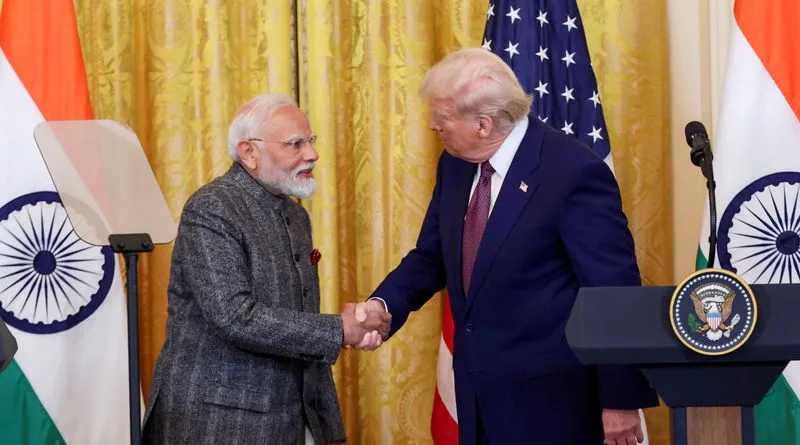
India receives US invitation to join Trump’s Gaza peace board
New Delhi – India has received an invitation from United States President Donald Trump to join his proposed “Board of Peace,” an international initiative aimed at resolving major global conflicts, starting with the war in Gaza, according to a senior Indian government source.
The move places New Delhi among a select group of countries being courted by Washington as it seeks broader international involvement in diplomatic efforts linked to the Palestinian enclave and wider regional stability.
The invitation comes at a delicate moment in India–US relations, with bilateral ties facing pressure over unresolved trade disputes.
Despite growing strategic cooperation in areas such as defense, technology and Indo-Pacific security, negotiations have stalled over tariffs on Indian exports to the United States, which are currently subject to levies of up to 50 percent, among the highest imposed by Washington.
This backdrop adds complexity to India’s consideration of Trump’s peace initiative.
According to the source, it remains unclear whether India will accept the invitation. New Delhi’s foreign ministry has not publicly commented, reflecting the cautious approach India often adopts when balancing diplomatic engagement with major powers against its own strategic autonomy.
India has traditionally supported a two-state solution to the Israel-Palestine conflict while maintaining close ties with Israel and longstanding support for Palestinian rights.
Trump’s “Board of Peace” initiative is envisioned as a multinational platform bringing together governments to explore pathways to conflict resolution, with Gaza positioned as its initial focus.
The US president has reportedly extended invitations to around 60 countries, signaling an attempt to give the initiative global legitimacy.
Among those invited is Pakistan, India’s neighbor and regional rival, which has already indicated it would engage in international efforts aimed at peace and security in Gaza.
For India, participation could offer both opportunities and challenges. On one hand, joining the initiative would allow New Delhi to project itself as a responsible global actor committed to peace-building, aligning with its broader aspirations to play a larger diplomatic role on the world stage.
On the other hand, involvement in a US-led mechanism during a period of trade friction could be seen domestically and internationally as politically sensitive.
India’s relationship with the Gaza conflict has been carefully calibrated. While condemning civilian casualties and calling for humanitarian access, India has also strengthened defense and technological cooperation with Israel over the past decade.
Any formal role in a peace board would require New Delhi to navigate these relationships carefully, ensuring it does not appear to tilt too far toward any single camp.
Analysts note that Trump’s outreach to India may also reflect Washington’s recognition of New Delhi’s growing influence, particularly among developing nations and in forums such as the G20 and the Global South.
India’s experience in peacekeeping missions, conflict mediation, and humanitarian assistance could add credibility to any multilateral peace initiative, even if its actual impact on the ground remains uncertain.
The timing of the invitation is also significant given the broader geopolitical landscape. With conflicts stretching from the Middle East to Eastern Europe and heightened competition among major powers, diplomatic initiatives aimed at de-escalation carry both symbolic and strategic weight.
For the United States, securing participation from countries like India could help counter criticism that its Middle East policies lack broad international backing.
Whether India ultimately joins the Board of Peace may depend on several factors, including clarity on the initiative’s mandate, decision-making structure, and alignment with India’s foreign policy principles.
New Delhi is likely to assess whether participation would offer tangible diplomatic leverage or risk entangling it in initiatives over which it has limited influence.
The invitation nonetheless underscores India’s rising profile in global diplomacy. How New Delhi responds could signal its approach to balancing strategic partnerships with independent foreign policy choices.