
Trump rules out force over Greenland bid at Davos
Davos – US President Donald Trump said the United States would not use military force to gain control of Greenland, seeking to calm global concerns while doubling down on his argument that Washington is uniquely positioned to secure the strategically vital Arctic territory.
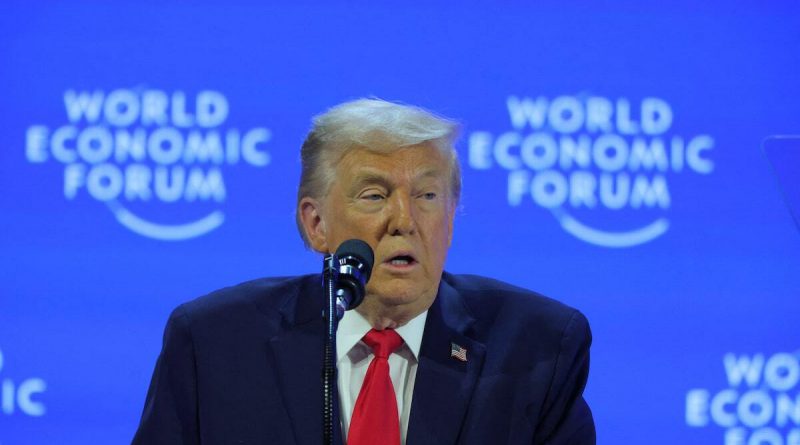
Speaking at the World Economic Forum in Davos, Trump insisted his push for Greenland was rooted in global security interests, not aggression, even as his remarks continued to strain relations with European allies.
Addressing a packed hall of political and business leaders, Trump dismissed speculation that his administration might resort to coercion or force. He told delegates that while many believed he would act militarily, such steps were unnecessary.
According to Trump, the United States could achieve its objectives through negotiations, adding that he had no intention of using force to acquire Greenland.
Despite the reassurance, Trump’s tone remained confrontational. He criticized European allies for what he described as ingratitude and repeated policy failures, ranging from energy choices to immigration and defense spending.
His comments underscored a widening rift between Washington and European capitals, with Greenland emerging as a flashpoint in already fragile transatlantic relations.
Trump argued that Greenland’s importance went beyond territorial expansion, framing it instead as a cornerstone of Arctic and global security.
He said no other country or group of nations was capable of securing the island, which is an autonomous territory under Denmark, as effectively as the United States.
The island’s strategic location, proximity to key Arctic routes, and relevance to missile defense and early warning systems have increasingly drawn attention amid rising great-power competition in the region.
Calling the acquisition a “small ask,” Trump downplayed concerns that a US takeover would threaten NATO unity, even though Denmark is a founding member of the alliance.
He suggested that greater American control would enhance collective security rather than undermine it, a claim that has been met with skepticism by NATO leaders and European policymakers.
Trump’s remarks came as NATO officials warned that his Greenland strategy could destabilize the alliance at a time when unity is being tested by conflicts in Europe and rising geopolitical tensions.
Danish and Greenlandic leaders have firmly rejected the idea of selling or transferring sovereignty over the island, though they have expressed openness to expanding US military presence and cooperation within existing frameworks.
During his lengthy speech, Trump repeatedly referred to Greenland incorrectly as Iceland, drawing quiet amusement from some delegates and criticism from others who viewed it as emblematic of a casual approach to sensitive diplomatic issues.
Still, his comments dominated the Davos agenda, overshadowing discussions on global growth, climate risks, and financial stability.
Trump said he was seeking immediate negotiations to reopen discussions on Greenland’s future, insisting that such talks would be conducted respectfully and without pressure.
He framed the issue as a matter of protecting the world from emerging threats in the Arctic, which is becoming increasingly accessible due to climate change and melting ice.
The reaction among Davos attendees was mixed. While some applauded Trump’s pledge to avoid force, others appeared disengaged as his speech stretched beyond an hour.
Many delegates reportedly drifted back to private conversations or watched portions of the address on screens outside the main hall, reflecting both the fatigue and fascination that often accompany Trump’s appearances on the global stage.
For Europe, Trump’s statements offered limited reassurance. While ruling out force eased immediate fears of escalation, his insistence that only the United States could secure Greenland was seen as dismissive of Danish sovereignty and European security capabilities.
Analysts say the comments highlight a broader shift toward transactional diplomacy, where strategic interests are pursued bluntly, even at the cost of long-standing alliances.
As Trump marked the end of his first year back in office, his Davos appearance reinforced a familiar pattern: bold declarations, provocative language, and a readiness to challenge established norms.
Whether his call for negotiations over Greenland leads to concrete talks or deepens diplomatic tensions remains uncertain, but the issue has clearly cemented itself as a defining element of his foreign policy agenda.
With Arctic competition intensifying and alliances under pressure, Trump’s remarks ensured that Greenland will remain at the center of global strategic debate, long after the Davos meetings conclude.


