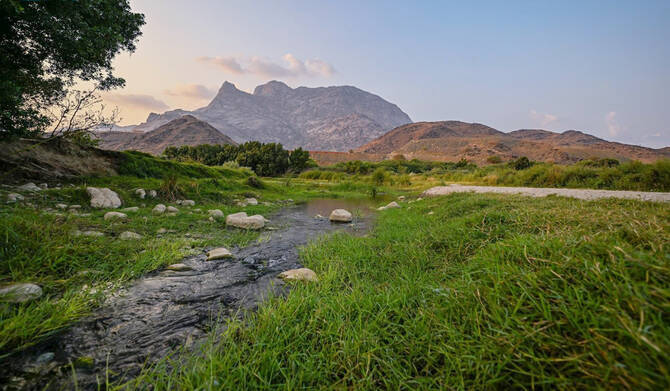
Winter destination Wadi Al-Ahsabah showcases Baha’s natural beauty
Jeddah – Wadi Al-Ahsabah has emerged as one of the most attractive winter and spring destinations in Saudi Arabia’s Baha region, drawing visitors with its distinctive geography, seasonal greenery and rich biodiversity.
Stretching for nearly 100 kilometers from Al-Makhwah governorate to the Tihamah plains before reaching the Red Sea, the valley offers a rare blend of natural landscapes and vital water resources.
The valley is known for its scenic terrain that transforms dramatically during the cooler months. Seasonal rainfall brings the area to life, covering the valley floor with wild plants such as lavender, rue and wild mint, alongside Sidr trees and wide green stretches that appeal to nature lovers.
Visitors are increasingly drawn to Wadi Al-Ahsabah for its peaceful environment and visual diversity. Rolling hills, flowing seasonal streams and fertile agricultural land combine to create an ideal setting for outdoor recreation and eco tourism.
At the heart of the valley lies the Wadi Al-Ahsabah Dam, a major infrastructure project completed in 2012. The dam plays a critical role in supporting nearby communities by serving as the main source of drinking water for Al-Makhwah and Ghamid Al-Zinad.
The structure supplies water to around 15 wells and has become a cornerstone of regional water security. With a length of 895 meters, a height of 22 meters and a storage capacity of nearly 11 million cubic meters, the dam represents a significant investment in sustainable resource management.
Beyond its functional importance, the area surrounding the dam has been developed to support tourism. A 3,600 square meter park near the dam provides visitors with shaded spaces, walking areas and scenic viewpoints that enhance the overall appeal of the destination.
During periods of heavy rainfall, the dam’s gates release excess water in a controlled manner. This process helps recharge groundwater reserves and supports agricultural wells used by local farmers.
Thanks to its reliable freshwater supply and fertile soil, Wadi Al-Ahsabah is among the most productive agricultural zones in the Baha region. The valley supports the cultivation of various crops, contributing directly to local food security and rural livelihoods.
Farming activity in the area benefits from the natural flow of water and nutrient rich sediment carried during seasonal rains. This has allowed agriculture to coexist alongside tourism and environmental conservation efforts.
The valley’s biodiversity further enhances its ecological value. Native plant species and wildlife thrive in the seasonal ecosystem, making the area attractive not only to tourists but also to researchers and environmental enthusiasts.
Local authorities view Wadi Al-Ahsabah as a model for balanced development. Efforts have focused on preserving the natural environment while improving infrastructure that allows visitors to enjoy the landscape responsibly.
The destination’s growing popularity reflects a broader trend toward nature based tourism in Saudi Arabia. Travelers are increasingly seeking destinations that combine scenic beauty, cultural value and environmental sustainability.
Wadi Al-Ahsabah’s accessibility during winter and spring makes it particularly appealing. Milder temperatures and flowing watercourses create ideal conditions for sightseeing, photography and family outings.
The valley also plays an educational role by highlighting the importance of water management in arid regions. The dam stands as an example of how infrastructure can support both human needs and environmental balance.
As tourism continues to develop in the Baha region, Wadi Al-Ahsabah is expected to play a central role. Its combination of natural charm, agricultural significance and water resources positions it as a key eco tourism destination in the Tihamah area.
By offering visitors a chance to experience untouched landscapes alongside modern development, the valley reflects a harmonious relationship between people and nature. Wadi Al-Ahsabah remains a symbol of how environmental preservation and economic activity can coexist in a sustainable way.