How Bangladesh’s July Ordinance Rewrites Law, History, and Accountability

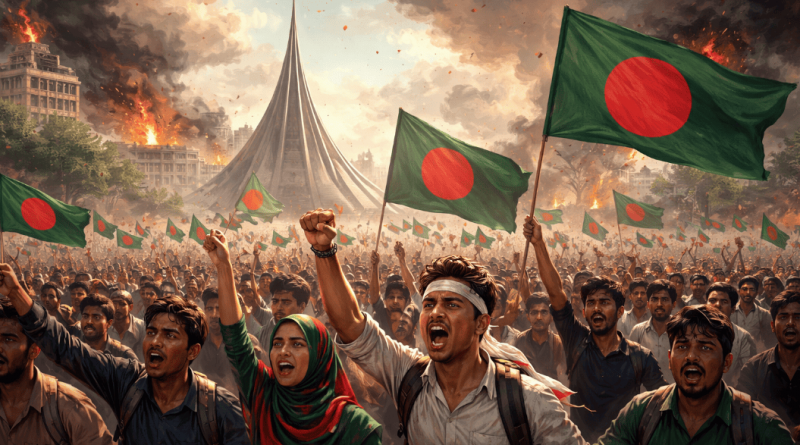
Bangladesh’s interim government recently gave its final approval to the draft of ‘July Mass Uprising Protection and Liability Determination Ordinance’ that grants indemnity to those who participated in the 2024 July Uprising that forced Sheikh Hasina to end her 15-year political rule and flee the country. The ordinance, believed to be the interim government’s fulfilment of ‘earlier commitment’ to ensure ‘legal protection’ to July participants, would take the shape of a law soon.
The ordinance provides impunity to participants from ‘activities carried out with the purpose of political resistance’ during 2024 uprising in July and August. Meaning, if criminal cases are slapped any of uprising participants for carrying out ‘political resistance during uprising’, such cases will be withdrawn by the government. Moreover, the ordinance adds that ‘no new cases will be filed’ against them, from now on, for their activities during the uprising.
The events of July-August have various connotations—uprising, revolution, political coup and political resistance. Those who participated in the uprising called it a ‘revolution’ that paved the way for ‘New Bangladesh’ or ‘Second Republic’. This group, composed mostly of student leaders who led the uprising and some later formed the National Citizen’s Party (NCP), has not only framed the uprising as ‘second liberation’ but also introduced a new political discussion where 1971 Liberation was brought back, reinterpreted and even compared with the 2024 uprising.
The 2024 ‘revolution’ has been portrayed by this group as fulfilling what 1971 could not, a liberation that gave Bangladesh its ‘true independence’. The same narrative is also echoed by another faction—the Islamists—for whom 2024 Uprising rolled the red carpet for their resurgence in the political field and now forms the main contending group against Bangladesh Nationalist Party (BNP) in the February 2026 national election.
Collectively, the Awami League is now branded as a ‘fascist’, a justification used by the interim government for banning Awami League’s political activities in May, closing the League’s door to participate in the February 2026 national election.
The interim government, in its official capacity, recognised the July participants as ‘july warriors’ (July Joddha), similar to ‘war heroes’ (Mukti Joddha) of Liberation War. On the first anniversary of the uprising, the interim government unveiled the July Declaration on 5 August 2025, following pressures from Student Against Discrimination (SAD), the main force behind the July Uprising and NCP to give 2024 events a constitutional recognition.
The Declaration, declared to be given a constitutional status, was supposed to be a statement to recognise the July Uprising and its ambitions for ‘Second Republic’. Rather, it became a political fatwa against Awami League and its political past since 1971 (as interpreted by its opponents), an obituary of the 1972 Constitution that is now labelled as ‘Mujibist Constitution’, and legitimising the ‘unconstitutionally’ formed interim government.
There is little doubt about the interim government’s biases towards leaders of the July Uprising. Indeed, it was the student leaders of SAD that invited Muhammad Yunus to come back to Bangladesh and take the role of the chief advisor of the interim government on 8 August 2024.
In return, three of the advisors in the interim government were student leaders of July Uprising. Many in the political circle believe that the interim government that helped the formation of National Citizen’s Party (NCP), a King’s Party, by intentionally delaying the announcement of an election roadmap. The neutrality became exposed when one of the advisors resigned to become the convenor of the NCP, while another resigned only recently to become the NCP’s spokesperson.
Since NCP’s establishment, the interim government displayed its soft corner for the student party, echoing the same political narrative as that of NCP, and even actively taking measures of historical revisionism to erase Awami League and Sheikh Mujibur Rahman’s legacy.
The recognition of July warriors has not been without controversy either. The gazetted list of about 1,402 warriors declared as ‘national heroes’ are promised tax benefits, welfare and rehabilitation, and now legal protection as per the 14 January ordinance. However, the gazetted lists were accused of including fake claimants, irregularities and political misuse, ironically the accusations slapped against Sheikh Hasina during the early phase of July Uprising when it was in the stage of anti-quota protest.
The ‘July warriors’ also violently clashed with police on the day of signing of the July Charter in October demanding for state recognition of martyr status, in addition to compensation and legal immunity—demands that were ultimately added as Clause 5 of the July Charter.
The latest move to this shenanigan—the July Mass Uprising Protection ordinance—justifies all kinds of acts that happened in July-August, especially violence against minorities and looting of arms from security forces, by indirectly branding these acts as ‘political resistance’. The wave of communal violence witnessed during this time, and continues even today were dismissed by the interim government as ‘political’.
Despite international reports, the interim government insists on these being ‘non-communal’ attacks. With only less than three weeks before 13th national election, over one-third of the polling booths are also marked as ‘risky’, while about 1,3331 of the 5,763 firearms and explosive looted during July Uprising remain missing, posing an alarming risk to security during the election time.
The protection ordinance potentially shields all human rights abuses. Although the interim government clarified that only ‘political resistance’ is to be given legal protection, the tweaking of human rights abuses as ‘political reaction’ leaves little room to comprehend that all these criminal acts will also be treated as ‘political resistance’.
The shameful attempt to equate 2024 July with the 1971 Liberation War, by providing equal status, benefits, memorials, and now legal protection not only downplays Bangladesh’s painful history but also changes the whole political trajectory of the country where political violence will get state protection.
Disclaimer: Views expressed by writers in this section are their own and do not reflect Milli Chronicle’s point-of-view.