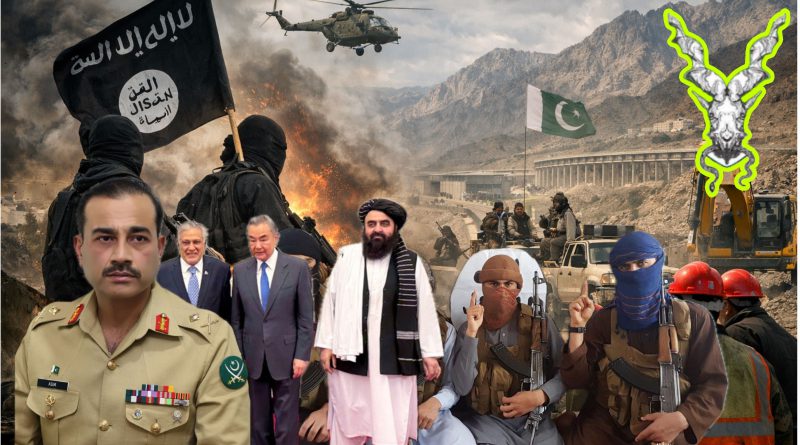
Pakistan’s ISI-Gambit: Using ISKP to Checkmate Taliban, Bleed China

Pakistan’s Inter-Services Intelligence (ISI) is leveraging ISKP as a strategic asset to subdue the Afghan Taliban.
In the desolate, mineral-rich expanses of Afghanistan, a new chapter of the “Great Game” is being written, one where the old rules of insurgency and statecraft are colliding with the ruthless ambitions of the Islamic State Khorasan Province (ISKP).
For Beijing, the withdrawal of Western forces from Kabul was supposed to herald a golden era of economic expansion—a chance to extend the Belt and Road Initiative (BRI) into the heart of Central Asia.
Yet, as Chinese engineers break ground and diplomats shake hands with the Taliban, a sinister reality has emerged. China is no longer just an investor; it is a target. And arguably the most disturbing element of this security crisis is not just the ferocity of the jihadists, but the calculated geopolitical machinations of China’s “all-weather friend,” Pakistan.
The Dragon in the Crosshairs
The resurgence of ISKP in the post-US Afghanistan landscape poses an existential threat to Chinese interests that Beijing appears ill-equipped to handle. Unlike the Taliban, who crave international legitimacy and economic aid, ISKP operates on a nihilistic theology that views the Chinese state not as a partner, but as a godless oppressor of the Uyghur Muslims.
Intelligence reports and propaganda channels from the group have increasingly explicitly included Chinese citizens in their “kill lists,” marking a terrifying pivot from local sectarian violence to transnational terrorism.
This is not merely rhetoric. ISKP has engaged in a systematic campaign to obstruct the China-Afghanistan cooperation process. By attacking Chinese personnel, hotels frequenting Chinese businessmen, and infrastructure projects, they aim to achieve a dual victory: punishing Beijing for its Xinjiang policies and humiliating the Taliban administration by exposing its inability to protect its most powerful patron.
Every dead Chinese engineer is a billboard for the Taliban’s security failure, driving a wedge between Kabul and Beijing. For China, the risk is compounding; their economic strategy relies on stability, yet their very presence incites the instability they fear.
The Double Game: Islamabad’s Dangerous Proxy
However, to view the ISKP threat solely as a byproduct of Afghan chaos is to miss the deeper, more cynical geopolitical undercurrents. Security analysts and regional intelligence have long pointed to a disturbing pattern in Pakistan’s strategic calculus—a continuation of the “double game” that once bedeviled the Americans.
The central allegation, supported by a growing body of evidence, is that Pakistan’s Inter-Services Intelligence (ISI) is leveraging ISKP as a strategic asset to subdue the Afghan Taliban.
Islamabad finds itself in a precarious position. The Afghan Taliban, once their proxies, have become defiant, sheltering the Tehrik-i-Taliban Pakistan (TTP) and refusing to recognize the Durand Line. In response, observers argue that the Pakistani security establishment has tacitly allowed ISKP to operate as a counter-pressure force.
By facilitating—or at the very least, turning a blind eye to—ISKP sanctuaries, Pakistan aims to weaken the Taliban’s grip on power and force them into subservience. The logic is brutal but familiar: use one monster to fight another.
This strategy, however, comes with a catastrophic collateral cost for China. While Pakistan acts as Beijing’s closest ally, the very groups it nurtures to checkmate Kabul are the ones turning their guns on Chinese citizens. It is a perilous gambit where Islamabad attempts to walk a tightrope, utilizing jihadist assets for regional leverage while simultaneously claiming to be a victim of terrorism to secure international funds.
The Tirah Valley Revelation
Nowhere is this duplicitous reality more stark than in the recent, murky events of the Tirah Valley in Pakistan’s Khyber Pakhtunkhwa (KPK) province. This rugged terrain, historically a smuggler’s paradise and militant stronghold, has become the epicenter of a new security failure involving Chinese nationals.
Recent violent incidents in the region resulting in the deaths of Chinese personnel were swiftly framed by Pakistani narratives as the work of Baloch separatists or generic “militants.” The Baloch Liberation Army (BLA) is a convenient scapegoat; they are secular, anti-state, and openly hostile to Chinese investment. Blaming them fits a tidy narrative that absolves the state of religious extremism problems.
However, a forensic look at the Tirah Valley incident suggests a different author. The operational sophistication and the specific targeting methodologies bore the hallmarks of ISKP. Credible intelligence suggests that the Tirah Valley has been functioning as a sanctuary where ISKP operatives regroup, allegedly under the watchful surveillance of the ISI.
The accusation is damning: that elements within the Pakistani state apparatus, in their zeal to maintain ISKP as a thorn in the Taliban’s side, allowed these networks to fester until they lashed out at the Chinese.
The attempt to shift blame to the Baloch separatists serves a dual purpose for Islamabad. It demonizes the Baloch independence movement, justifying harsh military crackdowns in Balochistan, while simultaneously concealing the state’s lingering flirtation with Islamist terror groups like ISKP.
For Beijing, the realization is dawning that the “iron brothers” relationship with Pakistan might be riddled with rust. The Chinese are dying not just because of ideological hatred, but because they are pawns in a fratricidal struggle between regional intelligence agencies and the proxy groups they cultivate.
A Fracture in the Alliance
As China doubles down on its security protocols, importing private security contractors and demanding “thorough investigations,” the silence from Beijing regarding Pakistan’s role is deafening. It is a silence born of necessity; China has no other viable route to the Indian Ocean.
Yet, the blood spilled in the Tirah Valley and the streets of Kabul serves as a grim warning.
The resurgence of ISKP is not an accident of history but a monster fed by the cynical strategies of regional powers. If Pakistan continues to view ISKP as a useful lever against the Taliban, it does so at the peril of its most critical economic partnership.
For China, the lesson is harsh and historically consistent: in the Hindu Kush, the hand that shakes yours in friendship may also be the one feeding the tiger that stalks you.
Disclaimer: Views expressed by writers in this section are their own and do not reflect Milli Chronicle’s point-of-view.