UK Prime Minister Starmer begins China visit urging firms to seize new opportunities
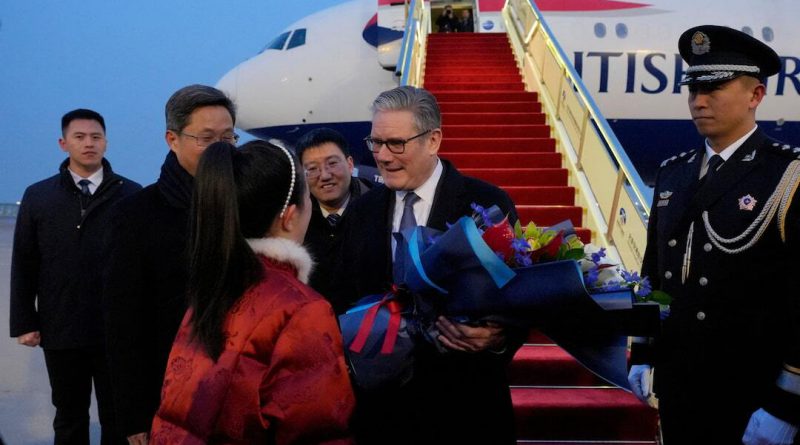
Beijing – UK Prime Minister Keir Starmer has arrived in China on a landmark visit aimed at resetting relations between London and Beijing while encouraging British companies to explore new commercial opportunities in the world’s second largest economy. The trip marks the first visit by a British prime minister to China since 2018 and signals a cautious but pragmatic shift in engagement after years of strained ties.
Addressing a delegation of more than 50 British business leaders travelling with him, Starmer stressed the importance of engagement over isolation. He said the visit was focused on delivering tangible benefits for people back home, particularly through trade, investment and job creation.
The prime minister described the moment as historic, noting that eight years had passed since a UK leader last set foot in China. He framed the visit as part of a broader effort to adapt Britain’s foreign and economic policy to a changing global environment marked by uncertainty and competition.
Starmer acknowledged concerns around national security, human rights and political differences but argued that these issues should not prevent dialogue. He said Britain could pursue economic cooperation while remaining vigilant about risks and protecting its national interests.
The visit includes planned meetings with President Xi Jinping and Premier Li Qiang, where discussions are expected to cover trade, investment, climate cooperation and regional security issues. British officials have indicated that the talks will be wide ranging but pragmatic in tone.
Relations between the UK and China have been tense in recent years due to Beijing’s actions in Hong Kong, allegations of espionage and China’s relationship with Russia amid the Ukraine war. Starmer’s trip is widely seen as an attempt to stabilise ties without fully reversing previous policy positions.
For China, the visit offers an opportunity to present itself as a reliable economic partner at a time of global volatility. With geopolitical tensions rising and trade routes shifting, Beijing is keen to maintain strong links with major European economies.
Starmer told reporters that it was not in Britain’s interest to ignore China’s economic weight or global influence. He said engagement was necessary to address shared challenges such as climate change, global growth and supply chain resilience.
The trip is also taking place against the backdrop of growing unpredictability in relations with the United States. Western governments have stepped up diplomacy with China as they hedge against sudden policy shifts and trade tensions under US President Donald Trump.
Starmer rejected the idea that improving economic ties with China would undermine Britain’s close relationship with Washington. He emphasised the long standing partnership between the UK and the US in defence, intelligence and security, saying London could manage both relationships simultaneously.
Questions remain over whether sensitive political issues will be raised directly with Chinese leaders. Starmer declined to specify whether he would discuss individual cases linked to Hong Kong or press Beijing to use its influence over Moscow regarding the Ukraine conflict.
He did, however, express hope for progress on easing travel restrictions, including the possibility of expanded visa free arrangements. Improved mobility could support business ties, tourism and cultural exchange between the two countries.
The prime minister also distanced himself from calls for middle powers to unite against American dominance, stressing instead a practical approach based on national interest. He described his foreign policy stance as rooted in British pragmatism rather than ideological alignment.
Business leaders accompanying Starmer see the visit as a chance to rebuild commercial bridges. China remains a major market for sectors including finance, manufacturing, green technology and education, despite regulatory and political challenges.
Analysts say the visit will not erase long standing disagreements but could help lower tensions and reopen channels of communication. Even modest progress on trade, travel and dialogue would mark a significant shift after years of limited high level contact.
As Starmer’s visit unfolds, both sides appear keen to strike a balance between cooperation and caution. The outcome may shape the future trajectory of UK China relations at a time when global alliances and economic strategies are being reassessed.