
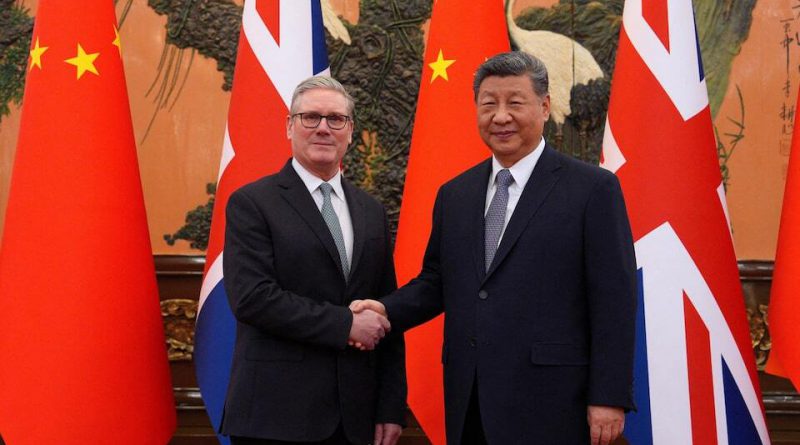
Britain and China Signal Reset in Relations as Starmer Pushes Sophisticated Engagement
Beijing – Britain and China have signaled a renewed phase in their bilateral relationship after Prime Minister Keir Starmer and Chinese President Xi Jinping pledged deeper cooperation across trade, investment, and technology.
The visit marked a significant diplomatic moment, with both sides emphasizing mutual economic benefit and long-term stability following years of strained relations and limited high-level engagement.
Starmer became the first British prime minister to visit China since 2018, underscoring the importance his government places on rebuilding ties with the world’s second-largest economy.
During meetings in Beijing, he called for what he described as a “more sophisticated relationship,” one that balances economic opportunity with open dialogue on areas of disagreement.
The visit comes at a time of global uncertainty, as shifting US foreign policy has prompted several Western leaders to recalibrate their international partnerships.
The talks resulted in several tangible gestures aimed at boosting people-to-people and commercial links. China announced 30 days of visa-free access for British citizens, a move expected to encourage tourism and business travel.
In addition, Beijing agreed to cut tariffs on British whisky by half, a step welcomed by UK exporters seeking better access to the Chinese market.
A major highlight of the visit was the announcement by pharmaceutical giant AstraZeneca of a $15 billion investment in China. The company said the funds would support the development of new medicines and expand its research and manufacturing footprint.
Starmer cited the investment as clear evidence of how improved diplomatic relations could translate into concrete economic gains for both countries.
The British prime minister spent several hours with President Xi during a formal summit and working lunch, where discussions covered a wide range of topics including global security, trade, technology cooperation, and the war in Ukraine.
The meeting also touched on softer cultural themes such as football and literature, reflecting an effort to humanize relations after years dominated by political and strategic tensions.
For Starmer, improving relations with China is closely tied to his domestic economic agenda. His centre-left Labour government has faced pressure to deliver stronger growth, and closer engagement with major global markets is seen as a key pillar of that strategy.
By attracting investment and opening doors for British companies, the government hopes to stimulate innovation, job creation, and long-term competitiveness.
However, the renewed engagement has not been without controversy. Critics in Britain and the United States have raised concerns over security risks, allegations of industrial espionage, and China’s human rights record.
Starmer acknowledged these concerns, arguing that stronger ties would actually allow for more effective and frank dialogue on contentious issues rather than silence or isolation.
During the meeting, Starmer stressed that cooperation and disagreement need not be mutually exclusive. He said Britain aims to identify areas where collaboration is possible, while maintaining the ability to speak openly when interests or values diverge.
This approach, he suggested, reflects a mature and realistic foreign policy suited to an increasingly complex global environment.
President Xi welcomed the shift in tone, saying China was ready to build a long-term partnership with Britain after years of “twists and turns” that benefited neither side.
He emphasized that stable relations between the two countries could contribute positively to global economic growth and international cooperation.
The visit highlights a broader trend of renewed diplomatic engagement between China and Western nations seeking to diversify partnerships amid geopolitical uncertainty.
Whether the reset in UK-China relations will lead to sustained cooperation remains to be seen, but both leaders signaled a willingness to move forward pragmatically, focusing on shared interests while managing differences through dialogue rather than confrontation.

