Jordanian Army Chief Holds Talks With Lebanese Leaders
Beirut – Jordan’s army chief held high-level talks with Lebanese political and military leaders in Beirut, focusing on security cooperation, regional stability, and strengthening defense coordination between the two countries.
The visit reflects ongoing efforts by Jordan and Lebanon to enhance collaboration amid evolving regional security challenges and shared strategic concerns.
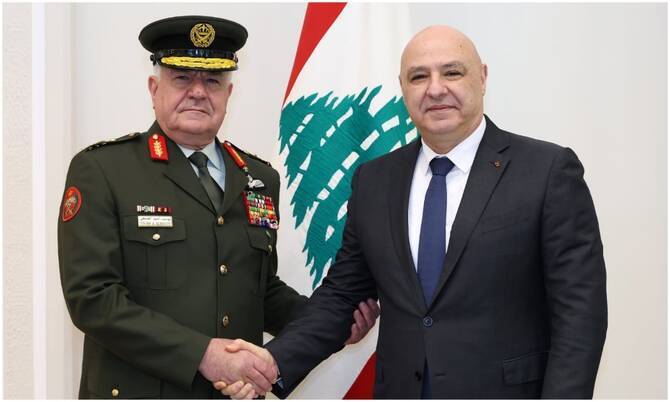
Major General Yousef Huneiti, Chairman of the Joint Chiefs of Staff of the Jordanian Armed Forces, met Lebanese President Joseph Aoun at the Presidential Palace in Beirut, where both sides discussed bilateral relations and defense cooperation.
The discussions emphasized mutual interests in safeguarding national security and maintaining stability in a region facing persistent political and security pressures.
During the meeting, Huneiti underlined the importance of close coordination between Jordanian and Lebanese institutions, especially in areas related to counterterrorism, border security, and intelligence sharing.
Both leaders highlighted the value of dialogue and cooperation in addressing cross-border threats and ensuring long-term regional resilience.
The talks also covered broader regional developments, including ongoing security challenges affecting the Middle East, and the role of military institutions in preserving peace.
Jordan reiterated its commitment to supporting regional partners through cooperation, training, and strategic coordination aimed at enhancing collective security.
In addition to meeting the Lebanese president, the Jordanian army chief held discussions with the commander of the Lebanese Armed Forces, General Rodolphe Haykal.
The military-to-military talks focused on expanding cooperation frameworks and strengthening institutional ties between the two armed forces.
Key areas of discussion included the exchange of military expertise, joint training programs, and capacity-building initiatives designed to improve operational readiness.
Both sides acknowledged that shared training and experience are essential to improving efficiency and adaptability in modern security environments.
Huneiti highlighted the historically strong relationship between the Jordanian and Lebanese armed forces, describing it as a foundation for deeper strategic cooperation.
He stressed that continued collaboration would help both countries respond more effectively to emerging threats and regional instability.
The Lebanese military leadership praised Jordan’s role in supporting regional security and stability, noting its experience and professionalism in addressing complex security issues.
Lebanese officials expressed appreciation for Jordan’s continued engagement and its willingness to share knowledge and expertise.
The meetings underscored the importance of maintaining open communication channels between allied military institutions in the Middle East.
Such engagement is seen as vital for fostering trust, coordination, and collective responses to shared security challenges.
Jordan’s outreach to Lebanon comes at a time when regional cooperation is increasingly viewed as essential to managing security risks.
Both countries face overlapping challenges, including border security concerns, regional tensions, and the need to strengthen institutional resilience.
The visit also reflects Jordan’s broader diplomatic and defense strategy of reinforcing partnerships with neighboring countries.
By engaging directly with political and military leadership in Lebanon, Jordan aims to contribute to stability while advancing mutual security interests.
Analysts note that such high-level military visits play a crucial role in aligning defense priorities and enhancing operational coordination.
They also help build confidence between armed forces, which is essential in a region marked by rapid geopolitical shifts.
The discussions concluded with a shared commitment to continue cooperation and explore new avenues for collaboration in defense and security.
Both sides emphasized that sustained engagement would benefit not only Jordan and Lebanon but also the wider region.