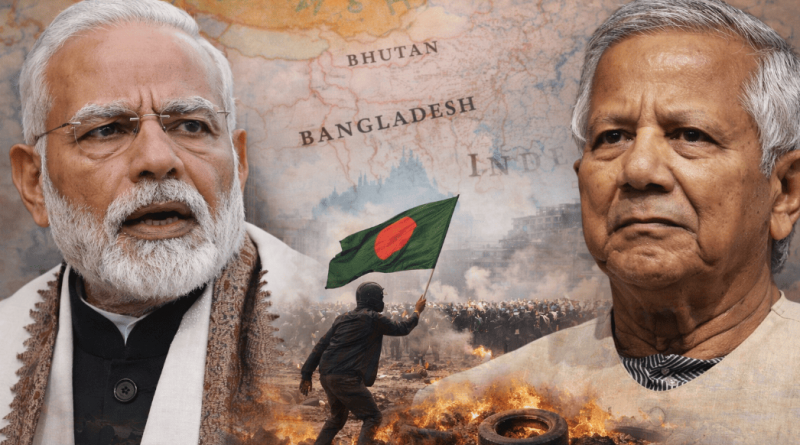
OPINION: Why India Can’t Ignore Bangladesh’s Post-Election Volatility

Co-Author: Abu Obaidha Arin (He is a student from Bangladesh studying at Delhi University. He is a Bangladesh observer)
Sustained Jamaat rule could also exhaust anti-India sentiment by exposing governance failures, internal contradictions, and economic stress.
As Bangladesh approaches a decisive national election, the dominant assumption across political camps is not stability but an absolute turbulence. Irrespective of who wins, the post-election phase is likely to be marked by extreme confrontation, street mobilisation, and institutional paralysis.
From India’s perspective, this election is not merely about Dhaka’s internal power transition; it is about the direction of Bangladesh’s statehood, its ideological trajectory, and the security implications for India’s eastern flank.
The Ground Reality: BNP’s Electoral Advantage
If a broadly fair election takes place, the Bangladesh Nationalist Party (BNP) and its alliance remain electorally better positioned. Based on constituency-level dynamics, BNP could plausibly secure around 220 seats, driven by organisational depth, street muscle power, informal financing networks like Hawala, and a long-standing vote bank.
Jamaat-e-Islami, despite improved coordination, better organisational capabilities, and administrative reach, lacks comparable grassroots strength, social acceptance, and credible candidates, particularly in urban centres like the capital, Dhaka. Even where Jamaat has attempted voter engineering, such as shifting large voter blocs across constituencies, it remains structurally weaker than BNP in terms of coercive capacity and public legitimacy.
The administration itself appears aware of this reality. Bureaucratic behaviour already suggests a strong hedging towards a BNP-led future, which limits the effectiveness of Jamaat-centric electoral engineering. Smaller players such as the NCP, technically an offshoot of the Jamaat, are, at present, marginal, possibly securing only isolated victories like Cumilla-4, without national impact.
Yet electoral victory does not equate to political stability.
Scenario One: BNP Wins, But the Street Erupts
A BNP victory is unlikely to bring calm. The immediate trigger for unrest would be any attempt by the outgoing regime to retain influence through a “Gono Parishad” or all-party interim arrangement for 180 working days, or through continued authority for figures like Muhammad Yunus to push a July Charter or constitutional referendum.
BNP supporters, and crucially, large sections of the general-public, are unlikely to accept such arrangements after an electoral mandate.
This would lead to a direct confrontation between the state apparatus and BNP’s Street power. While this clash may temporarily benefit forces seeking to re-enter political relevance, it carries a deeper risk: Jamaat’s silent expansion under a BNP government.
Historically, Jamaat has thrived not by leading governments but by embedding itself within them, leveraging ideology, street cadres, and foreign networks while avoiding direct accountability.
From India’s perspective, this is the most dangerous long-term trajectory. A BNP government under constant pressure may tolerate Jamaat’s growth to maintain street balance.
As anti-India rhetoric rises, often as a unifying political tool, so too does the risk of cross-border radicalisation, revival of dormant terror networks, and gradual erosion of Bangladesh’s secular foundations. This is not short-term chaos but a slow destabilisation, which is far harder to counter.
Scenario Two: Jamaat Engineers a Victory, Short-Term Fire, Long-Term Clarity
If electoral engineering succeeds and Jamaat emerges dominant, instability would be immediate and severe. BNP would mobilise its full street strength against what it would frame as an illegitimate, radical takeover. The resulting confrontation, between Jamaat-aligned state forces and BNP supporters, would fracture the political system.
Paradoxically, this scenario, though more violent in the short term, may be strategically clearer. Lines would be sharply drawn between the legacy forces of 1971 and openly pro-Pakistan, Islamist formations.
BNP, weakened by repression and internal strain, would be forced to recalibrate, potentially seeking reconciliation with secular forces it previously sidelined. In such a polarised environment, Awami League would likely re-emerge over time as the only cohesive national alternative.
For India, this scenario carries immediate security risks but fewer illusions. New Delhi tends to manage overt threats better than ambiguous ones.
A Jamaat-led dispensation would likely compel India to harden its eastern security posture, strengthen intelligence coordination, and work more openly with global partners. Importantly, sustained Jamaat rule could also exhaust anti-India sentiment by exposing governance failures, internal contradictions, and economic stress.
India’s Core Interest: Stability Without Radicalisation
In the present circumstances, where the Awami League has been manipulatively debarred from electoral participation by the interim authority, India’s primary concern is no longer which party governs Bangladesh. The overriding question is whether Bangladesh can remain a stable, secular, and non-hostile neighbour.
A prolonged phase of instability combined with the deepening institutionalisation of Islamist politics represents the gravest threat. While short-term unrest is costly, it remains manageable if it culminates in ideological clarity and an eventual institutional reset. Long-term destabilisation, however, would steadily erode state capacity and regional security.
What makes the current moment especially dangerous is the growing footprint of the most radical sections operating out of Pakistan, increasingly intersecting with ISIS-linked ideological and operational ecosystems, and sustained by continuous external patronage, financial, digital, and organisational. These networks do not merely seek political leverage; they aim to reshape Bangladesh’s ideological orientation itself.
If left unchecked, Bangladesh risks evolving into a new and more complex Pakistan-type challenge for India, with greater unpredictability, higher levels of urban penetration, technologically adept radical actors, and a far deeper integration of extremism into civil society than India has historically faced from Islamabad.
For New Delhi, this transforms Bangladesh from a familiar diplomatic and security equation into the most difficult neighbour to manage in the long run. The threat is no longer confined to cross-border militancy but extends to radicalisation pipelines, information warfare, and the slow hollowing out of secular political space.
India must therefore resist reactive diplomacy and prepare for multiple contingencies: quietly reinforcing border security, intensifying surveillance of radical networks, countering transnational extremist financing, and maintaining calibrated engagement with all non-extremist political forces inside Bangladesh.
The months ahead will test not only Bangladesh’s democratic resilience, but also India’s strategic patience and foresight. The election may determine a government. The aftermath will determine the region’s future.
Disclaimer: Views expressed by writers in this section are their own and do not reflect Milli Chronicle’s point-of-view.