OPINION: Islam Didn’t Ban Women Leaders—Jamaat Islami Did

These examples suggest that women’s leadership was neither alien nor unacceptable in early Islamic practice.
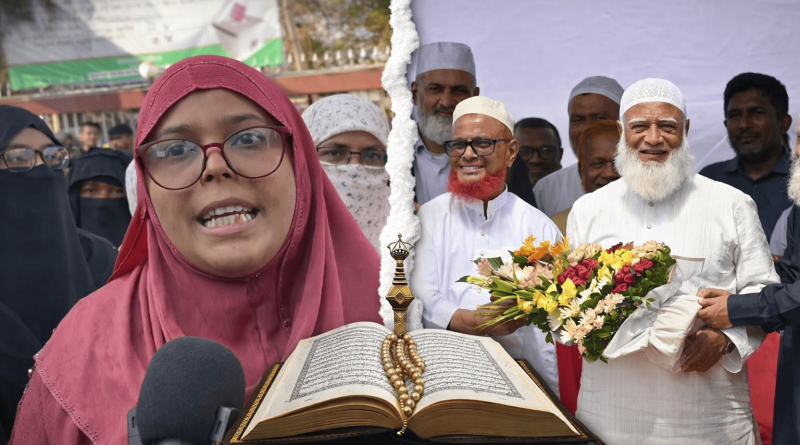
The discourse surrounding women’s leadership in Islam is complex and deeply contested. Recently a female leader from Jamaat-e-Islami cited a Qur’anic verse to argue that Islam prohibits women from holding leadership roles. The verse quoted was “Men are qawwamun over women” (Surah An-Nisa 4:34).
A closer textual and historical reading however reveals that this verse was revealed in a specific domestic context. Classical interpretations indicate that it addressed household responsibility and accountability during a marital dispute rather than questions of political authority or governance. The emphasis of the verse lies on responsibility not dominance.
If the verse had intended to establish a permanent hierarchy between men and women the Prophet Muhammad peace be upon him would not have considered punitive action against a husband accused of wrongdoing.
This context makes it clear that the verse cannot be used as a blanket prohibition against women’s leadership.
Islamic history further complicates the claim of prohibition. The Qur’an does not condemn the rule of Queen Bilqis of Sheba. Instead, her wisdom and consultative leadership are presented positively.
Shifa bint Abdullah was entrusted with administrative authority in Madinah. Aisha may God be pleased with her was a leading authority in hadith jurisprudence and political understanding.
Khadijah may God be pleased with her was economically independent and decisive in commercial affairs.
These examples suggest that women’s leadership was neither alien nor unacceptable in early Islamic practice.
The Qur’an states that women have rights similar to the obligations upon them. It also describes believing men and women as allies of one another. Such language implies partnership and shared responsibility rather than fixed subordination.
The modern political implications are equally significant. If women’s leadership were truly forbidden then women occupying spokesperson or organizational roles within political parties would themselves be violating that principle. This contradiction becomes even more pronounced when parties operate within legal frameworks that mandate women’s representation.
Ultimately the debate over women’s leadership in Islam is less about clear textual prohibition and more about selective interpretation. A balanced reading of the Qur’an Islamic history and contemporary realities suggests that women’s leadership is not inherently incompatible with Islamic principles.
Disclaimer: Views expressed by writers in this section are their own and do not reflect Milli Chronicle’s point-of-view.