
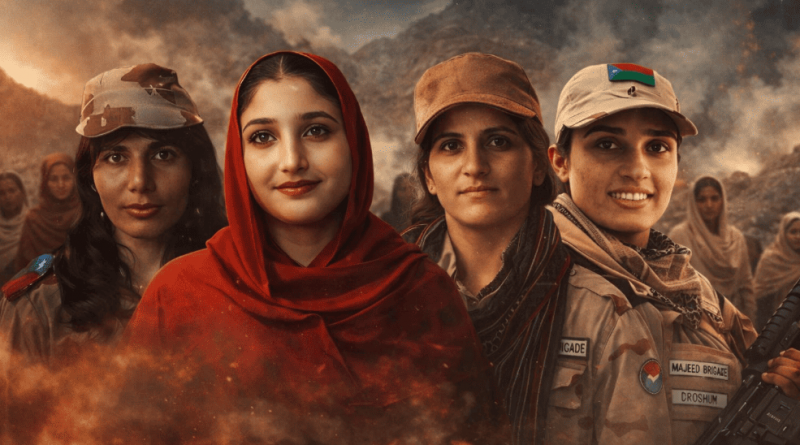
Indigenous Baloch Women and the New Face of Resistance

By organizing, leading, and, in some cases, fighting, Baloch women are challenging both state power and internal patriarchal constraints.
An extraordinary transformation is underway in Balochistan, one that unsettles long-held assumptions about protest, militancy, and gender in one of South Asia’s most militarized regions. Once pushed to the margins of political life and public dissent, Baloch women have emerged as the central force of a movement that is unprecedented in scale and distinctly indigenous in character.
From long marches demanding answers about enforced disappearances to visible participation in armed resistance, Baloch women are no longer peripheral to the struggle. Increasingly, they are defining it.
This moment marks a historic rupture. For decades, resistance in Balochistan was framed as a male-dominated, tribal insurgency—rooted in geography, kinship, and armed confrontation with the state. Women appeared mainly as mourners or symbols of suffering.
Today, that frame no longer holds. Political consciousness among Baloch women has been forged through loss, repression, and the systematic failure of peaceful avenues for justice, producing a movement that is emotionally charged yet politically sophisticated.
From Protest to Resistance
The immediate catalyst has been the persistence of enforced disappearances, extrajudicial killings, and collective punishment across the province, documented over the years by Pakistani human rights groups such as the Human Rights Commission of Pakistan.
Women—mothers, daughters, and wives of the disappeared—were often the first to mobilize publicly, precisely because men had been silenced through imprisonment, intimidation, or death. Their initial actions were resolutely peaceful: sit-ins outside press clubs, hunger strikes, and arduous long marches toward the capital of Pakistan, demanding little more than acknowledgment and due process.
When these nonviolent efforts produced no accountability, a profound shift followed. Baloch women began occupying spaces once considered unthinkable: leading mass rallies, confronting security officials, and, in some cases, joining armed resistance movements.
Footage released by the Baloch Liberation Army from the Nushki district, showing coordinated attacks on military installations with women visible in frontline roles, crystallized this transformation. The imagery was striking not only for its symbolism but for what it suggested—that sustained repression had expanded the movement beyond traditional gender boundaries.
An Indigenous Movement, Not an Imported Feminism
Despite their rising visibility, many Baloch women consciously reject identification with Pakistan’s urban, mainstream feminist movement. In interviews and public forums, they describe it as detached from Baloch realities and largely silent on state violence in the province. For them, the primary oppressor is not Baloch society per se, but the state’s security architecture.
This sentiment was articulated starkly by Dr. Shalee Baloch at the Saryab Literary Festival in Quetta, where she argued that the language of gender oppression imported from metropolitan centers fails to capture life under militarization. Her remarks echoed a widely shared belief that while patriarchy exists within Baloch society, it has been overshadowed by the far more intrusive violence of the state. When a man is abducted or killed, it is often the women who bear the longest and most visible burden—economically, emotionally, and politically.
The result is a movement that occupies a distinct political space. It neither mirrors liberal Pakistani feminism nor isolates women’s rights from national oppression. Instead, women’s emancipation is articulated as inseparable from the collective struggle for Baloch political rights, resources, and dignity.
Women at the Forefront, Not Behind the Lines
Crucially, this does not mean unquestioning alignment with male leadership. Prominent activists such as Mahrang Baloch have openly challenged men within Baloch society to support women’s education and political participation.
Addressing a massive rally in Quetta at the conclusion of a long march, Mahrang framed women’s empowerment as a measure of national self-respect, insisting that land, history, and struggle belong equally to women and men.
Her message captured a critical evolution. Baloch women are no longer mobilizing behind men as moral support or symbolic figures. They are organizing alongside—and often ahead of—them, setting agendas and redefining leadership in a movement long shaped by masculine norms.
A New Phase of Conflict
The scale of recent violence underscores the depth of this transformation. Coordinated attacks across multiple locations in Balochistan, reportedly resulting in significant casualties among security forces, drew national attention when images of female attackers circulated widely. For many observers, this shattered the assumption that militancy is an exclusively male domain.
Analysts argue that this shift reflects less ideological radicalization than strategic and emotional rupture. Political scientist Ayesha Siddiqa has noted in her writings on civil-military relations that when women enter insurgent movements, it signals the exhaustion of conventional deterrents. The cost of repression has become so normalized that even the deepest social taboos no longer restrain participation.
This pattern has been years in the making. The 2022 Karachi University bombing carried out by Shari Baloch, a highly educated mother of two, marked a grim turning point. Subsequent cases involving women such as Sumaiya Qalandrani Baloch and Banuk Mahikan Baloch suggested that female participation was becoming structurally embedded rather than exceptional.
Notably, many of these women came from educated, middle-class backgrounds, reflecting a broader shift in Baloch resistance away from tribal elites toward politicized, professional constituencies—a trend discussed in regional security analyses published by outlets like Dawn and The Friday Times.
Feminist scholars have long critiqued nationalism as inherently patriarchal, yet the Baloch case complicates that narrative. Here, women are not being asked to defer their rights until after liberation. They are actively reshaping the nationalist project itself, integrating gender equality into its core. By organizing, leading, and, in some cases, fighting, Baloch women are challenging both state power and internal patriarchal constraints.
Whether this experiment will succeed remains uncertain. What is clear, however, is that across Balochistan, women are no longer waiting on history. They are making it—forcefully, visibly, and at great personal cost.
Disclaimer: Views expressed by writers in this section are their own and do not reflect Milli Chronicle’s point-of-view


