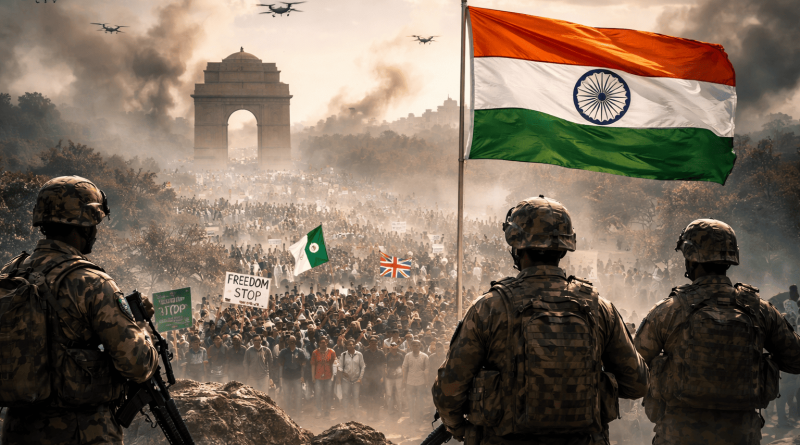
The “All-Inclusive” Subscription with Zero Loyalty: India’s Internal Security Paradox

Modern national security is no longer confined to physical borders.
On National Security Day 2026, India celebrates the men and women who guard its borders—from the glacial ridges of the Himalayas to the desert frontiers of Rajasthan. The spectacle of military readiness often reinforces a comforting narrative: that India’s principal security threats lie beyond its borders.
Yet beneath the triumph of improved border surveillance, satellite intelligence, and modernized defense systems lies a far more complex dilemma. The challenge today is not simply foreign aggression but the subtle paradox of internal ideological subversion—what might be described as the “internal security glitch.”
India’s defense establishment has, over the past decade, demonstrated increasing capability in conventional and hybrid warfare preparedness. According to the Ministry of Home Affairs Annual Report 2024–25, coordinated border management systems and technological upgrades have significantly strengthened India’s external security architecture.
But internal security threats—often intangible and ideological—operate on a different battlefield altogether: the realm of narrative, perception, and loyalty.
The Comfort of the “Subscription Model”
A striking contradiction has emerged within segments of public discourse. Individuals enjoy the economic and civic privileges that India’s democratic framework offers—education, legal protections, economic opportunity—while simultaneously amplifying narratives that undermine the state itself. It is, metaphorically, a subscription service with no loyalty clause.
The analogy is simple: a guest checks into a well-secured hotel, enjoys the food, safety, and infrastructure, yet spends the evening informing rivals about the building’s vulnerabilities. The contradiction lies not in dissent itself—after all, dissent is a democratic right—but in the selective romanticization of systems that would not reciprocate such freedoms.
Political theorist Partha Chatterjee once argued that democratic citizenship is built upon a “negotiated relationship between state and society” (Chatterjee, The Politics of the Governed, Columbia University Press, 2004). When that negotiation collapses into outright hostility toward the very structures that sustain it, the social contract begins to fray.
When Dissent Meets Contradiction
India’s constitutional architecture explicitly protects the right to protest and critique the state. Article 19 of the Constitution guarantees freedom of speech and expression, a principle reaffirmed repeatedly by the Supreme Court. However, the paradox arises when democratic liberties are used to glorify regimes that suppress similar freedoms.
This contradiction is not uniquely Indian. Political sociologists have long observed the phenomenon of “performative dissent,” where ideological signaling often outweighs substantive engagement with policy or governance. According to a 2023 study by the Observer Research Foundation, digital discourse around national security issues in India frequently amplifies external geopolitical narratives that do not necessarily reflect domestic realities.
The irony becomes evident when activists who freely criticize the Indian state simultaneously express admiration for governments where public dissent can lead to imprisonment or worse. In such cases, the debate shifts from legitimate criticism to a deeper question of civic responsibility.
The Cognitive Battlefield
Modern national security is no longer confined to physical borders. The battlefield increasingly lies within the information ecosystem—social media platforms, academic discourse, and digital propaganda networks. As the Global Risks Report 2025 by the World Economic Forum notes, misinformation and narrative manipulation have become critical geopolitical tools used to destabilize societies from within.
India, with its vast digital population of over 900 million internet users (Telecom Regulatory Authority of India, 2025), represents fertile ground for information warfare. Narratives—whether organically developed or externally influenced—can shape public perception in ways that traditional security frameworks struggle to address.
In this context, intellectual vigilance becomes as crucial as military readiness. Education systems, media institutions, and civil society must play a role in encouraging informed debate rather than reflexive ideological polarization. National pride, in this sense, should not be framed as blind nationalism but as an informed appreciation of democratic institutions and their fragility.
The Loyalty Question
The core issue is not dissent. Democracies thrive on disagreement. The real question is whether criticism strengthens institutions or seeks to delegitimize them entirely. Nations, after all, rely not only on armies and surveillance technologies but also on the intangible glue of collective belonging.
Political scientist Benedict Anderson famously described nations as “imagined communities” sustained by shared narratives and mutual trust (Anderson, Imagined Communities, Verso, 1983). When that trust erodes, the strongest defense systems cannot fully compensate.
As India celebrates National Security Day, the conversation must extend beyond the heroism of soldiers at the frontier. The most resilient shield a nation possesses is the civic commitment of its citizens. External enemies can be confronted with strategy and force. Internal contradictions, however, demand something far more difficult: clarity of thought, honesty in discourse, and a renewed understanding that the freedoms citizens enjoy are inseparable from the nation that sustains them.
Disclaimer: Views expressed by writers in this section are their own and do not reflect Milli Chronicle’s point-of-view.