
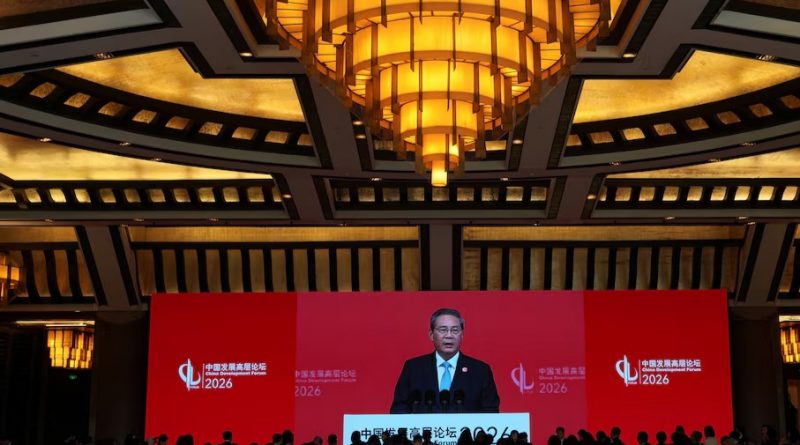
China signals calibrated trade shift, vows deeper market opening after record surplus
Beijing— Chinese Premier Li Qiang said on Sunday that China would further open its economy to foreign firms and pursue more balanced trade with global partners, as Beijing seeks to address rising trade frictions following a record $1.2 trillion surplus in 2025.
Speaking at the annual China Development Forum in Beijing, Li said China would expand imports of high-quality foreign goods and work with trading partners to promote more balanced global trade, according to state media.
Li’s remarks come as China faces mounting concerns from major economies, particularly the United States and the European Union, over its trade practices, industrial overcapacity and reliance on Chinese exports.
While he did not directly reference the record surplus, his comments indicated an effort to address imbalances that have strained international economic relations.The forum, which brings together foreign business leaders, policymakers and economists, is a key platform for Beijing to outline its economic priorities and signal openness to global investors.
In a separate address, central bank governor Pan Gongsheng said assessments of global imbalances should account for both goods and services trade, as well as financial flows. He noted that while China runs the world’s largest goods surplus, it also posts the largest services deficit.
Pan added that China does not intend to gain a competitive trade advantage through currency depreciation, responding to longstanding concerns from trading partners over exchange rate policies.
Beijing is also attempting to reverse a decline in foreign direct investment, which fell 5.7% year-on-year to just over 92 billion yuan ($13.36 billion) in January, following a 9.5% drop in 2025.
In December, authorities expanded incentives for foreign investors by adding 200 sectors eligible for benefits such as tax breaks and preferential land use, focusing on areas including advanced manufacturing and modern services.
Efforts to stabilise trade ties come as geopolitical tensions persist. U.S. President Donald Trump recently postponed a planned visit to Beijing to meet President Xi Jinping due to the Iran conflict, delaying talks aimed at easing economic tensions between the two countries.


