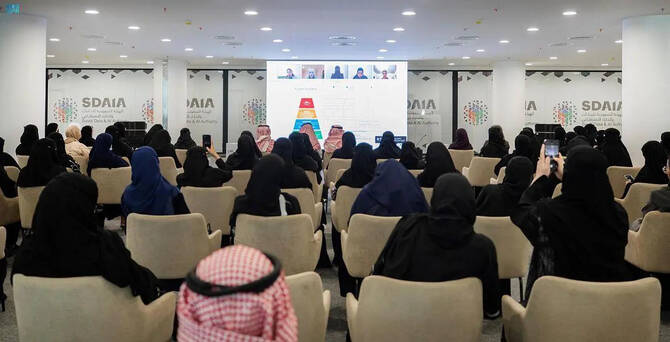
Saudi drive to train women in AI gains scale under Vision 2030 reforms
“Saudi Arabia now leads the world in the female-to-male ratio for AI training,” said Areeb Alowisheq, citing the Kingdom’s expanding investment in women’s participation in advanced technologies.
Saudi Arabia is accelerating efforts to expand women’s participation in artificial intelligence through state-led reforms and private sector initiatives tied to Vision 2030, as officials and industry leaders point to rapid gains in training, workforce inclusion and investment in emerging technologies.
Government-backed programs and institutional reforms have supported a sharp rise in female participation in technical education and the labor market, with policymakers framing gender inclusion as central to economic diversification.
According to Areeb Alowisheq, vice president of AI research at Humain, the Kingdom has achieved the highest global female-to-male ratio in AI training, reflecting what she described as a long-term policy focus on education and workforce development.
Alowisheq said the current expansion builds on decades of public investment in education, including overseas scholarship programs. Since 2005, the King Abdullah Scholarship Program has funded more than 250,000 Saudi citizens to study abroad, contributing to a skilled workforce across science and engineering disciplines.
Domestic institutions have also played a central role. Princess Nourah Bint Abdulrahman University, described as the world’s largest women’s university, has produced graduates in science, technology, engineering and medicine for decades.
By 2017, female university graduates in Saudi Arabia outnumbered male graduates, according to Alowisheq.She linked these educational gains to structural reforms introduced under Vision 2030, launched in 2016 by Crown Prince Mohammed bin Salman.
The program set a target to increase women’s workforce participation from 22 percent to 30 percent, alongside regulatory changes aimed at reducing barriers to employment.
These measures included lifting the ban on women driving in 2017, introducing workplace anti-harassment laws and amending the Civil Status Law to allow women to manage businesses, travel independently and act as heads of households.
Female labor force participation exceeded 36 percent by 2025, surpassing the initial target ahead of schedule, according to data cited by Alowisheq.
Saudi authorities have paired these reforms with targeted investment in artificial intelligence and digital infrastructure. Government spending on emerging technologies rose by more than 56 percent in 2024, while AI-focused companies secured $9.1 billion in funding, reflecting increased activity across the sector.
The Saudi Data and Artificial Intelligence Authority has played a central role in scaling training programs and institutional capacity. In collaboration with Google Cloud, it launched the Elevate Initiative in 2022, a five-year program aimed at training more than 25,000 women in emerging markets in artificial intelligence and machine learning.
Saudi Arabia has also expanded its international engagement in the field. It became the first Arab country to join the Global Partnership on Artificial Intelligence and hosts the UNESCO-backed International Center for Artificial Intelligence Research and Ethics in Riyadh, positioning itself within global governance frameworks for emerging technologies.
Training volumes have increased sharply. According to the 2025 AI Index published by Stanford University, more than 666,000 women in Saudi Arabia received training in data and artificial intelligence within a single year. The report ranked the Kingdom first globally in women’s AI empowerment based on participation metrics.
Alowisheq said the scale of training is critical to building an ecosystem capable of supporting adoption and innovation. She described the expansion as creating a base of skilled users and professionals able to integrate artificial intelligence into economic activity
.Alowisheq, who has more than two decades of experience in the sector, said her own career path reflects changes in access and opportunity over time. After completing undergraduate studies in computer applications at King Saud University and pursuing graduate work focused on networking and distributed systems, she said early gaps in AI education motivated her to pursue the field independently.
She now leads initiatives focused on developing Arabic-language AI models, part of broader efforts to localize technology and expand regional capabilities. Within her organization, she said women and men work under equal expectations, reflecting changes in workplace participation following regulatory reforms.
Saudi Arabia’s push to expand women’s participation in artificial intelligence also addresses a broader global imbalance. Data from UNESCO and UN Women indicate that women account for about 22 percent of professional roles in the sector worldwide.Officials and industry participants have framed Saudi Arabia’s approach as a response to both domestic economic priorities and international benchmarks on gender inclusion.
By linking workforce reforms with sector-specific investment, policymakers aim to align labor market participation with growth in high-technology industries.
Alowisheq said the integration of women into the AI workforce reflects a convergence of economic and social policy objectives. She noted that expanding access to education, removing structural barriers and scaling training programs have contributed to measurable increases in participation across both public and private sectors.
The Kingdom’s strategy combines regulatory reform, education investment and international collaboration, with implementation led by government institutions and supported by private sector partnerships.
Officials have emphasized that workforce development remains central to sustaining growth in artificial intelligence and related industries.