Two and a Half Centuries On, Adam Smith’s ‘Wealth of Nations’ Still Shapes Global Economic Debate
LONDON, March 8 (l— Economists, policymakers and historians are marking the 250th anniversary of An Inquiry into the Nature and Causes of the Wealth of Nations on March 9, revisiting the ideas of Scottish economist Adam Smith and their continuing influence on debates over trade policy, taxation and market competition in the global economy.
First published in 1776, Smith’s landmark work laid the intellectual foundation for modern economic thought, examining how labour, markets and trade contribute to national prosperity. Two and a half centuries later, the principles outlined in the book remain central to policy discussions in major economies grappling with questions about tariffs, inequality and corporate power.Scholars widely regard Smith as a foundational thinker of modern capitalism, though interpretations of his legacy vary. While some view him as a champion of free markets and minimal government intervention, others emphasize his warnings about monopolies and economic concentration.
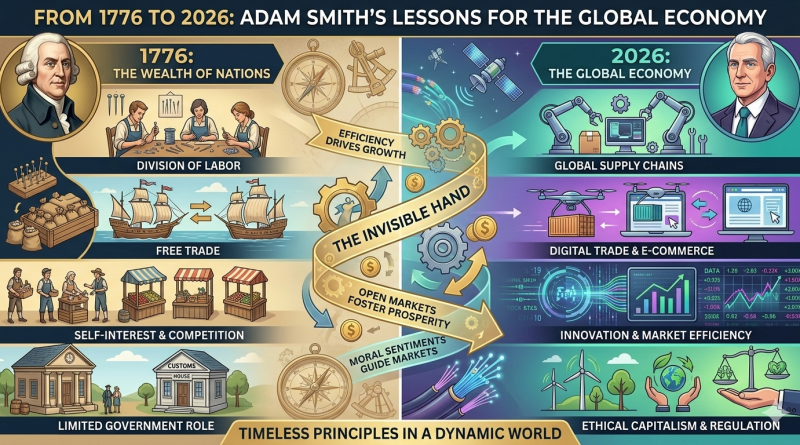
Smith’s analysis of markets centred on the idea that individuals pursuing their own economic interests could contribute to broader societal prosperity, a concept often associated with the “invisible hand.” His work also explored how specialization and the division of labour could increase productivity and economic growth.Those themes continue to resonate as governments debate trade barriers and industrial policy amid shifting global supply chains and geopolitical tensions. Discussions around tariffs, protectionism and the structure of global markets frequently echo arguments first articulated in Smith’s writings.Economists note that Smith was also critical of policies that concentrated economic power in the hands of a few firms. In The Wealth of Nations, he argued that monopolies and restrictive trade practices could distort markets and limit economic opportunity
The 250th anniversary has renewed academic debate over how Smith’s ideas should be interpreted in modern economic policy. Some economists highlight his support for open trade and competitive markets, while others point to passages in which he warned about the social consequences of inequality and unchecked corporate influence.Smith wrote during a period of profound economic transformation as Britain moved toward industrialization and global trade expansion. His observations about labour, productivity and wealth distribution helped shape early thinking on how economies function and grow.Today, policymakers in advanced and emerging economies alike continue to confront issues Smith addressed centuries ago, including how governments should regulate markets, manage trade relationships and ensure that economic growth translates into broader prosperity.
The global economic landscape has evolved dramatically since Smith’s era, with multinational corporations, complex supply chains and digital markets reshaping commerce. Yet analysts say the core questions explored in The Wealth of Nations remain central to economic policymaking.Debates about tariffs, taxation and competition policy often reflect the tension between protecting domestic industries and maintaining open global markets. Smith’s critique of protectionist trade barriers and monopolistic practices is frequently cited in discussions about how governments should balance those priorities.As governments reassess economic strategies in response to shifting geopolitical and technological forces, the work of Smith continues to serve as a reference point for understanding the dynamics of markets and the sources of national wealth.The enduring relevance of Smith’s ideas underscores the lasting impact of a book written in the 18th century but still invoked in economic debates shaping the 21st-century global economy.