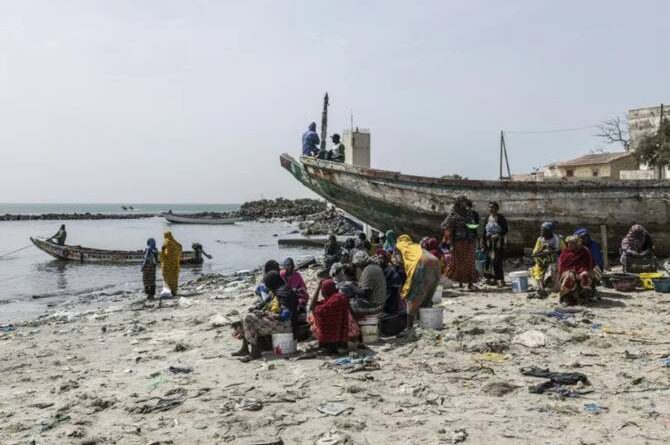
Illegal Fishing Devastates Senegal’s Coastal Livelihoods
Rufialsque — Coastal communities in Senegal are facing severe economic and social strain as declining fish stocks, driven by illegal and industrial fishing, erode a key source of income and food security, residents and experts said.
Fisherman Ibrahima Mar, 55, said dwindling catches have upended a way of life sustained for generations in Rufisque, near Dakar. He described a steady depletion of fish stocks that has left traditional fishers struggling to survive. “The fish have been taken from our path,” he said, pointing to worsening conditions in recent years.
Analysts attribute the decline to a combination of illegal practices and large-scale industrial operations. Bassirou Diarra, Senegal country manager for the Environmental Justice Foundation, said vessels engaged in bottom trawling and other activities often operate under Senegalese flags but are linked to foreign ownership, including European and Asian interests.
“These practices not only reduce fish availability for local consumption but also limit economic returns to the country,” Diarra said, citing issues such as unauthorized fishing in protected areas, non-compliant equipment and lax licensing.
A 2025 report by the Environmental Justice Foundation estimated that 57% of exploited fish populations in Senegal are in a state of collapse, underscoring the scale of the crisis.
The decline has had ripple effects across coastal economies. According to census data, more than 82,000 people in Senegal depend on fishing, accounting for about 2% of the workforce. Ancillary sectors such as fish processing, transport and retail have also been affected.
Local fishing leaders say productivity has sharply declined. Mamadou Diouf Sene, head of the Rufisque Fishing Wharf Revenue Commission, said it now takes up to seven months to catch what previously required two months, reflecting the strain on marine resources.
The economic pressure has contributed to increased migration attempts, with some fishermen undertaking dangerous journeys to Europe in traditional wooden boats known as pirogues. Community members say these journeys often end in tragedy.
Environmental factors have compounded the problem. Researchers note that climate change is shifting small pelagic species, such as sardinella and horse mackerel, northward, further reducing local availability.
Authorities acknowledge enforcement challenges. Cheikh Salla Ndiaye of Senegal’s Directorate of Fisheries Protection and Surveillance said monitoring vast maritime areas remains difficult despite support from security forces.
Efforts to improve oversight are underway, with environmental groups such as Greenpeace introducing technologies including satellite tracking and mobile reporting tools to help identify illegal activity at sea.
The crisis has raised concerns about long-term food security and economic stability in Senegal, where fish remains a central component of both diet and cultural identity.