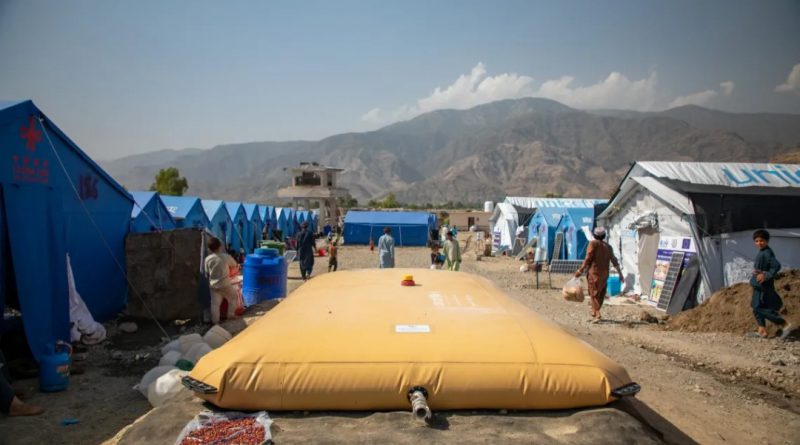
Earthquake Damage to Water Systems in Eastern Afghanistan Drives Humanitarian Response in Displacement Camps
“Every morning, I worried about where to get water… getting clean water became a daily struggle.”
Three months after a major earthquake struck eastern Afghanistan, access to safe drinking water remains a central challenge for thousands of displaced families, as humanitarian agencies scale up efforts to restore damaged infrastructure and prevent disease outbreaks.
The earthquake affected multiple provinces, including Nangarhar Province, Kunar Province, and Laghman Province, causing widespread destruction to homes and critical public services. Among the most significant impacts was the damage to water systems, with wells collapsing and water sources becoming unusable. The disruption has forced many families to rely on temporary solutions while living in displacement camps, where conditions remain fragile.
Sharifa, a displaced resident, described the daily challenges following the disaster. Prior to the earthquake, her household depended on a nearby well for water. After the infrastructure was damaged, securing safe drinking water became uncertain. She said that each day began with concern over how to meet basic needs, reflecting a broader pattern among displaced families facing similar conditions.
Humanitarian assessments indicate that more than 130 water points were destroyed in the affected areas. The loss of these facilities, combined with overcrowded living conditions in camps, contributed to increased reliance on unsafe water sources in the immediate aftermath.
The situation was further compounded by inadequate sanitation practices, including open defecation, which heightened the risk of waterborne diseases such as cholera.In response, UNICEF, through its polio programme and partner organizations, has implemented water, sanitation and hygiene interventions across seven camps and more than 50 affected communities.
According to programme data, over 20,000 people are currently receiving support aimed at restoring access to clean water and improving hygiene practices.Dr. Godwin Mindra, identified as UNICEF’s Chief of Immunization, stated that the earthquake disrupted essential services, including immunization systems and water supply networks.
He noted that social mobilizers have been deployed to promote health education and sanitation practices, with the objective of reducing the risk of disease outbreaks, including polio, during the recovery phase.In Khas Kunar Camp, a newly installed water supply network has begun operations, with a production capacity of approximately 120,000 liters per day.
The system has reduced dependence on water trucking, which had been the primary source of supply immediately after the earthquake. Humanitarian agencies report that water trucking continues to provide short-term relief, while more durable infrastructure is being developed to ensure long-term sustainability.Across six displacement camps, more than 15,500 people are reported to have continuous access to safe drinking water following recent interventions.
The establishment of permanent water systems has also led to a measurable reduction in reliance on emergency water deliveries. In Khas Kunar camp, daily water trucking requirements have decreased by more than half since the completion of the new system.Additional infrastructure has been deployed to support water access and storage.
According to operational data, 76 water reservoirs and 188 tap stands have been installed across affected locations. Distribution efforts have included more than 11,000 jerry cans, enabling households to collect and store water safely. These measures are intended to reduce contamination risks and improve overall water management at the household level.
Despite progress, challenges remain in ensuring consistent access across all affected areas. Work is ongoing in camps such as Satarwal Camp and Zeri Baba Camp, where additional water systems are under development. At the same time, efforts are being made to rehabilitate damaged infrastructure in home communities, allowing families to return when conditions permit.
Displacement remains a key issue, with many families reluctant to return to their villages due to concerns over aftershocks and structural safety. As a result, camps continue to serve as temporary settlements for extended periods, increasing the importance of reliable water and sanitation services in these locations.Sharifa noted that the restoration of water supply has had a tangible impact on daily life.
She described access to clean water as a critical step toward recovery, linking it to broader improvements in safety and living conditions. Her account aligns with observations from aid agencies that water access is a foundational element in stabilizing displaced communities.Humanitarian officials emphasize that water supply interventions are closely linked to public health outcomes.
The provision of clean water, combined with hygiene promotion, is seen as essential in preventing outbreaks of communicable diseases in high-density camp environments. These measures also support the continuity of other services, including immunization campaigns, which depend on stable operating conditions.
The response has received support from international partners, including the United States and the Centers for Disease Control and Prevention. According to programme updates, the focus is gradually shifting from emergency relief to the development of durable systems designed to enhance resilience against future shocks.Rehabilitation efforts in affected communities are expected to play a critical role in the transition from displacement to recovery.
Restoring local water systems is seen as a prerequisite for enabling families to return to their homes and resume normal activities. However, progress is contingent on both infrastructure repair and improvements in safety conditions.The ongoing situation highlights the central role of water access in post-disaster recovery efforts.
In the absence of functioning systems, basic daily activities are significantly disrupted, with implications for health, sanitation, and overall stability. As reconstruction continues, the effectiveness of water and sanitation interventions will remain a key factor in determining the pace and sustainability of recovery in eastern Afghanistan.