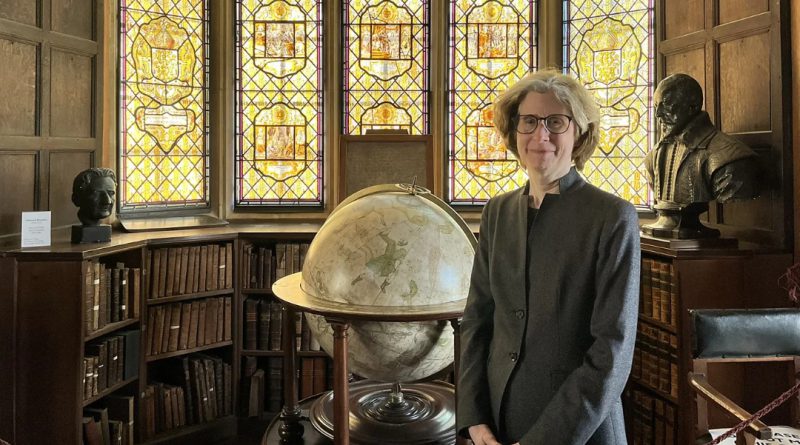
Oxford’s 750-Year-Old Merton Library Preserves Medieval Scholarship and the Debate Over the World’s Oldest Library
A library is not defined only by age, but by continuity of use, preservation of knowledge, and the changing ways generations choose to protect it.”
:At Merton College in Oxford, an old wooden chest stands as one of the earliest symbols of academic preservation. In the medieval period, the chest did not store money or jewels, but books—objects considered valuable enough to require multiple key holders for access.
According to college records and historical research cited by the institution, the formal origins of the library date to 1276, when the Archbishop of Canterbury issued a decree requiring fellows of Merton College to donate books to the academic community. That order laid the foundation for what is now recognised as one of Europe’s oldest continuously functioning academic libraries.
The library’s 750th anniversary highlights an uninterrupted institutional history that predates the Aztec Empire, the Black Death and the invention of the printing press. Over centuries, its users have included medieval scholars, prominent mathematicians and later literary figures such as J. R. R. Tolkien, whose academic life was closely linked to Oxford.
Dr Julia Walworth, librarian of Merton College, said the earliest form of the library differed significantly from the modern understanding of the institution. There was no librarian in the contemporary sense, no open shelves and no casual browsing. Instead, books were stored in a secured chest and circulated through a formal communal process.“There was a system of loaning and returning books from the chest,” Walworth said in an interview .
She explained that opening the chest required the presence of designated key holders and involved the participation of the college community, rather than individual access.Books in the 13th century were expensive assets because each manuscript had to be copied by hand, often over months of labour. In that context, the requirement for fellows to donate books served a similar institutional purpose to modern university endowments, ensuring the long-term growth of scholarly resources.
The library began moving toward a more recognisable form soon after its establishment. A small number of books were taken out of the chest and chained to tables, allowing permanent access for consultation while preventing theft. Walworth said this system anticipated the distinction between modern reference collections and books available for loan.A more significant transformation came in the 1370s, when a dedicated library room was built to house the growing collection.
This marked a major development in medieval academic architecture and book storage practices.Walworth noted that horizontal shelving installed during this period represented the first recorded use in Britain of books being stored upright on shelves. However, unlike modern arrangements, the books were placed with their spines facing inward and their fore-edges facing outward, where titles were written by hand.
This unusual arrangement reflected the practical realities of chained books. Chains were attached to the fore-edge of each volume, making inward-facing spines the most functional method of storage. According to Walworth, fellows understood that chained books had a greater chance of survival than volumes sent out on unrestricted loan.Today, only a few chained books remain in place for display, while the majority are shelved in the modern style.
The medieval room itself, however, remains largely intact and continues to serve students during academic term time.Near the entrance, visitors can still see what Walworth believes is the original 13th-century chest used to secure the earliest volumes. Its continued presence contributes to what scholars describe as the rare continuity of the site.
Professor Teresa Webber of the University of Cambridge said Merton’s significance lies not only in its age but in the continuity of use. She noted that while there are older repositories of manuscripts, it is difficult to identify an earlier academic library room in continuous institutional use.Webber also cautioned against simplistic claims about “the oldest library.” She said the concept itself is difficult to define because libraries developed in stages and served different purposes across religious, academic and private settings.
“There’s no single definition of a library,” she said, adding that monastic libraries, private subscription collections and university libraries cannot always be judged by identical standards.Merton’s reputation for exceptional age grew significantly during the Victorian era, when Oxford increasingly became a destination for visitors interested in historic architecture and scholarship.
The library’s stained-glass windows, oak roof and rare printed books attracted both scholars and tourists.Among its notable holdings is a 15th-century edition of The Canterbury Tales, one of the earliest books printed in England. Walworth said Merton’s copy is particularly notable for its hand-illuminated decorative borders, which distinguish it from other surviving editions.
Visitors over the years included American writer Ralph Waldo Emerson, who mentioned the library in his 1856 travelogue English Traits, and Beatrix Potter, who wrote in her 1884 diary about its “beautiful oak roof” and “ancient, dusty smell.”By the late 19th century, publications were increasingly describing Merton Library in record-setting terms. An 1878 Oxford guide called it the most ancient library in England, while the 1885 edition of the Encyclopaedia Britannica described it as the oldest existing library in the country.Over time, these claims expanded further.
A 1928 report in The Times referred to an Oxford Preservation Trust event where Merton was described as the oldest library in the world.The library’s cultural symbolism extended into literature. In The Great Gatsby, F. Scott Fitzgerald has the wealthy title character refer to a recreation of “the Merton College Library” as part of his mansion’s display of prestige and historical imitation.
Walworth said that by that period, Merton Library had become shorthand for the ideal of an ancient and prestigious scholarly space. She noted that this literary reference also reflected reality, pointing to dining clubs at Princeton University where one historical room was modelled on Merton’s library.
Despite that legacy, Walworth rejects claims that Merton is the world’s oldest library. She prefers the description “one of the oldest still-functioning academic libraries in Europe,” which she says is both accurate and globally aware.She said earlier generations often framed such claims through a narrow cultural lens, placing European institutions at the centre of historical prestige.
Modern scholarship, she said, takes a broader view.That broader comparison includes institutions such as Al-Qarawiyyin Library and Saint Catherine’s Monastery, both frequently cited in debates over the world’s oldest continuously operating library.When Al-Qarawiyyin underwent major restoration in 2016, several media reports described it as the world’s oldest library.
However, Guinness World Records identifies Saint Catherine’s Monastery as the oldest continuously operating library.Historians note that both claims depend heavily on how a library’s beginning is defined. Some scholars have questioned the certainty of Al-Qarawiyyin’s ninth-century origins, while Saint Catherine’s formal monastery structure dates to the sixth century, though some manuscript collections may be older.
Professor Richard Gameson of Durham University said Saint Catherine’s is probably the strongest candidate for the longest continuous library history, but added that the nature and purpose of the institution changed significantly over time.For scholars of medieval libraries, the debate is less about declaring a single winner and more about understanding how knowledge has been preserved across centuries.
At Merton, that history still survives not only in manuscripts and architecture, but in a reading room where students continue to work beneath the same oak roof that sheltered scholars hundreds of years.