Cuba’s elderly struggle as economic crisis deepens and migration drains support networks
Havana— Cuba’s elderly population is facing mounting hardship as the island’s deepening economic crisis, shrinking state subsidies and large-scale emigration leave many older residents increasingly dependent on churches, informal work and community aid to survive.
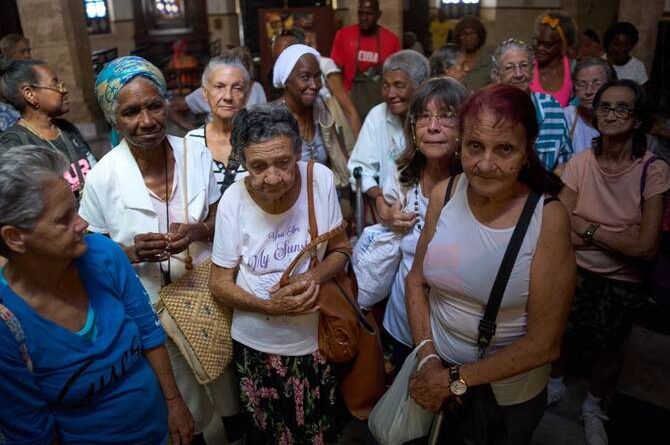
At the Church of the Holy Spirit in Old Havana, nearly 50 elderly residents gather three times a week for a free lunch of rice, beans, ground meat and coffee, a modest but essential supplement for pensioners whose monthly incomes often amount to less than $10 at informal exchange rates.
Among them is 84-year-old retired chemical engineer Carmen Casado, who receives a monthly pension of 2,000 Cuban pesos, worth roughly $4 on the informal market. Living alone, without children or remittances from relatives abroad, she relies on church meals in addition to the limited bread, rice and beans available through Cuba’s state-run ration stores.“This is a lifeline for us retirees with small pensions,” Casado said.
“What we get from the bodegas alone is not enough.”Older Cubans, many of them former state employees such as teachers, doctors, nurses and technicians, have been among the hardest hit by the worsening downturn, which intensified this year following an oil embargo imposed by U.S. President Donald Trump.
The crisis has brought further cuts to subsidized goods that for decades formed the backbone of Cuba’s social safety net, while rising shortages and inflation have eroded the value of fixed pensions.At the same time, the migration of younger Cubans has left many elderly residents isolated, without family members to provide financial support or day-to-day care.
Cuba was already one of Latin America’s oldest societies before the latest wave of emigration. By the end of 2024, nearly 26% of the population was aged 60 or older, according to Cuba’s National Bureau of Statistics, compared with a regional average of 14.2% reported by the U.N. Economic Commission for Latin America and the Caribbean (ECLAC).Over the last five years, Cuba’s population has declined by nearly 1.5 million, largely because of outward migration.
The number of residents on the island has fallen from 11.1 million to 9.7 million.The demographic shift is increasingly visible in Havana, where elderly residents stand in long lines for rationed food, sell small items such as cigarettes on the streets or search for assistance from churches and state institutions.
The pressure has prompted the government to authorize private entrepreneurs to operate elder-care services and residential facilities, a notable shift in a country where social services have traditionally remained under state control.Casado says she still considers herself fortunate. At 84, she remains physically independent, climbs the stairs to her aging apartment without a cane and needs only blood pressure medication, which she says is still available through state pharmacies.
Born in 1942, she has lived through the Cuban Revolution, the 1962 missile crisis, the Soviet-backed economic boom of the 1970s and 1980s, and the severe shortages of the post-Soviet “Special Period.”Despite today’s hardships, she continues to place responsibility for Cuba’s economic difficulties largely on the United States.
“We’re doing everything we can here to move the country forward,” she said. “But the thing is, we have a very powerful enemy, and he’s right there, right on our doorstep.”