Displaced Lebanese families face deepening hardship as war nears two months
Beirut— Nearly two months after renewed fighting between Israel and Hezbollah forced them from their homes, many displaced Lebanese families remain trapped in worsening conditions, unable to return to southern towns still under bombardment and military occupation despite a U.S.-brokered ceasefire.
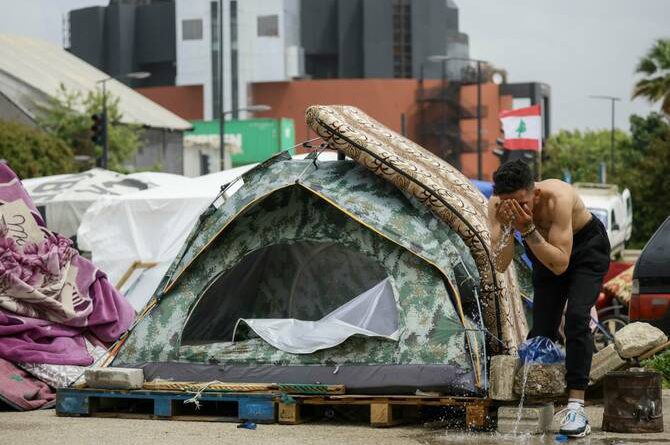
Among them is Rabih Khreiss, a 45-year-old mechanic and father of nine from the southern town of Khiyam, who now lives in a makeshift tent on Beirut’s waterfront after fleeing with his family in the early hours of March 2, when Hezbollah launched attacks into Israel and Israeli retaliatory strikes began almost immediately.
Khreiss, who once supported his family through a car repair workshop in southern Lebanon, now relies on donations for survival and says the uncertainty has left him feeling trapped.“I feel like my children and I are prisoners in a room, sentenced to life imprisonment,” he said.
“But when will relief come so we can get out of this life sentence? No one knows.”His family now lives in a fragile shelter built from wooden beams and plastic tarps that shake in the wind. Without showers, they bathe in plastic tubs and wash clothes by hand. His older sister, who is living with them, is battling cancer and struggles to access medical care.
“We’re living in tents, not knowing where these days will take us,” he said. “We start thinking, if only we could wake up and win the lottery so we could get out of this mess.”Although a ceasefire brokered by the United States was intended to reduce hostilities, Israeli forces have continued airstrikes and maintained troops in a strip of southern Lebanon, where they say Hezbollah infrastructure remains active.
That includes near-daily controlled demolitions in Khiyam, a town once home to around 10,000 residents and now described by locals as almost entirely flattened and deserted.Hezbollah has also continued attacks against Israeli forces inside Lebanon and on northern Israel, while both sides accuse each other of violating the ceasefire terms.
The prolonged conflict has deepened despair among Lebanon’s estimated 1.2 million displaced people, many of whom had hoped the truce would allow them to return home but now face indefinite displacement.“Khiyam is my town, my region, my land, my home, my work, my people, my loved ones, everything,” Khreiss said. “Of course, all my memories are in Khiyam.
I miss everything about it.”The family has already endured repeated cycles of conflict. During the previous Hezbollah-Israel war in 2024, one of Khreiss’s older sons lost an eye when an Israeli strike hit their home in Khiyam.Khreiss said he pulled his children from the rubble with his own hands and felt he had aged “years” in a single hour.
His garage was also damaged during that war, but he rebuilt and returned. This time, he does not know whether either his workshop or his home still stands.With no steady income and rising anxiety over his children’s future, he says he is considering selling his car if he cannot find work soon.
“It’s showing in my children that they’ve never known joy or happiness, never been to an amusement park, never had fun like other children,” he said.“I brought them into this world, and I have to take responsibility for them and secure their future.
But circumstances have forced me to do nothing for them. There’s nothing I can do.”