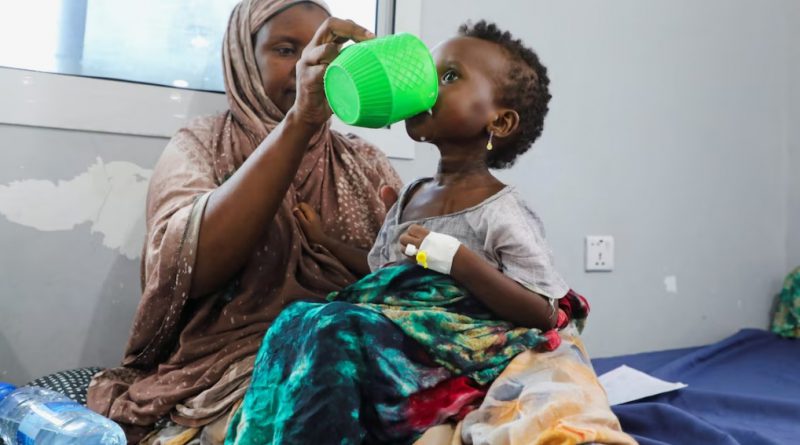
Iran War Disruptions Deepen Somalia’s Child Hunger Crisis as Aid Supplies Slow and Costs Surge
“For Somalia’s malnourished children, delays of a few weeks in therapeutic food are not logistical problems—they can mean irreversible damage or death.”
Shipping disruptions linked to the U.S.-Israeli war on Iran are worsening Somalia’s hunger emergency, delaying life-saving food supplies for severely malnourished children and forcing health clinics to ration treatment as the country faces the combined pressures of drought, aid cuts and rising fuel costs.
Aid agencies and health workers say the delays have become critical for children suffering from severe acute malnutrition, also known as wasting, the most dangerous form of hunger. Nearly half a million Somali children under the age of five are currently affected, according to humanitarian agencies, with interruptions in treatment carrying long-term physical and cognitive consequences.
In clinics across Mogadishu and Baidoa, health workers say stocks of specialised therapeutic milk and Ready-to-Use Therapeutic Food (RUTF), a high-energy peanut-based paste essential for treating acute malnutrition, are running dangerously low.
“Since the needs are large and we don’t have a lot of supplies, we have had to keep reducing the amount we give children,” said Hassan Yahye Kheyre, a nurse at a clinic in Baidoa supported by the International Rescue Committee (IRC).The facility, which treats more than 1,200 children, had only 225 cartons of therapeutic peanut paste remaining and expected stocks to be exhausted within two weeks, according to the IRC.Kheyre warned that interrupted treatment can have permanent consequences.
“If treatment is on-and-off, the children will become very weak, physically and mentally. And it may not be possible to reverse it,” he said.Somalia is already confronting one of its most severe food security crises in years. A new drought has pushed 6.5 million people roughly one in three Somalis into acute hunger, according to government and United Nations estimates.
The Integrated Food Security Phase Classification (IPC), the global hunger monitoring system, says more than 2 million people are now in the “Emergency” phase, one step below famine.The crisis has been compounded by deep reductions in foreign humanitarian funding.
The United Nations Office for the Coordination of Humanitarian Affairs (OCHA) says more than 200 health facilities have already been closed and mobile health teams disbanded because of funding shortages.In December, OCHA said more than 60,500 severely malnourished children had gone untreated as a direct result of these gaps and warned the number could rise to 150,000 if funding shortages continue.
Somalia was not included among the 17 countries selected to receive a share of this year’s reduced humanitarian allocations from the United States, the donor that has made the sharpest cuts among major foreign aid contributors.OCHA has appealed for $852 million from global donors this year to prevent famine conditions from worsening.
That request is already significantly lower than the $1.42 billion sought last year, yet humanitarian officials say only around 14% of the current target has been funded.The outbreak of war involving Iran on February 28 added a new layer of disruption. After the United States and Israel launched attacks and Iran closed access to the Gulf, shipping routes were severely affected, reducing vessel availability and increasing freight costs for aid deliveries to East Africa.
Aid groups say the result has been slower deliveries and sharply higher prices for therapeutic food.In 2024, deliveries of therapeutic milk and RUTF from Europe to Somalia typically took between 30 and 35 days. In 2025, shipping diversions around Africa caused by Red Sea security threats extended delivery times to 40 to 45 days.
Since the Iran conflict escalated, those delivery times have stretched further to between 55 and 65 days, according to Mohamed Omar, head of health and nutrition at Action Against Hunger (ACF) in Mogadishu.Admissions of severely malnourished children to ACF-supported health centres during January to March this year rose 35% compared with the same period last year, reflecting the growing nutritional emergency.
At Daynile General Hospital in Mogadishu, where 360 children are currently being treated for wasting, staff said on April 20 they had barely enough therapeutic supplies for a single week.“Some children’s nutritional status has already worsened,” said Xafsa Ali Hassan, the hospital’s health and nutrition supervisor.
The International Rescue Committee said one of its key shipments of peanut paste from India became stranded at the western Indian port of Mundra, where cargo congestion intensified after vessels were diverted away from Gulf ports.
The shipment, enough to feed more than 1,000 children, had been delayed for two months. After being told it would take at least another 30 days to arrive, the IRC cancelled the order.Instead, the organisation placed an emergency order for 400 cartons from Nairobi and began transferring supplies from Mogadishu to Baidoa to cover immediate shortages.
But regional sourcing has become far more expensive.CARE International said increased freight and manufacturing costs pushed the price of a single carton of therapeutic food to $200 from $55. That means the same budget that previously bought enough supplies for 300 children now covers treatment for only 83.
For families already living through repeated drought cycles, the shortages are immediate and deeply personal.At the Baidoa clinic run by IRC’s local partner READO, mother-of-nine Muumino Adan Aamin has been trying to obtain peanut paste for her 11-month-old daughter, Ruweido.
The child requires three sachets a day, but Aamin said she had been turned away twice because the clinic had run out of stock.She recalled nearly losing another daughter, Anisa, during the 2017 drought crisis that pushed Somalia to the edge of famine.“Just bone and skin,” she said, describing the child’s condition at the time.
Therapeutic peanut paste saved her daughter’s life then, and she fears history repeating itself.Domestic fuel prices in Somalia have also risen by 150% since the Iran conflict began, increasing transport costs inside the country and further straining already fragile supply chains.“Somalia is really hard hit by the Iran war because people are still reeling from the impact of the previous drought,” said Shukri Abdulkadir, IRC’s Somalia coordinator.
“It’s very difficult for people to absorb these shocks.”For aid agencies, the crisis illustrates how conflict far beyond Somalia’s borders can directly determine whether children receive treatment in time.
For clinics facing empty shelves and mothers turned away at the door, those geopolitical disruptions are measured not in shipping schedules, but in survival.