The Gorilla Encounter That Changed Wildlife Television Forever
“It was one of the most privileged moments of my life — the most breathtaking experience anyone interested in the natural world could wish for.” — David Attenborough
Few moments in television history have captured the connection between humans and the natural world as powerfully as the famous scene of David Attenborough sitting quietly among a family of mountain gorillas in the forests of Rwanda.
The unforgettable sequence, filmed in 1978 for the landmark BBC series Life on Earth and broadcast in 1979, showed a young gorilla climbing over Attenborough, another tugging at his shoelaces, and an adult female gently turning his head to look directly into her eyes.
It was a brief moment of trust, curiosity, and extraordinary calm and it would become one of the defining images of wildlife broadcasting.Now, as Attenborough approaches his 100th birthday on May 8, new BBC and Netflix documentaries are revisiting that iconic encounter and the remarkable story of the gorilla family behind it.
The original plan had been far simpler. Attenborough and his crew had travelled to Rwanda’s Virunga Mountains hoping only to film a gorilla’s thumb a small but important detail for explaining how primates evolved the ability to grip tools.Instead, they found themselves in one of the most intimate wildlife moments ever captured on camera.
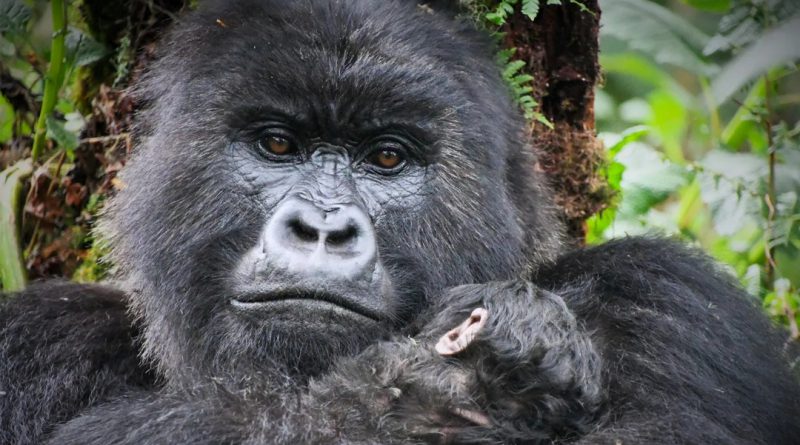
At the time, mountain gorillas were on the brink of extinction. Poaching, trophy hunting, and the illegal capture of animals for zoos had reduced their numbers in the Virunga region to fewer than 300. They were difficult to approach, and filming them in the wild was considered nearly impossible.
The crew’s only hope was gaining the trust of Dian Fossey, the American gorilla expert whose pioneering work at the Karisoke Research Center had made her the world’s leading authority on mountain gorillas.Fossey, who later became globally known for her conservation efforts, had dedicated her life to studying and protecting gorillas in Rwanda’s Volcanoes National Park.
Attenborough doubted she would allow a television crew anywhere near her carefully observed gorilla groups.But after writing to her, the team received an invitation.“We couldn’t have got anywhere near them without Dian,” Attenborough later said. “She introduced us to this group and taught us how to behave in their presence.”
Her instructions were simple but crucial: never stare directly at a gorilla, keep your head lowered, and communicate calmly using soft belching sounds a form of gorilla reassurance.That advice proved invaluable.When the crew finally entered the gorillas’ territory, they expected only a careful observation from a distance. Instead, the gorillas approached them.
A young gorilla named Poppy became fascinated with Attenborough’s shoes and tried to pull them off. Another infant, three-year-old Pablo, climbed onto him and lay across his body as if using him as furniture. Then an adult female placed her hand on Attenborough’s head, turned his face toward hers, and gently put a finger in his mouth before making a belching sound.
“So I did my best to respond,” he recalled.The crew watched nervously. Film stock was limited, and they had not planned to spend it on their presenter rolling on the forest floor with gorillas. Yet those spontaneous minutes became the emotional heart of the series.Only a short section of the interaction was captured, but it was enough.“It was one of the most privileged moments of my life,” Attenborough said. “I dream about it.”The day did not end peacefully.
As the team descended the mountain, gunshots rang out nearby. Rwandan soldiers stopped them at a roadblock, questioned them, and detained the crew overnight. Attenborough and his cameraman were later taken to an army compound in Kigali and held for hours before being released.
Though shaken, they were relieved that the precious film footage had not been confiscated.When Life on Earth aired in 1979, it became a global phenomenon. The BBC series transformed natural history television, reaching an estimated 500 million viewers worldwide and changing the way audiences saw wildlife.The gorilla sequence stood out because it did something unusual: it reversed the traditional relationship between humans and animals.
Rather than humans observing wild beasts from a safe distance, viewers watched gorillas showing curiosity, gentleness, and emotional intelligence toward a human visitor.As Attenborough said in the original narration, “We see the world in the same way as they do.”The scene challenged long-held stereotypes of gorillas as dangerous jungle creatures and instead revealed them as complex social beings — affectionate, playful, protective, and deeply familiar.
The impact extended beyond television. Inspired by the encounter, Attenborough worked with the conservation charity Fauna & Flora to help establish the Mountain Gorilla Project, aimed at protecting the species and supporting conservation efforts.In 1985, seven years after Attenborough’s visit, Dian Fossey was murdered in Rwanda, a tragedy that brought even greater international attention to the threats facing gorillas.
Her legacy, however, endured. Conservation programs, education, and carefully managed eco-tourism helped stabilize the gorilla population. Today, around 600 mountain gorillas live in the Virunga Mountains a fragile but significant conservation success.The story also continued within the gorilla family itself.
A new Netflix documentary, A Gorilla Story: Told by David Attenborough, follows the descendants of Pablo, the playful infant gorilla who climbed onto Attenborough during filming.Researchers discovered that Pablo survived despite being abandoned by his mother as a baby a rare achievement.
He later became the dominant silverback leader of his group, a powerful position reserved for the strongest males. He died at the age of 33 while defending his family.His descendants still live in the Virungas today.Dr Tara Stoinski of the Dian Fossey Gorilla Fund said the reason the original footage still resonates is because people instantly recognized something familiar.“We can see so much of ourselves,” she said.
“Any three-year-old might want to come and sit on your lap and use you as furniture. Pablo was doing exactly the same thing.”That simple truth may explain why the moment has never faded.
In a forest clearing in Rwanda nearly half a century ago, the line between human and animal briefly disappeared. What remained was recognition one species looking into the eyes of another and finding something unmistakably shared.