US Pushes Aoun-Netanyahu Summit as Lebanon Ceasefire Frays
Beirut — The United States on Thursday urged a direct meeting between Lebanese President Joseph Aoun and Israeli Prime Minister Benjamin Netanyahu as Israeli strikes in southern Lebanon killed at least 17 people despite an ongoing ceasefire, deepening tensions over efforts to launch formal negotiations between the two countries.
The appeal came as Washington sought to advance direct diplomacy following two rounds of Lebanese-Israeli talks held this month in Washington, the first such high-level contacts in decades, after cross-border fighting involving Iran-backed Hezbollah escalated into a wider regional conflict in March.
President Donald Trump had announced a 10-day ceasefire beginning on April 17, later extending it by three weeks after the second round of discussions. He has said he hopes to host Aoun and Netanyahu “over the next couple of weeks” as both sides prepare for direct negotiations.
In a statement, the U.S. Embassy in Beirut said Lebanon faced a decisive moment and called for leadership from Beirut to move toward a broader political settlement.
“Lebanon stands at a crossroads. Its people have a historic opportunity to reclaim their country and shape their future as a truly sovereign, independent nation,” the embassy said.
It added that a direct meeting between Aoun and Netanyahu, facilitated by Trump, could secure guarantees on sovereignty, territorial integrity, border security, reconstruction support and the restoration of Lebanese state authority across all its territory.
The proposal has exposed divisions inside Lebanon, where Hezbollah has rejected direct negotiations with Israel and opposed Beirut’s previous commitment to disarm the group, a longstanding demand from Western governments and Israel.
Aoun said on Wednesday that Israel must first fully implement the ceasefire before negotiations could meaningfully proceed.“Israeli attacks cannot continue as they are,” he said, adding that Lebanon was waiting for the United States to set a date for the start of direct negotiations.
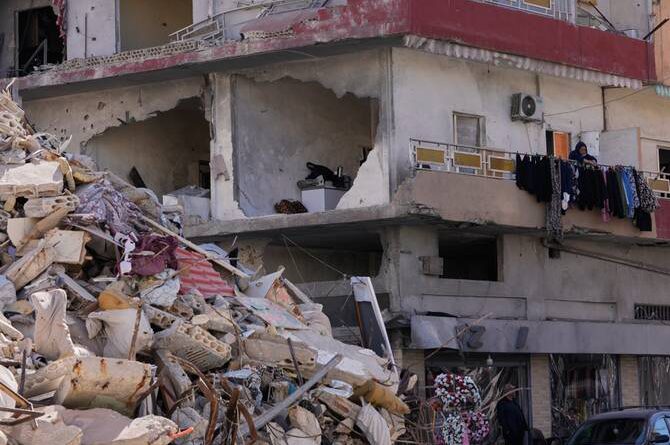
Israeli forces have continued military operations despite the truce, maintaining troop activity inside what officials describe as a “Yellow Line,” a zone extending roughly 10 km into southern Lebanon along the border.Lebanon’s health ministry said Israeli strikes on Thursday killed at least 17 people in the south, including five women and two children.
The Lebanese army said a separate strike killed one of its soldiers.Israel’s military also said one of its soldiers had been killed in southern Lebanon.
Aoun on Thursday condemned what he called Israel’s “continuing violations” of the ceasefire, citing airstrikes, demolitions of homes and places of worship, and attacks on civilians and emergency personnel.
Speaking to a delegation from the International Federation of Red Cross and Red Crescent Societies, he called for international pressure on Israel to halt attacks on civilians, paramedics, civil defense teams and humanitarian workers.
Three Lebanese civil defense personnel killed in Israeli strikes were buried on Thursday.Lebanon’s state news agency NNA reported multiple Israeli airstrikes across the south, while an Israeli military spokesperson issued evacuation warnings for more than 20 villages near the border.
Hezbollah said it carried out 10 attacks on Israeli military targets in southern Lebanon, including strikes on tanks and troop positions.In Beirut, dozens of residents from southern Lebanon and local officials gathered to protest what they described as the continued destruction of villages despite the ceasefire.
“We will not surrender and will not normalize,” protester Hanaa Ibrahim, 48, told AFP.The ceasefire text published by the U.S. State Department states that Israel retains the right to act against “planned, imminent or ongoing attacks,” language Hezbollah says was never formally presented to Lebanon’s cabinet.
Aoun said on Wednesday that the wording matched the November 2024 ceasefire agreement that ended the previous war and that all parties had accepted it at the time.
Parliament Speaker Nabih Berri, a Hezbollah ally, rejected that account, calling Aoun’s remarks “inaccurate, to say the least,” and disputing that the same terms had been accepted in the earlier agreement.