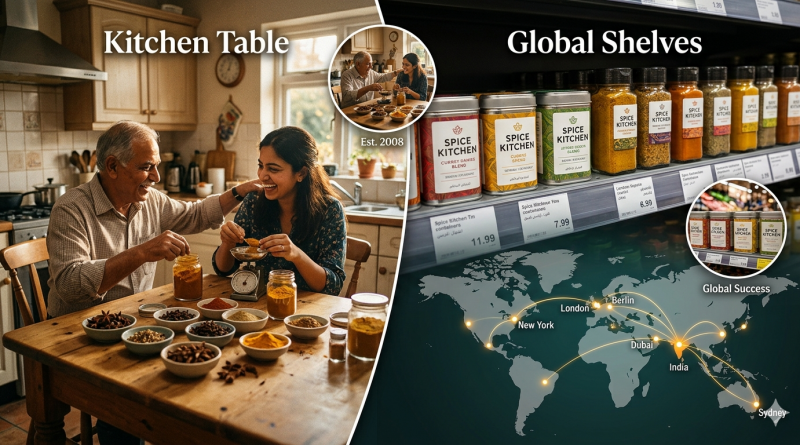
From Kitchen Table to Global Shelves: How Spice Kitchen Built an Export Business from Family Tradition
“As exports grow, it’s not demand that limits you — it’s cashflow, timing and the confidence to take bigger opportunities.”
Spice Kitchen, a family-run food company founded from a retirement hobby in 2012, has expanded from local market stalls in Manchester to exporting spice products to Europe and the United States, illustrating how small businesses are increasingly using government-backed trade support to scale internationally.
The company was started by Sanjay Aggarwal and his mother, Shashi Aggarwal, after he noticed that his mother, recently retired, was looking for a new purpose. Sanjay said the idea was initially simple: to turn her knowledge of traditional spice blends into a small home-based business that would keep her engaged.
On Christmas Day in 2012, the family listed a masala dabba, a traditional Indian spice tin containing Shashi’s homemade spice blends, on eBay. By the following day, it had sold. That early response encouraged them to continue, and what began as a kitchen-table project gradually developed into a commercial operation.
In the early years, the business relied heavily on direct sales through local markets, including Altrincham market in Greater Manchester, where the family sold products in difficult winter conditions while testing customer demand.
Shashi also used unused saris to create handmade gift wrapping for the spice tins, a detail that remains part of the company’s branding today.More than a decade later, Spice Kitchen has grown into a food manufacturing business with products stocked across UK retail shelves and sold internationally.
Its product line has expanded beyond spice tins to include a wider range of food products, and the company has also published its own cookbook. According to Sanjay, the value of exported spices now reaches six figures.He said the business has moved far beyond its original scale.
What started as a personal family project has become a structured manufacturing and export operation with growing international demand, particularly in North America.Support from the UK government played a role in that transition.
After receiving assistance from the North West Department for Business and Trade to register as an exporter, the company began attending trade shows in the UK and Ireland and later entered European markets including Belgium, Germany and the Netherlands.In recent years, the company expanded into the United States, which Sanjay identified as a major long-term growth market.
He said the U.S. offers significant commercial potential because of both consumer demand and the scale of retail opportunities compared with domestic markets.As export volumes increased, however, financing and operational capacity became more significant concerns.
Sanjay said one of the main challenges for small exporters is not finding demand but managing the working capital required to fulfill large overseas orders before payment is received.Payment terms for international trade can stretch over months, creating pressure on cashflow, particularly for businesses that need to increase stock, staffing and logistics quickly.
For Spice Kitchen, this challenge has led to a focus on automation.Currently, much of the filling and labelling process is still done manually. Sanjay said investment in automated systems would improve margins, reduce unit costs and allow the business to compete more effectively on price while increasing production capacity for overseas markets.
He said external funding may soon become necessary as the company negotiates larger international distribution deals. That is where support from UK Export Finance could become increasingly important.UKEF provides loans, guarantees and insurance designed to help UK exporters manage international trade risks and secure finance.
For smaller companies, this support can be critical when approaching unfamiliar overseas markets or working with new distributors.Sanjay said export growth is often constrained by financial timing rather than demand. Large overseas orders may require upfront production and shipping costs months before payment arrives, increasing risk for smaller operators with limited reserves.
He said guarantees could help unlock larger working capital facilities during periods of peak demand, while export insurance reduces the commercial risk of entering relationships with new overseas distributors. In practical terms, he said, that support creates confidence for planning stock, staffing and logistics and provides stability for owners managing rapid growth.
He also noted that entering new markets involves risks that are not always obvious to businesses focused primarily on domestic trade. Regulatory expectations, distribution systems and payment structures in markets such as the United States differ significantly from those in the UK.
Export finance managers, who work through UKEF, provide consultations to help businesses assess whether they are receiving the right financial support and identify gaps in trade finance. Sanjay said access to that knowledge can prevent costly mistakes and make international expansion more manageable.
As a South Asian-owned business, Spice Kitchen also supports targeted efforts to improve access to finance for ethnic minority entrepreneurs. Sanjay said exporting can be a major leap for small businesses already balancing growth and cashflow pressures, and visible institutional backing sends an important signal that those businesses are valued.
Despite the company’s international expansion, he said the family remains focused on maintaining the values that shaped the business in its earliest days. Spice Kitchen still operates as what he describes as a passion-led project rather than a purely profit-driven enterprise.
He said the goal has never been simply to build a high-value company, but to continue doing work the family enjoys while preserving the personal connection to food, tradition and customer relationships that helped the business grow.
Looking ahead, Sanjay said continued innovation will remain essential. Every stage of the company’s growth, from online sales to exports, began with opportunities that initially seemed larger than the business could handle.
He said the decision to pursue those opportunities has always involved uncertainty, but that willingness to take calculated risks remains central to the company’s future expansion.