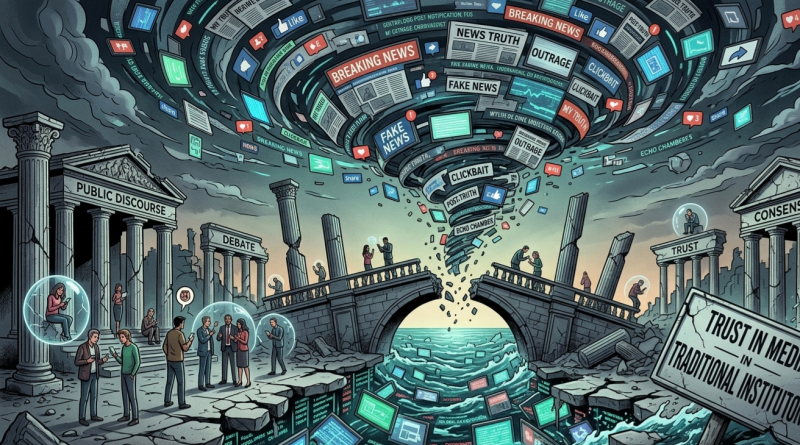
Information Overload and Eroding Trust Are Reshaping Public Discourse
“We once talked about fake news – now reality itself feels fake.”
The rapid expansion of digital media and emerging technologies is contributing to what analysts describe as a widening “information crisis,” marked by declining trust, rising misinformation, and increasing social fragmentation.
Observers note that these developments are not occurring in isolation but are interacting with broader societal trends, including political polarisation and a growing sense of disconnection among individuals.One of the defining features of the current environment is the weakening of shared social frameworks that once anchored public discourse.
Loneliness, increasingly understood by researchers as a structural rather than purely personal issue, is shaping how individuals engage with information and politics. Experts argue that socially disconnected individuals are more likely to seek community in online spaces, where simplified narratives and emotionally charged messaging often dominate.
These online ecosystems frequently provide direct, personalised communication that attributes blame for individual or societal grievances to identifiable groups. Such narratives, which may target elites or minority communities, can gain traction in environments where users are seeking clarity and belonging.
At the same time, influencers operating within digital platforms have built large audiences by promoting highly individualised worldviews, including forms of aspirational capitalism or identity-based messaging that critics say offer limited substantive engagement.
The cumulative effect is an information landscape that many users find difficult to navigate. Rapid technological change, combined with the perceived inadequacy of institutional responses, has contributed to a sense that traditional political and social mechanisms are struggling to address contemporary challenges.
Analysts suggest that this disconnect can lead individuals to question not only specific claims but the broader reliability of information itself.
Attempts to improve the quality of online discourse have had mixed results. Earlier initiatives by media organisations to moderate comment sections and encourage more constructive engagement demonstrated that platform design can influence behaviour.
Adjustments such as limiting the number of discussion threads and reframing participation guidelines were associated with improvements in tone and substance within controlled environments. However, these efforts have not been replicated consistently across the wider internet, where scale and commercial incentives complicate moderation.In recent years, the tone of online interaction has become increasingly hostile, particularly for public figures and members of marginalised groups.
Reports indicate that harassment, including threats of violence, has become a routine aspect of online visibility. The emergence of new technologies has further intensified these concerns. Tools capable of generating synthetic images and other manipulated content have expanded the range and scale of potential abuse, raising questions about regulation and accountability.
At the same time, the prioritisation of user engagement by technology platforms has altered the incentives governing information distribution. Content that captures attention regardless of accuracy tends to be amplified, while verification processes struggle to keep pace. The proliferation of low-quality, automatically generated material, often referred to as “AI slop,” alongside increasingly convincing deepfakes, has complicated users’ ability to distinguish between authentic and fabricated content.
This shift is contributing to what some commentators describe as “epistemic uncertainty,” in which individuals lose confidence in their ability to evaluate truth claims. The phenomenon is reinforced when real-world events themselves appear unusual or contradictory, further blurring the line between credible information and misinformation.
In such an environment, even accurate reporting can be met with scepticism.Public figures and policymakers have also become part of this dynamic. Statements or positions that challenge established scientific or factual consensus can gain visibility in fragmented media ecosystems, amplifying confusion. Analysts note that the presence of such viewpoints in positions of authority may further erode trust in institutions, particularly when combined with broader patterns of misinformation.
Despite these challenges, there is evidence that audiences continue to value credible, human-centred journalism. Media organisations that maintain direct relationships with their readershipthrough transparency, accountability, and engagement—have reported continued trust and participation from their audiences.
These interactions often extend beyond passive consumption, with readers contributing insights, feedback, and information that support investigative reporting.The role of community in this context remains central. As traditional forms of social connection evolve, the demand for reliable information sources that also provide a sense of belonging is increasing. Analysts suggest that rebuilding trust in information systems will require not only technological solutions but also renewed emphasis on social cohesion and institutional credibility.
The ongoing transformation of the information environment highlights the complexity of balancing openness, innovation, and accountability. As digital platforms continue to shape how information is produced and consumed, the implications for public discourse, governance, and social stability are likely to remain a central area of concern.