Putin Casts Ukraine War as Clash With NATO During Victory Day Address
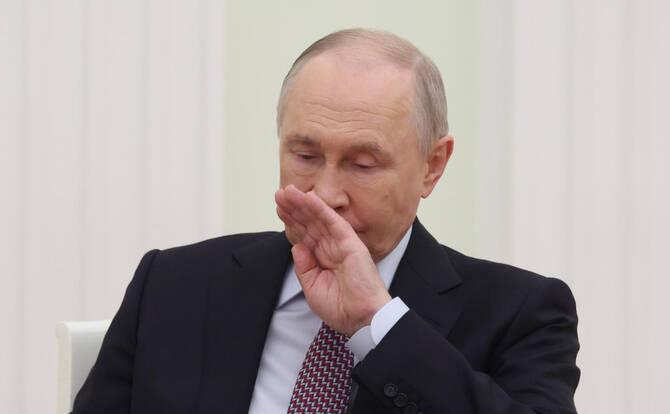
Moscow — Russian President Vladimir Putin said on Saturday that Russian forces fighting in Ukraine were confronting an “aggressive force” backed by the entire NATO alliance, using his annual Victory Day speech to frame the conflict as part of a broader geopolitical confrontation with the West.
Addressing troops and military hardware assembled on Moscow’s Red Square for commemorations marking the Soviet Union’s victory over Nazi Germany in World War Two, Putin linked Russia’s ongoing military campaign in Ukraine to what the Kremlin has repeatedly described as a struggle against Western influence and military expansion.
“The great feat of the generation of victors inspires the soldiers carrying out the goals of the special military operation today,” Putin said, using Moscow’s official terminology for the war in Ukraine.“They are confronting an aggressive force armed and supported by the entire NATO bloc.
And despite this, our heroes move forward,” he added.Putin also said he believed Russia’s military campaign was justified, declaring: “I firmly believe that our cause is just.”The remarks came during Russia’s annual Victory Day celebrations, one of the country’s most important patriotic events, which the Kremlin has increasingly used to rally domestic support for the war in Ukraine since the conflict began in February 2022.
Russia has repeatedly accused NATO and Western governments of escalating the conflict through military assistance, intelligence sharing and weapons deliveries to Ukraine. NATO members have said their support is aimed at helping Ukraine defend its sovereignty and territorial integrity against Russia’s invasion.
The war has reshaped European security dynamics, prompting increased defense spending across NATO states and the expansion of the alliance with the accession of Finland and Sweden.
Victory Day ceremonies in Moscow have taken on heightened political significance since the start of the conflict, with Russian authorities portraying the war as part of a historic struggle against external threats and Western pressure.