Thaksin Walks Free, Reigniting Thailand’s Political Fault Lines
Bangkok-Former Thai prime minister Thaksin Shinawatra was released from prison on parole on Monday after serving part of a one-year sentence for corruption, reopening questions over the future of Thailand’s deeply polarized political landscape and the enduring influence of the Shinawatra family.
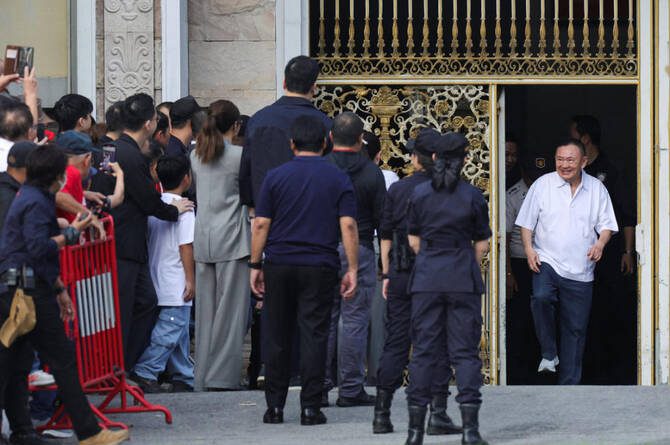
The 76-year-old telecommunications tycoon left a Bangkok prison facility early Monday morning, greeting supporters gathered outside before departing with family members. Under the terms of his release, Thaksin will remain under probation for four months and wear an electronic monitoring device.
Several hundred supporters wearing the red shirts associated with his political movement assembled outside the prison, with many chanting slogans backing the former leader, according to AFP journalists at the scene.
Thaksin did not address reporters before leaving the facility, though supporters expressed confidence that he would continue to shape Thai politics despite his release conditions.
His return to public life is likely to revive tensions between populist forces aligned with the Shinawatra family and Thailand’s conservative establishment, including military and royalist factions that have opposed his influence for more than two decades.
Thaksin’s political network, led primarily through the Pheu Thai Party, has dominated much of Thailand’s electoral politics since the early 2000s, drawing strong backing from rural and working-class voters through populist economic policies.
The Shinawatra family has produced four Thai prime ministers, including Thaksin’s daughter Paetongtarn Shinawatra, who previously led the party before stepping aside.
However, Pheu Thai suffered its weakest electoral showing in February, finishing third and raising doubts over the long-term strength of the Shinawatra political dynasty.
Political analysts say Thaksin’s release could still stabilize support for the party in the near term, particularly among loyalists who view him as the movement’s central figure.
“People will feel that the Pheu Thai owner is back,” political science lecturer Wanwichit Boonprong said, while cautioning that conservative rivals would likely consolidate behind Prime Minister Anutin Charnviraku
Thaksin was first elected prime minister in 2001 and won re-election in 2005 before being ousted in a military coup the following year. He spent years in self-imposed exile before returning to Thailand in August 2023.
Upon his return, he was sentenced to eight years in prison on corruption and abuse-of-power charges. His sentence was later reduced to one year through a royal pardon.
Controversy surrounded his imprisonment after authorities transferred him almost immediately to a hospital suite on medical grounds rather than keeping him in prison. Critics accused authorities of granting preferential treatment as Pheu Thai negotiated participation in a coalition government.
Thailand’s Supreme Court ruled in September that Thaksin’s hospital stay could not count toward his sentence because he was not suffering from a critical condition, forcing him back into prison custody.
Thailand’s corrections department approved his parole last month, citing his age and the limited time remaining on his sentence. Officials said he was among more than 850 prisoners granted early release under similar criteria.
Thaksin’s nephew Yodchanan Wongsawat, who led Pheu Thai’s campaign in the February election, now serves as higher education minister in Anutin’s cabinet, underscoring the family’s continued political relevance despite recent setbacks.