Bulgaria Celebrates First Eurovision Victory as Dara’s ‘Bangaranga’ Captures Europe’s Vote
“Bangaranga represented a quiet belief that everything’s going to be all right.” — Dara
Bulgaria celebrated its first-ever victory at the Eurovision Song Contest on Sunday after singer-songwriter Dara secured a decisive win with her dance anthem “Bangaranga,” prompting scenes of celebration across the country and drawing praise from political leaders during a period marked by prolonged domestic instability.
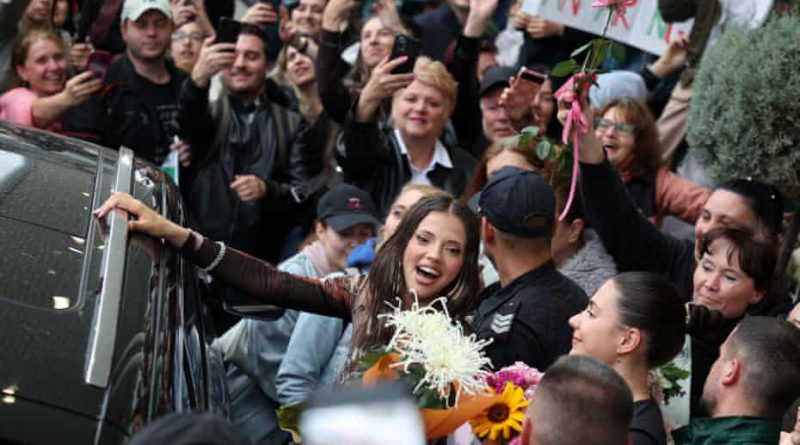
The 27-year-old performer, whose full name is Darina Nikolaeva Yotova, returned to Sofia to a public welcome after winning the 70th edition of the contest in Vienna with 516 points, comfortably ahead of Israel’s entry “Michelle,” performed by Noam Bettan, which finished second with 343 points.
Eurovision organisers said Bulgaria’s entry won both the jury and public vote, marking the first time in nearly a decade that one act had topped both categories since the 2017 contest in Kyiv.Prime Minister Rumen Radev described the victory as a significant national achievement and praised Dara for overcoming what he called the political and cultural complexities often associated with Eurovision voting.
“Dara is yet more proof that Bulgaria can win,” Radev said, adding that the singer had risen “above all the complexities and prejudices surrounding the voting process” through “talent and professionalism.”
The result delivered a rare moment of national unity in Bulgaria, an EU member state that has experienced years of political turbulence and repeated elections. The country has held eight elections in five years amid fragmented coalition politics and continuing institutional instability.
Ina Dobreva, Dara’s former acting teacher in the Black Sea city of Varna, said the singer’s victory had resonated beyond the music competition itself.“Bulgarians really needed to have a moment like this where we can gather around common happiness,” Dobreva said.
For many younger Bulgarians, the Eurovision result represented a symbolic breakthrough for a country that has often struggled for visibility on the European cultural stage.“I didn’t expect Bulgaria to win, so it was quite nice to see that for the first time, we actually managed to do it,” said Kristina Dureva, a 25-year-old recruitment specialist from Sofia.
Ilayda Kayalar, a 21-year-old interior design student, said the victory reinforced Bulgaria’s place within Europe while improving the country’s international profile.“Winning means that Bulgaria is finally known for something,” Kayalar said.
The contest itself unfolded against a backdrop of political controversy surrounding Israel’s participation. Ireland, Spain, the Netherlands, Slovenia and Iceland boycotted this year’s competition in protest, while hundreds of pro-Palestinian demonstrators gathered outside Vienna’s host venue chanting slogans against the event.
Despite the political tensions surrounding the competition, Eurovision organisers emphasised the scale of support received by the Bulgarian entry across both professional juries and public voting systems.
Dara’s performance combined electronic dance production with Balkan-inspired rhythms and multilingual lyrics, helping “Bangaranga” emerge as one of the surprise successes of the competition season after initially receiving limited expectations from bookmakers and commentators.
Speaking after her victory, Dara said the song reflected optimism during a period of wider international uncertainty.“In a turbulent world, Bangaranga represented a quiet belief that everything’s going to be all right,” she told reporters at a post-event press conference.
“Nobody believed that we can win and that Bangaranga can win, and having this love from all the juries and all the audience tonight, it feels like a dream,” she added.The singer’s arrival in Sofia on Sunday evening was marked by celebrations organised by local authorities.
Sofia mayor Vasil Terziev said Dara would receive a ceremonial welcome featuring a red carpet reception in the capital.Attention has already shifted toward preparations for the 2027 Eurovision Song Contest, which Bulgaria is now expected to host following the victory.
According to Bulgarian media reports, Sofia and the Black Sea port city of Burgas are both preparing bids to stage next year’s competition.The general director of BNT, Bulgaria’s public broadcaster, said discussions over hosting arrangements were already under way shortly after the final concluded.
Bulgaria first entered Eurovision in 2005 but had never previously won the competition. The country achieved its best prior result in 2017, when Kristian Kostov finished second with the song “Beautiful Mess.”
This year’s victory is expected to boost the profile of Bulgaria’s music industry internationally while providing a cultural milestone for a country that has frequently faced political and economic challenges since joining the European Union in 2007.
The United Kingdom again struggled in the competition, finishing last with just one point. Its entry, “Ein, Zwei, Drei,” was performed by musician Sam Battle, known professionally as Look Mum No Computer.
Israel’s second-place finish nevertheless drew significant attention given the political controversy surrounding its participation. Demonstrations outside the Vienna venue remained largely peaceful, according to organisers and local authorities.
Dara’s victory capped a contest that mixed geopolitical tensions with one of Eurovision’s strongest audience turnouts in recent years, as organisers reported substantial public voting participation across Europe.