Inside Pakistan’s Textbooks: Nationalism, Religion and the Battle Over Young Minds

When children grow up hearing that their neighbors and minority peers are existential threats, empathy dies early.
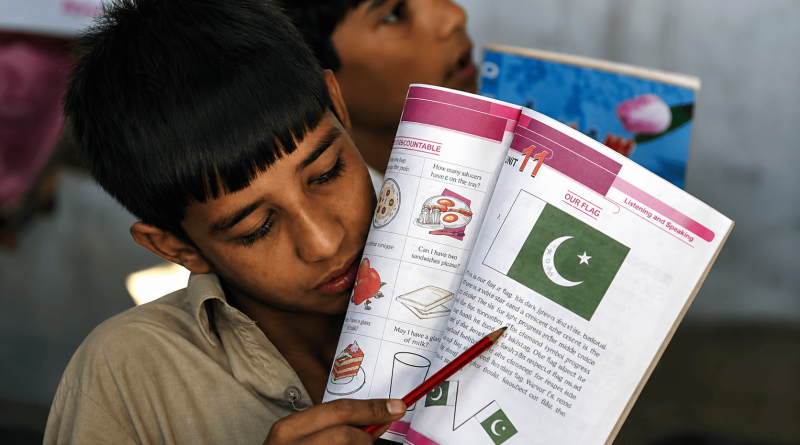
For generations, Pakistan’s school system has done far more than teach kids how to read, write, and pass exams. It operates as a quiet, methodical machinery—one that molds exactly how young Pakistanis view religion, nationalism, history, and, most crucially, those they are taught to see as “the enemy.”
Ideally, a classroom should spark curiosity. It should teach a child how to question the world. But in Pakistan, critics point out a grim reality: the public-school system serves as an assembly line for ideological conformity rather than independent inquiry.
This is not a new debate, but it just took on a sharp, urgent relevance. A major 2025 report by IMPACT-se titled Review of Pakistani Textbooks—authored by Ratnadeep Chakraborty and edited by Madeleine Ferris—blew the lid off the current curriculum.
After investigating 86 government-approved textbooks across Punjab, Sindh, and the Federal Directorate, the study exposed a deeply unsettling reality. Historical distortion, religious exclusivism, and aggressive nationalistic messaging are systematically baked into everything from social studies and Urdu to geography and Islamic education.
The report highlights how India is routinely painted as an existential, permanent threat. Meanwhile, discussions regarding Jews and Israel rely heavily on hostile stereotypes, classical antisemitic tropes, and highly selective historical narratives.
Furthermore, the concept of jihad is frequently framed not as an internal spiritual struggle, but as a noble, militaristic obligation, with virtually zero discussion about the human cost of violence or extremism.
A National Identity Built on Exclusion
This is no sudden shift. It is the continuation of a dark pattern researchers have warned about for decades. Way back in 2003, a seminal study titled The Subtle Subversion revealed that Pakistan’s textbooks were actively promoting intolerance and glorifying militarism.
More recently, a report by the Centre for Social Justice (CSJ), Quality Education vs. Fanatic Literacy, reached the exact same conclusion: discriminatory narratives and exclusionary ideas about citizenship are deeply embedded in both provincial and federal classrooms.
At its core, this is a symptom of Pakistan’s ongoing identity crisis. Ever since the partition of British India in 1947, successive governments have tried to manufacture national unity through religion-centered nationalism. This project peaked in the 1980s under the military dictatorship of General Zia-ul-Haq, whose sweeping “Islamization” policies hardwired religious ideology into state institutions—especially the schools.
The fallout of those choices is what children are breathing in today. According to the IMPACT-se report, multiple textbooks explicitly teach that Pakistan was created “exclusively as a free state for Muslims.” While wrapped in the flag of patriotism, this language effectively strips religious minorities of their stakes in the country. It implies that Hindus, Christians, and Shia communities exist completely outside the central national story.
The textbooks pay lip service to equality, but the daily reality for these minority communities is one of severe social and institutional marginalization—a truth completely erased from the classroom.
The portrayal of history is equally black-and-white. Complex historical events are flattened into a simplistic narrative: Muslims are always the victims; Hindus are always the aggressors. The “Two-Nation Theory”—the political idea that Indian Muslims required a separate homeland—is taught as infallible divine truth rather than a debated historical theory.
When children grow up hearing that their neighbors and minority peers are existential threats, empathy dies early. Education built on fear yields an adult population ruled by suspicion.
The Slow Death of Independent Thought
The crisis isn’t just what these kids are learning; it’s how they are being taught. Pakistan’s education system rewards rote memorization over actual analysis. Students get top marks for parroting official state talking points, not for questioning them.
The CSJ report highlights an even more aggressive trend: religious material has spilled far beyond the boundaries of Islamic Studies (Islamiyat). It now shows up in science, social studies, and language textbooks.
Consequently, non-Muslim students are routinely subjected to compulsory Islamic teachings inside mainstream classes. This directly violates Articles 20 and 22 of Pakistan’s own Constitution, which explicitly guarantee religious freedom and protection from forced religious instruction.
The Structural Breakdown
Pakistan is already battling a massive educational emergency. Millions of children are entirely out of school, literacy rates are stagnant, and public spending on education hovers around a dismal two percent of GDP. But the deeper tragedy is what happens to the children who do make it inside the classroom.
When you feed students a diet of simplified history, rigid dogmas, and state-sanctioned hostility, you produce adults completely unequipped for democratic participation or informed citizenship. A society that outlaws questions eventually hollows out its own intellect.
Is Real Reform Possible?
There have been piecemeal attempts to fix the system. The CSJ notes that some provincial boards have tried to introduce more inclusive content. Sindh’s curriculum, for example, features a bit more material on diversity and peaceful coexistence. Reformers continuously advocate for human rights education, peace studies, and comparative religion to be taught from an early age.
Yet, these efforts are drop-in-the-bucket fixes against a massive, rigid structure. The state still treats national identity as something incredibly fragile—something that will collapse if it isn’t guarded by strict ideological conformity.
The profound irony is that this fearful approach completely betrays the vision of Pakistan’s own founder. In his famous speech on August 11, 1947, Muhammad Ali Jinnah explicitly declared that religion should have nothing to do with the business of the state, and that all citizens would be equal. Today, that speech is rolled out for ceremonial occasions but kept far away from civic textbooks. Instead, patriotism remains fiercely shackled to religious conformity.
Ultimately, Pakistan’s textbook crisis is a mirror of the society it is choosing to build. Schools can either raise a generation capable of critical thought, empathy, and healthy debate, or they can continue to manufacture individuals trained only to repeat inherited grievances. A curriculum rooted in fear might enforce short-term obedience, but it will never build intellectual confidence or regional stability.
Disclaimer: Views expressed by writers in this section are their own and do not reflect Milli Chronicle’s point-of-view.