Beyond the ‘All-Weather’ Myth: Why China-Pakistan Geo-Economics Is Faltering

On the one hand, Pakistan keeps China entangled by highlighting the potential of the CPEC; on the other, it abides by the dictates of the IMF to get new loans and delays CPEC projects.
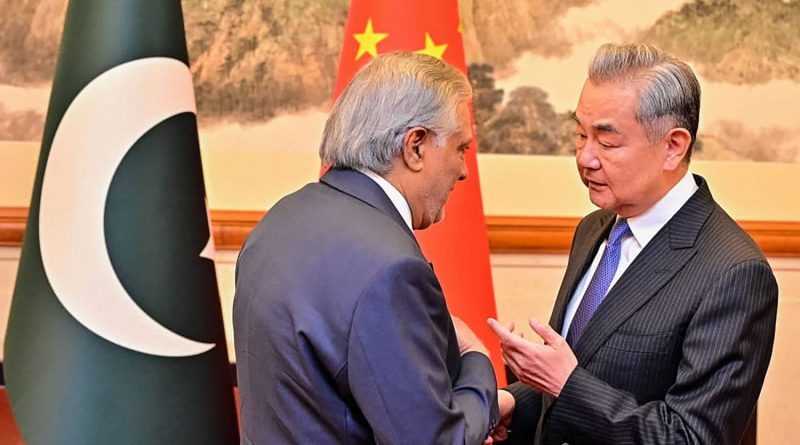
Ishaq Dar, the Deputy Prime Minister and Foreign Minister of Pakistan, recently said that “Pakistan and China share a converging vision on regional and global issues.” Dar’s silver-tongue didn’t spell out the “vision”; he doesn’t have one. Pakistan doesn’t have one. That is the reason for its consistent loan-seeking and reliance on foreign bailouts to keep the country’s economy afloat.
Islamabad has been knocking at every possible door with its begging bowl. It holds the record of taking the maximum number of loans from the International Monetary Fund (IMF) – 23 in a short span of over 75 years since joining the financial body in 1950.
A part of Dar’s statement highlighted the true intention behind Pakistan’s relationship with China. Dar said that the ties between Islamabad and Beijing have “grown from strength to strength into a robust economic and strategic partnership”. The downside of the latter part of the statement is that it is overwhelmingly one-sided, heavily favouring Pakistan.
Pakistan has been shrewd in buttering up China to extract maximum economic help from the Chinese. Celebrating Pakistan-China’s 75th anniversary of diplomatic relations with much fanfare remains part of the same policy. Even the Senate passed a resolution praising China for its support for Pakistan. The latter, in turn, has led to Beijing’s entanglement in Pakistan’s economic mess.
Pakistan has become a rentier state, living off financial support provided to it by others. It has time and again failed abysmally to reform its economic structure. From the money coming from outside the country, the ruling elite and the military establishment siphon off a large chunk. Some portion of it is used to manage macroeconomic indicators, to keep hopes of the local population alive and, at the same time, keep money flowing in from countries like China, Saudi Arabia, Qatar and international financial institutions.
Islamabad’s relations with China are emblematic of what can be called Pakistan’s rent-seeking policy. For example, the China-Pakistan Economic Corridor (CPEC) has been presented by Islamabad as a “game changer” for the country. The project has been seen as vindicating “ironclad friendship” between Pakistan and China. It is sold to build infrastructure, create jobs, and transform the country’s economic structure for lasting suitability.
Hardly anything concrete has been achieved from the billions of dollars of investment from China. In the last few years, about $8 billion in potential investment was lost due to the failure to woo foreign investors. An editorial in Dawn vindicates the larger failure of the project: “The gap between ambition and delivery is too wide to ignore. The fact that only four SEZs have moved beyond the planning stage in over a decade exposes the deeper failure of execution.” This remains important as 75 per cent of the CPEC was supposed to go into the development of new and old Special Economic Zones (SEZs) that could have boosted outputs to be transported on the corridor to other countries, helping in increasing exports.
Pakistan’s decision not to establish SEZs was taken because the IMF had set no SEZ condition for new loans. On the one hand, Pakistan keeps China entangled by highlighting the potential of the CPEC; on the other, it abides by the dictates of the IMF to get new loans and delays CPEC projects. In this way, it keeps both sponsors hooked.
Despite all hyperbolic talks and symbolism about the potential of the project, given Pakistan’s structural constraints for economic reforms and security threats for foreign investors, CPEC has underperformed in achieving whatever goals it was supposed to achieve. Already, various issues are being raised over the CPEC. Many projects started since it was rolled out in 2014 have not been completed; work on many goes slowly, and many are yet to take off. And whatever has been completed has not yielded economic benefits.
China has realised that. The Chinese have expressed their frustration with Pakistan time and again. The Chinese were “not happy with the current progress of CPEC projects” and wanted the government of Pakistan to work to remove bottlenecks in the implementation of the project. Later, China’s concerns were compounded by increasing armed attacks in Balochistan, also targeting Chinese investments and nationals working on various projects and political instability in Pakistan, asking Pakistan to overcome its political crisis. None of these issues has been addressed. In fact, armed attacks in Balochistan have increased, and political instability remains.
There is a difference in the views of CPEC as well. While for Pakistan the CPEC is projected as a solution to all its problems, for China, it is part of larger Belt and Road Initiative (BRI). Therefore, expectations of the two are consequently different. Both, China and Pakistan, however, are aware of the fact that the CPEC is not meeting the desired expectations. Still, they keep selling it, in Pakistan particularly, by overstating its potential. Both countries have their interests in doing so; more so, Pakistan.
Pakistan’s foreign exchange reserves always fall short of the country’s needs to pay for imports and pay back loans to countries and institutions. Pakistan has mostly suffered a current account deficit; lately, again in April, the current account deficit was $324 million. That being the case, Pakistan needs two things: continuous foreign financial aid and its deferment, since it cannot pay back loans on time.
That is the reason Pakistan wants to be in China’s good books: it does so by showering praise on China and highlighting the potential of CPEC, which it knows very well has not been achieved. By rolling a narrative about “iron-clad” relationship, “all-weather” friendship, etc., Pakistan seeks keep China hooked on to the Pakistani dream. Time to time, high level visits and requests from the Pakistani side aim to convince China about investing its fortunes in Pakistan. The recent visit by President Asif Zardari to China was also aimed at securing Chinese assurance to stay engaged economically under CPEC.
Pakistan is eternally busy dragging China into various sectors of its economy. After welcoming Chinese investment in infrastructure, industry and agriculture, Pakistan has now opened the defence sector to China. During Zardari’s visit, it was clear that Islamabad wanted to present provinces as new potential investment options. He went on to sign memorandums of understanding (MoUs) on agriculture technology, water desalination, and tea production, with a focus on provincial-level collaboration: at least two agreements were signed with the Sindh Government.
Even China seems to know it well and has lost its enthusiasm in CPEC. Given the failure of CPEC to achieve its goals, its consistently rising costs, and the security threats to the investment, China now wants to protect the huge investment at all cost. To do so, it has announced new small projects — more to keep a watch on the current investment than being hopeful of securing benefits from them. China has not so far announced any major investment, knowing that previous ones have not yielded desired dividends.
Pakistan has been trying to increase its labour-intensive exports but faces tough competition from countries like Bangladesh and Vietnam. Any possible success in this sector would depend on credible policy determination and a viable business environment. Both these are lacking in Pakistan. And given the mindset of the Pakistani ruling elite, they are likely to continue their rent-seeking policy vis-à-vis China by playing various cards, like offering new sectors for investment, of late.
It is unlikely, however, that the inscrutable but highly mercantile Chinese will fall for Pakistani charm in the realm of economics. This would mean that while Pakistan-China will try to remain geopolitically together, geo-economic bonding between the two will not be as strong as Pakistan would like the world to believe.
Disclaimer: Views expressed by writers in this section are their own and do not reflect Milli Chronicle’s point-of-view.