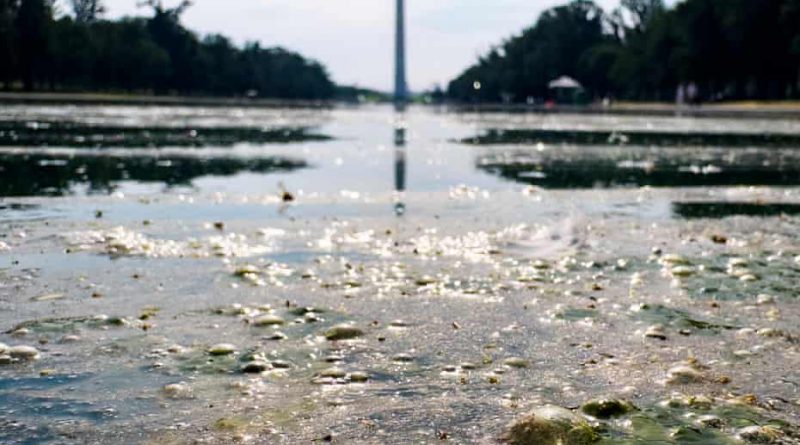
Algae-Choked Reflecting Pool Fuels Scrutiny of Trump’s $14.7 Million Washington Renovation
“What was designed as a space for reflection between two of America’s most recognizable monuments has instead become a focal point for criticism over cost, execution and maintenance.”
A major renovation of the Reflecting Pool on the National Mall has become the subject of growing public criticism after a large algae bloom transformed the waterway beneath the Lincoln Memorial into a murky green expanse, drawing tourists, local residents and television crews to a project intended to showcase infrastructure improvements.
The controversy centers on a $14.7 million overhaul backed by U.S. President Donald Trump, whose administration promoted the renovation as part of broader efforts to upgrade prominent federal landmarks in the nation’s capital. Instead, visible water-quality problems have prompted questions about the project’s execution and maintenance, turning one of Washington’s most recognizable public spaces into an unexpected political flashpoint.
On Monday, visitors arriving at the Reflecting Pool encountered water covered by a substantial algae bloom. The condition altered the appearance of the landmark, which traditionally serves as a visual corridor linking the Lincoln Memorial and the Washington Monument. The pool’s unusual condition quickly became a point of interest for tourists, many of whom stopped to photograph the scene.
The Reflecting Pool occupies a central place in the symbolic geography of the United States capital. Stretching more than 2,000 feet along the National Mall, the water feature has long been associated with presidential ceremonies, national commemorations and public demonstrations. Its image is widely recognized through photographs and television broadcasts of major historical events.
The emergence of algae across the surface has shifted attention away from those historical associations and toward questions regarding project management. Critics argue that the condition of the pool undermines the purpose of a renovation intended to enhance one of the country’s most visited public landmarks.
Among those expressing concern was Washington-based tour guide José Lebron, who said visitors are increasingly focused on the problems surrounding the renovation rather than the historical significance of the site itself.
“He has a contrary of the Midas touch, which is everything he touches becomes crap,” Lebron said while standing near the pool.
Lebron said the Reflecting Pool was originally conceived as a unifying visual element connecting two major monuments and encouraging contemplation within the surrounding memorial landscape.
“The point of visiting the pool is seeing the whole spectacle of the mistake,” he said. “It’s not enjoying what the pool actually is meant for, which is a reflective space.”
The criticism reflects a broader pattern in which infrastructure projects associated with political leaders become symbols of wider debates about governance and public spending. Although technical details regarding the algae bloom have not been fully outlined publicly, environmental experts generally note that algae growth can result from a combination of factors including water stagnation, nutrient concentrations, temperature and maintenance practices.
The appearance of the pool has also fueled commentary on social media, where photographs of the green water circulated widely. Images posted online generated renewed debate over the renovation’s cost and effectiveness, with critics arguing that the project has failed to deliver the visual improvements promised during its planning stages.
Visitors interviewed at the site appeared divided between curiosity and concern. Some viewed the bloom as a temporary maintenance issue, while others regarded it as evidence of deeper problems affecting the project. Television crews and photographers documented conditions throughout the day as tourists gathered along the edges of the pool.
For local guides and historians, the development is particularly significant because of the Reflecting Pool’s role within the broader National Mall landscape. The waterway was designed to complement the monumental architecture surrounding it and provide visitors with a sense of symmetry and perspective. Changes to its appearance can therefore attract attention disproportionate to what might occur at a less prominent public facility.
Lebron said the conversation surrounding the landmark has changed dramatically as a result of the renovation’s difficulties.
“Now we’re not talking about that,” he said, referring to the pool’s historical and architectural purpose. “Now we’re analysing what a bad job it is, how it’s peeling, how the animals are dying, that it’s not a healthy ecosystem, that the algae are blooming.”
The controversy arrives at a time when public scrutiny of federal spending remains high and infrastructure projects are frequently evaluated not only on technical performance but also on their political symbolism. High-profile landmarks often become visible measures of administrative competence because their condition is readily observed by residents, tourists and media organizations.
The Reflecting Pool’s current state has reinforced that dynamic. What was intended to highlight a renovation effort has instead generated headlines focused on maintenance concerns and public dissatisfaction. Critics have increasingly used the pool’s condition as a metaphor for broader questions regarding project oversight and government execution.
Despite the criticism, the site continues to attract visitors from across the United States and abroad. Many tourists arriving at the Lincoln Memorial stop at the Reflecting Pool regardless of its condition, underscoring the enduring significance of the landmark within Washington’s civic landscape.
As public attention remains fixed on the project, officials face growing pressure to address the water-quality issues and restore the pool to the appearance expected at one of the nation’s most prominent memorial sites.