IAEA Chief Calls for Robust Nuclear Verification in Iran as Postwar Talks Advance
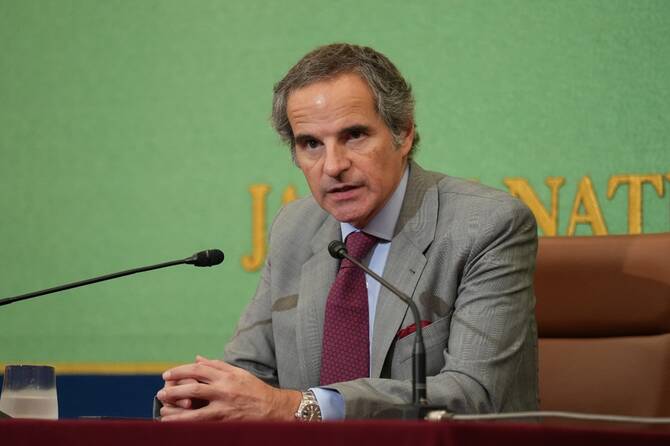
Tokyo-International Atomic Energy Agency (IAEA) Director General Rafael Grossi said on Friday that a “very strong” verification regime would be essential to ensure Iran does not develop nuclear weapons as Tehran and Washington pursue negotiations on a broader agreement following the recent Middle East conflict.
Speaking in Tokyo, Grossi said the preliminary agreement between the United States and Iran was intended to prevent the development of nuclear weapons, but stressed that political assurances alone would not be sufficient.
“I think the objective of this agreement is to ensure that there is no development of nuclear weapons in Iran,” Grossi told reporters. “The government of Iran has declared quite clearly that this is not their intention. But intentions are not enough. We have to have a very strong verification system in place as soon as is practicable.”
Grossi said the IAEA had only begun preliminary discussions with Iranian authorities regarding the future of Tehran’s enriched uranium stockpile and expected technical negotiations to accelerate in the coming weeks.
Before the conflict, the IAEA estimated that Iran possessed about 440 kilograms of uranium enriched to 60 percent purity, a level approaching weapons-grade enrichment and significantly above the 3.67 percent limit established under the 2015 nuclear agreement.
Iran suspended cooperation with the IAEA after Israeli and U.S. military strikes in June 2025, preventing inspectors from verifying the status of the stockpile. Under the terms of the current preliminary agreement, the enriched uranium is expected to be downblended under IAEA supervision, although Grossi said exporting the material from Iran also remained a technically viable option.
“The memorandum of understanding includes the possibility of downblending as one alternative,” Grossi said. “It could also be shipped out directly. There are a few technical alternatives to deal with the material.”
Grossi said the prevailing assessment was that the uranium stockpile remained near Iran’s Isfahan nuclear facility, although the site had since been damaged during military strikes. Iran has indicated it does not intend to permit IAEA inspections at facilities targeted during the conflict.
Iran continues to deny seeking nuclear weapons while maintaining that it has the right to pursue a peaceful civilian nuclear program under the Nuclear Non-Proliferation Treaty. Before the conflict, Iran allowed IAEA inspections under its safeguards agreement.
The 2015 nuclear accord between Iran and six world powers placed limits on Tehran’s nuclear activities in exchange for sanctions relief, but the agreement unraveled after the United States withdrew during President Donald Trump’s first term.