
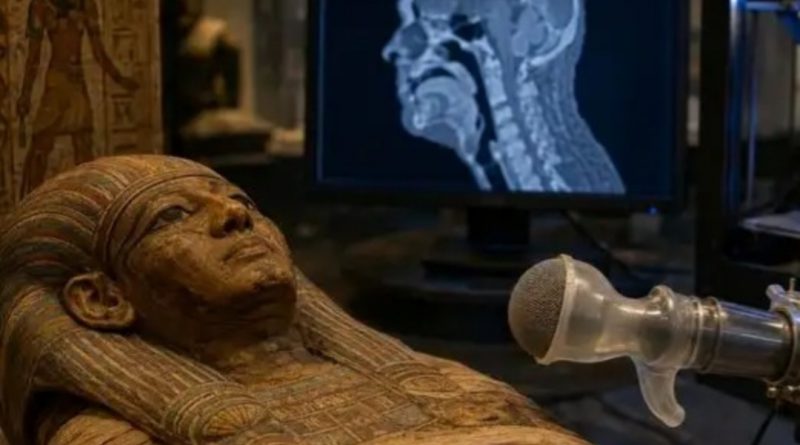
Scientists Recreate Sound from 3,000-Year-Old Egyptian Priest Using CT Scans and 3D-Printed Vocal Tract
“The experiment did not recreate a man’s voice—it reconstructed the sound his preserved vocal tract was physically capable of producing.”
An international team of researchers has demonstrated how modern medical imaging, three-dimensional printing and speech synthesis can provide new insights into the ancient world by recreating a sound from the preserved vocal tract of Nesyamun, an Egyptian priest who lived approximately 3,000 years ago during the late New Kingdom.
The experiment, first published in the journal Scientific Reports in 2020, produced a single vowel-like sound generated from a reconstructed model of Nesyamun’s vocal tract. While the achievement attracted global attention for appearing to “recreate” an ancient voice, researchers stressed that the experiment did not restore the priest’s actual speech or voice. Instead, it demonstrated what his preserved vocal anatomy could physically produce under controlled laboratory conditions.
Nesyamun, also known as Natsef-Amun and widely referred to as the Leeds Mummy, lived around 1100 BC during Egypt’s Twentieth Dynasty. Historical evidence indicates that he served as a high-ranking priest and scribe at the Karnak Temple Complex under the reign of Pharaoh Ramesses XI, one of the final rulers of the New Kingdom.
Researchers selected Nesyamun for the study because his identity is well established through inscriptions preserved on his coffin and burial materials. Unlike many unidentified mummies, extensive historical records allowed scientists to connect their technological reconstruction with a documented individual whose profession, social status and religious beliefs are known.
One inscription on his coffin carries the phrase “True of Voice,” an expression deeply rooted in ancient Egyptian funerary beliefs. The phrase referred to an individual’s successful judgment in the afterlife, where truthful speech and moral conduct were believed to determine acceptance into the eternal world. Researchers said this cultural context added symbolic significance to an experiment centered on recreating sound.
The project combined expertise from archaeology, medical science, engineering and speech technology. Scientists first examined the mummy using computed tomography (CT) scanning, a non-invasive imaging technique that produces detailed cross-sectional images of internal structures without damaging archaeological remains.
Because Nesyamun’s throat and vocal tract had remained unusually well preserved over nearly three millennia, the CT scans enabled researchers to measure the dimensions and shape of the airway with considerable accuracy. These digital measurements formed the basis for constructing a three-dimensional computer model of the vocal tract.
Using additive manufacturing, commonly known as 3D printing, researchers produced a physical replica of the reconstructed vocal tract. The printed model was then connected to an electronic device called the Vocal Tract Organ, a speech synthesis system capable of generating sounds based on the geometry of a human vocal tract.
The resulting output was a sustained vowel-like sound rather than recognizable speech. According to the research team, the sound represented only the acoustic characteristics that Nesyamun’s preserved vocal anatomy could generate if air passed through it. It was not a recording of his original voice and did not reproduce spoken language.
Scientists emphasized that human speech depends on far more than the shape of the throat. Voice production requires coordinated movement of the tongue, lips, jaw and soft palate, together with airflow from the lungs, vibration of the vocal folds and neurological control exercised by the brain. None of these dynamic biological functions survive in preserved human remains.
As a result, the recreated sound should be understood as a physical approximation based on anatomy rather than a reconstruction of how Nesyamun actually spoke during his lifetime.
Researchers from the University of York, who participated in the study, described the work as a proof of concept demonstrating how multiple technologies can be integrated to investigate aspects of ancient human biology that have traditionally remained inaccessible to archaeology.
The study represents an emerging interdisciplinary approach in which archaeological research increasingly incorporates advanced imaging, digital reconstruction and biomedical engineering. Such methods have already been used to examine ancient diseases, facial appearances, diet, migration patterns and burial practices. The Nesyamun project extends those techniques into the field of acoustic archaeology by exploring how preserved anatomy may contribute to understanding historical sound.
Although the experiment cannot recover ancient languages, accents or conversations, researchers argue that it opens new possibilities for museum interpretation and public engagement. Future exhibitions could potentially incorporate scientifically reconstructed sounds alongside visual displays, allowing visitors to experience archaeological discoveries through multiple senses.
The project also illustrates the expanding role of digital technologies in cultural heritage preservation. Three-dimensional scanning enables fragile archaeological remains to be studied without repeated physical handling, while digital models can be archived, shared internationally and reproduced for future research.
Experts caution, however, that public descriptions of the experiment should accurately reflect its scientific limitations. Headlines suggesting that scientists “brought back” an ancient voice may overstate what the research accomplished. The experiment reconstructed only one sustained vocal sound derived from anatomical measurements rather than restoring a complete human voice.
Nevertheless, the study remains one of the most innovative demonstrations of how modern technology can contribute to understanding ancient civilizations. By combining medical imaging, engineering and archaeology, researchers were able to produce an audible representation of a physical characteristic preserved for thousands of years.
More broadly, the Nesyamun project highlights how scientific advances continue to reshape archaeological research. While written records, monuments and artifacts remain central to interpreting the ancient world, technologies such as CT imaging, 3D printing and digital modelling are providing additional ways to investigate the lives of historical individuals without compromising the preservation of cultural heritage.
For researchers, the recreated sound is not an attempt to revive the past in its entirety but evidence that carefully preserved human remains can still yield previously inaccessible information. As imaging and reconstruction technologies continue to evolve, similar interdisciplinary approaches may offer further opportunities to examine the physical realities of ancient lives through methods that complement traditional archaeological investigation.


