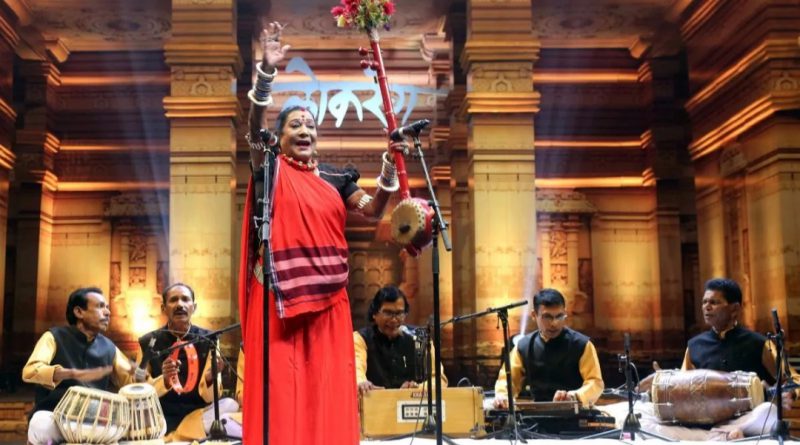
Teejan Bai Redefined Pandavani, Taking Chhattisgarh’s Oral Tradition to the Global Stage
“They tried to silence her voice, but it became the sound through which the world discovered Pandavani.”
The death of Pandavani exponent Teejan Bai at the age of 70 marks the end of one of the most influential careers in India’s folk performing arts, closing a chapter that transformed a regional oral storytelling tradition into an internationally recognised cultural form. Over several decades, Teejan Bai reshaped public understanding of Pandavani through a distinctive theatrical style that combined narration, music and dramatic performance, taking an art rooted in the villages of present-day Chhattisgarh to audiences across India and abroad.
Born in 1956 in Ganiyari village in Durg district into the Pardhi Scheduled Tribe, Teejan Bai was introduced to stories from the Mahabharata during childhood through her maternal grandfather, Brijlal, who regularly narrated episodes from the epic. According to Chhattisgarhi writer Dharmendra Nirmal, author of the biography Teejan Gatha, those early performances became the foundation of her artistic development, despite her receiving no formal training in classical or folk performance.
Pandavani, literally meaning “the voice of the Pandavas,” is a traditional storytelling form based on episodes from the Mahabharata. During the period when Teejan Bai began performing, women generally presented the art in the seated and restrained Vedamati style. Instead, she adopted the more dramatic Kapalik style, traditionally associated with male performers. Nirmal said this decision challenged prevailing social conventions within both the artistic community and her own social environment.
Her decision to perform publicly attracted opposition from members of her family and community. According to Nirmal, Teejan Bai had been married during childhood, but when she refused to abandon singing after her gauna ceremony at around the age of 12, the marriage collapsed. She was subsequently ostracised and forced to leave her home. Living independently in a hut and relying on assistance from neighbours for basic necessities, she continued practising and performing Pandavani despite financial hardship.
Her earliest public performances took place in Ganiyari village with support from her grandfather. As interest in her performances increased, members of the Deshmukh family from nearby Chandrakhuri invited her to perform in the village square. According to Nirmal, public response extended those engagements for several weeks as audiences travelled from surrounding villages to watch the performances.
Although records differ regarding her exact birth date, Nirmal said local tradition associates her birth with the Teej festival in 1956, from which her name was derived. She belonged to the Pardhi community, historically associated with hunting and the production of bamboo baskets and household items.
Despite lacking institutional instruction, Nirmal said Teejan Bai memorised all eighteen parvas of the Sanskrit Mahabharata within twenty-one days, providing the narrative foundation that later distinguished her performances. On stage, she used a tambura not only as a musical instrument but also as a dramatic prop, transforming it into symbolic objects representing weapons and characters from the epic. Her vocal delivery, physical expression and narrative transitions gradually established a performance style that broadened the appeal of Pandavani beyond traditional audiences.
Her personal life remained marked by hardship. According to Nirmal, she entered a second marriage in her late teenage years and had three sons. The relationship later deteriorated amid allegations of domestic abuse. Nirmal recounted that one incident occurred while she was performing publicly, after which she separated from her husband. She subsequently married harmonium player Tukaram Verma, who accompanied her during performances and managed her professional engagements. She raised her three sons independently, although two later died.
A decisive turning point in her career came after noted theatre personality Habib Tanvir recognised her performances and recommended that she perform before then Prime Minister Indira Gandhi. That opportunity significantly expanded her national visibility and opened doors to larger cultural platforms.
In 1986, Teejan Bai joined the Bhilai Steel Plant, a unit of the Steel Authority of India Limited (SAIL). According to the organisation, her artistic career received institutional encouragement during her tenure, enabling her to continue performing while representing Indian folk traditions nationally and internationally. Following her receipt of the Padma Bhushan in 2003, Bhilai Steel Plant promoted and honoured her in recognition of her contribution to Indian culture.
Over the following decades, Teejan Bai emerged as one of India’s most recognised cultural ambassadors. She performed in countries including the United States, the United Kingdom, France, Germany, Switzerland, Italy, Japan, Russia, Australia, Turkey and Tunisia, among others. Although most international audiences were unfamiliar with the Chhattisgarhi language, her performances attracted widespread appreciation through expressive narration, theatrical interpretation and musical presentation.
Her work also reached wider Indian audiences through television after she appeared in filmmaker Shyam Benegal’s acclaimed historical series Bharat Ek Khoj, introducing millions of viewers to the Pandavani tradition.
Despite receiving international recognition, acquaintances and colleagues consistently described her as remaining closely connected to her village roots. According to those who knew her, overseas tours never altered her personal habits or lifestyle. She continued speaking in her native dialect, regularly chewed paan and often remarked that the food she missed most while travelling abroad was basi, a traditional Chhattisgarhi preparation made by soaking cooked rice overnight in water. On one overseas visit, she reportedly requested plain rice from hotel staff so she could prepare the dish herself the following morning.
Nirmal said one of Teejan Bai’s most significant performances centred on the episode of Draupadi Cheerharan from the Mahabharata. Through that narrative, she encouraged audiences to reflect on violence against women and broader questions of justice, demonstrating how traditional storytelling could also engage contemporary social concerns.
Her contribution to Indian performing arts was recognised through several of the country’s highest civilian and cultural honours. She received the Padma Shri in 1987, the Padma Bhushan in 2003 and the Padma Vibhushan in 2019. She was also honoured with the Sangeet Natak Akademi Award, while several universities conferred honorary doctorates in recognition of her contribution to Indian culture and folk performance.
Following her death after a prolonged illness, Bhilai Steel Plant described the loss as irreparable for both Chhattisgarh’s cultural heritage and India’s folk arts. The organisation said Teejan Bai remained among its most distinguished employees and credited her with bringing international recognition to the institution, the state of Chhattisgarh and India through her artistic achievements. The organisation also stated that her lifelong commitment to preserving India’s cultural traditions would continue to influence future generations of performers.