Deadly Landslide Strikes Philippines as Typhoon Bavi Nears Taiwan
KEELUNG-Five people were killed in a rain-triggered landslide in the southern Philippines on Friday as Typhoon Bavi, described by Taiwan’s weather authorities as the largest storm to threaten the island in more than three decades, advanced toward Taiwan before an expected path toward Japan’s southwestern islands and eastern China.
Police in the Philippines said the landslide, triggered by heavy rainfall intensified by the approaching typhoon, struck the southern island of Mindanao, killing at least five people and leaving six others missing. The fatalities came as governments across the western Pacific stepped up emergency measures ahead of the storm’s arrival.
In Taiwan, authorities evacuated more than 1,000 residents, most of them from the mountainous eastern county of Hualien, where officials were also monitoring two barrier dams amid concerns over flooding and landslides.
The Central Weather Administration (CWA) said Typhoon Bavi was carrying maximum sustained winds of 162 kph (100 mph) with gusts reaching about 198 kph on Friday. While the storm had weakened from super typhoon status after crossing Guam and the Northern Mariana Islands earlier in the week, forecasters said it remained a major threat because of its unusually large wind field.
CWA forecaster Wang Ping-hsiang said environmental conditions were expected to weaken the system further, but warned that Taipei, New Taipei, Keelung and Yilan would likely experience the strongest impacts, while mountainous areas in central and northern Taiwan were forecast to receive the heaviest rainfall.
The agency said Bavi’s wind radius had expanded to about 380 km (240 miles), making it the largest typhoon to affect Taiwan in more than 30 years. Authorities warned the storm could bring up to one metre of rain in some areas.
Schools and businesses were closed across northern and eastern Taiwan, including in the capital Taipei, while hundreds of domestic and international flights were cancelled as residents rushed to complete storm preparations.
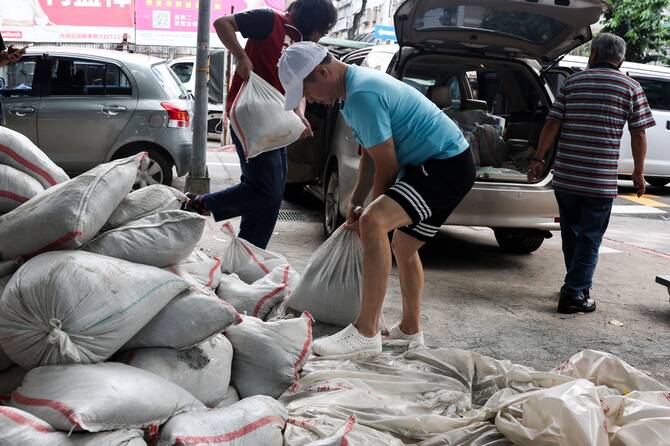
In the northern port city of Keelung, shopkeepers stocked food supplies, reinforced storefronts with sandbags and taped windows after authorities urged residents to prepare for severe weather.
“They’re saying it’s going to be huge; of course that’s scary, right?” grocery store owner Chang Shih-huo, 76, told AFP, adding that his family had stocked up on instant noodles, bread and other essentials before expecting to close the shop as conditions deteriorated.
Restaurant owner Penny Pan said stronger preparations reflected expectations of unusually powerful winds. “In the past we never used sandbags to prepare for typhoons. But this time they’re forecasting Force 10 gusts, so the captains and fishermen have all been saying we need to be better prepared,” she told AFP.
Taiwanese President Lai Ching-te urged residents in areas expected to bear the brunt of the storm to remain on high alert. Authorities said more than 20,000 troops, along with machinery, equipment and vehicles, had been placed on standby for emergency response operations.
Across the East China Sea, Japan’s remote Sakashima islands also prepared for the approaching storm. Some schools and offices were closed as weather officials warned of high waves, strong winds and possible landslides.
Masaru Nakamura, who works at a hotel on Miyako Island, said workers had secured outdoor objects with protective nets as weather conditions steadily worsened. In Okinawa’s capital, Naha, water sports operator Koki Ohama said weekend reservations had been cancelled because of the approaching typhoon.
After passing near Taiwan and Japan’s southwestern islands, Bavi is forecast to make landfall in eastern China over the weekend.
The storm approaches as parts of southern and central China are already recovering from severe weather that left at least 39 people dead, caused dozens of rivers to overflow and led to the bursting of a reservoir dam earlier this week.
Scientists have said warmer ocean temperatures can strengthen tropical cyclones and increase atmospheric moisture, resulting in heavier rainfall. The European Union’s Copernicus Marine Service said last week that the world’s oceans recorded their hottest June on record, while the return of the El Nino climate pattern this year is also contributing to warmer Pacific Ocean surface temperatures.