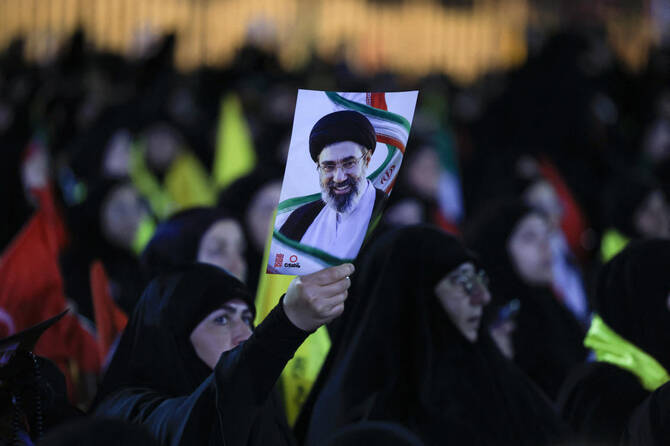
Iran’s Supreme Leader Vows Revenge for Father’s Killing
TEHRAN-Iran’s Supreme Leader Ayatollah Mojtaba Khamenei vowed on Saturday to avenge the killing of his father and predecessor, Ayatollah Ali Khamenei, declaring that retaliation was inevitable while saying its realization would depend not only on Iran but also on supporters beyond its borders.
In his first public message since funeral ceremonies for Ayatollah Ali Khamenei began a week earlier, Mojtaba Khamenei said vengeance was “the demand of the nation” and “must certainly” be carried out. The statement was broadcast on Iranian state television.
Ayatollah Ali Khamenei was killed in a U.S.-Israeli airstrike on Feb. 28 at the outset of the war, according to Iranian authorities. In the statement, Mojtaba Khamenei pledged to avenge what he described as the blood of his father and others killed during the conflict.
The statement said that retribution would be achieved regardless of individual circumstances and asserted that “free people around the world” would each play a role in carrying out what it described as a divine mission.
Despite issuing the statement, Mojtaba Khamenei has not appeared publicly since assuming the position of supreme leader on March 8. No photographs, video footage or audio recordings of him have been released since he was reportedly injured in the airstrike that killed his father.
Senior sources have previously said Mojtaba Khamenei suffered facial disfigurement and other injuries during the attack. His prolonged absence from public view has fueled uncertainty inside Iran, with some Iranians publicly questioning why the country’s highest authority has not appeared even briefly following his appointment.
Mojtaba Khamenei succeeded his father with the backing of Iran’s powerful Islamic Revolutionary Guard Corps following the death of Ayatollah Ali Khamenei, who had led the Islamic Republic for 37 years.
The statement comes amid renewed uncertainty over relations between Tehran and Washington following a recent exchange of military attacks that cast doubt on a ceasefire intended to end the four-month conflict between the two countries.
Iran has maintained that the ceasefire, despite recent violations, is expected to produce significant economic benefits if it ultimately holds.
U.S. President Donald Trump said on Friday that, although he considered the ceasefire effectively over following the latest hostilities, Washington and Tehran had nevertheless agreed to continue diplomatic talks.
State media reported on Friday that Ayatollah Ali Khamenei was buried at one of Iran’s holiest shrines after funeral ceremonies that drew large crowds of mourners from across the country.
The latest statement underscores Tehran’s continued emphasis on retaliation following the death of its longtime leader, while also highlighting the political and security challenges confronting the country’s new leadership as it navigates heightened regional tensions and uncertain diplomatic prospects.