
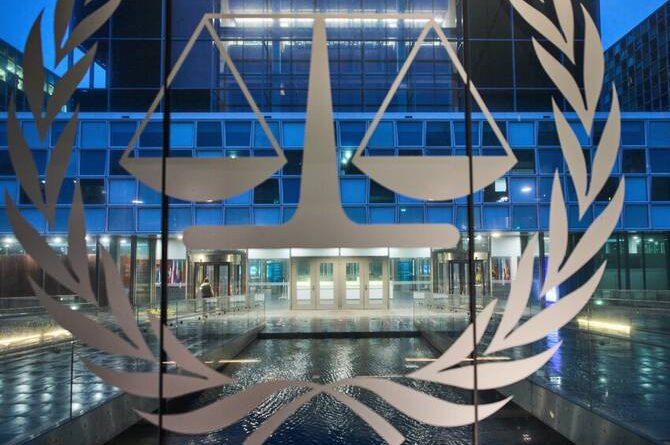
Trump ICC Sanctions Face Free Speech Challenge in US Court
WASHINGTON- Two U.S.-based advocacy organizations filed a lawsuit in federal court in New York on Wednesday seeking to block President Donald Trump’s executive order imposing sanctions on the International Criminal Court (ICC), arguing the measures violate constitutional protections for free speech by restricting advocacy related to the court’s work.
The lawsuit, brought by Democracy for the Arab World Now (DAWN) and the Taxpayer Alliance Against Genocide, comes as the Trump administration intensifies diplomatic efforts against the Hague-based court. Earlier this week, U.S. officials said the ICC posed a threat to U.S. sovereignty and pledged to expand sanctions, including travel restrictions on court personnel, while increasing pressure on the institution.
According to the complaint, the organizations contend that Trump’s February 2025 executive order has prevented them from engaging in activities protected under the First Amendment. They argue they have refrained from submitting information to the ICC and coordinating advocacy with individuals targeted by U.S. sanctions because of concerns they could face financial penalties or imprisonment.
The complaint also states that the sanctions extend to ICC judges and prosecutors as well as Palestinian human rights groups that called on the court to investigate allegations that the United States and Israel may have committed war crimes during the conflict in Gaza. Among those cited by the plaintiffs is Francesca Albanese, the United Nations special rapporteur on the occupied Palestinian territories, whose inclusion under the sanctions has, according to the lawsuit, further discouraged advocacy efforts.
“The Trump administration is using the blunt instrument of economic sanctions not only to punish human rights defenders but to police the political expression of millions of Americans,” Omar Shakir, executive director of Democracy for the Arab World Now, said in a statement.
Trump has consistently challenged the authority of the ICC, arguing that the court should not have jurisdiction over U.S. citizens, particularly members of the American military. His administration has maintained that international prosecutions involving U.S. personnel infringe upon national sovereignty.
The latest legal challenge follows a similar dispute during Trump’s first term. In 2020, his administration issued an executive order authorizing sanctions against ICC officials after the court pursued investigations that included possible crimes committed by U.S. forces in Afghanistan. A federal judge later blocked that order, finding it was likely to violate First Amendment protections. The sanctions were subsequently rescinded by President Joe Biden’s administration in 2021.
The Trump administration renewed its campaign against the ICC after the court issued an arrest warrant last year for Israeli Prime Minister Benjamin Netanyahu, a close U.S. ally. The renewed sanctions have also prompted separate legal action from three ICC judges, who have filed their own lawsuits challenging the measures.
Although ICC prosecutors opened an investigation in Afghanistan in 2020 that included alleged crimes involving U.S. forces, the court shifted its priorities in 2021. Since then, prosecutors have focused primarily on alleged crimes committed by Afghanistan’s former government and Taliban forces. According to the information provided, the court has not taken steps in recent years to investigate U.S. personnel.
The Trump administration’s latest announcement drew criticism from European partners that continue to support the ICC. On Tuesday, the European Union reaffirmed its commitment to the court and described it as an essential institution in efforts to combat impunity for serious international crimes.
European Commission spokesperson Anouar El Anouni said attacks or threats directed at the court, its elected officials, staff or individuals cooperating with its work were unacceptable. He added that the ICC does not target sovereign states and should not be regarded as a threat to their sovereignty.
The Dutch Foreign Ministry also reiterated its backing for the independence of international judicial institutions. In comments to Reuters, the ministry said it had taken note of the latest U.S. statements, describing Washington’s position as longstanding but expressing concern over what it called the increasingly hardened tone toward the court.