
US, Iran Escalate Conflict as Gulf States Come Under Fire
DUBAI-The United States expanded its military campaign deeper into Iran on Thursday while Tehran launched missile and drone attacks against Bahrain and Kuwait, widening the regional scope of the conflict after Washington tightened a naval blockade around the Islamic Republic following renewed hostilities centered on the Strait of Hormuz.
Kuwaiti authorities said their air defense forces intercepted four cruise missiles and 21 drones targeting the country, reporting material damage but no casualties. Air raid sirens sounded across neighboring Bahrain as authorities urged residents to seek shelter, while Jordan said it had intercepted three incoming Iranian missiles. Iran’s Islamic Revolutionary Guard Corps (IRGC) said it had targeted U.S. military facilities in Bahrain, Kuwait and Jordan.
The latest exchanges followed another night of U.S. airstrikes across Iran. Iranian state media reported attacks around Tehran and in Semnan province, an area associated with Iran’s ballistic missile production facilities and space program.
U.S. Central Command said it also carried out strikes on Greater Tunb Island, targeting coastal defense systems, cruise missile launch sites and other military infrastructure that it said threatened freedom of navigation through the Strait of Hormuz.
Iranian media also reported strikes near Ahvaz, Bandar Abbas, Konarak, Sirik and Qeshm. State broadcaster IRIB said an attack near a hospital in Ahvaz temporarily forced the evacuation of a pediatric cancer center. Iranian authorities did not immediately provide casualty figures from the latest wave of strikes.
Separately, Iranian state television reported that a U.S. strike hit barracks belonging to the 388th Mechanized Infantry Brigade in Sistan and Baluchestan province, killing seven soldiers and wounding others.
Iranian Health Ministry spokesperson Hossein Kermanpour said more than 35 people had been killed and over 300 wounded in recent U.S. airstrikes in recent days. He did not distinguish between civilian and military casualties. The figures marked the first overall casualty toll released by Iranian authorities for the current round of fighting.
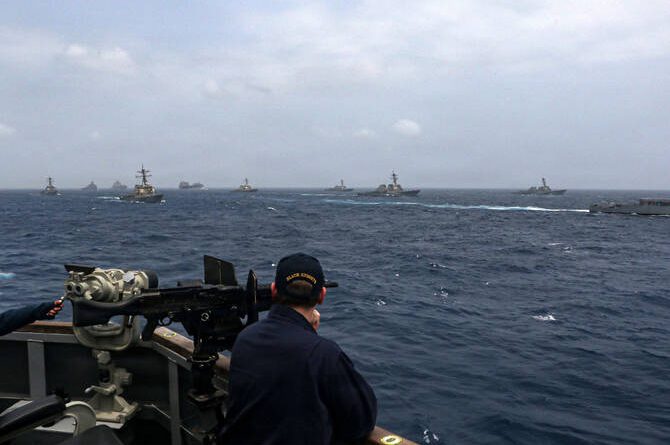
The United States has increased military pressure after reimposing a naval blockade on Iranian ports, saying the measure followed attacks on vessels attempting to transit the Strait of Hormuz.
The U.S. military said it disabled a Curacao-flagged oil tanker headed toward Iran’s Kharg Island export terminal after the vessel ignored repeated warnings. According to the military, a Hellfire missile struck the ship’s smokestack, rendering it inoperable. It added that two other vessels had been redirected since the blockade resumed, describing the operations as measures to enforce maritime restrictions.
Iran closed the Strait of Hormuz after U.S. and Israeli military operations launched on Feb. 28, disrupting one of the world’s most strategically important energy shipping lanes. Before the conflict, approximately one-fifth of global oil and gas shipments passed through the waterway.
Concerns over prolonged supply disruptions pushed Brent crude to settle at a one-month high of $84.95 per barrel on Wednesday.
Iranian Parliament Speaker Mohammad Bagher Qalibaf described the conflict as an “existential war with America,” arguing that Iran’s security depended on maintaining what he called Iranian control over arrangements governing the Strait of Hormuz.
In a statement published online, Qalibaf accused Washington of failing to honor an interim peace agreement that he said had recognized Iranian arrangements for the strategic waterway. He also sought to reassure critics inside Iran that negotiations with the United States should not be interpreted as surrender but rather as part of a broader strategy of resistance.
The IRGC warned that regional energy exports would remain at risk while the U.S. blockade continued, declaring that “the export of oil and gas from the region will be either for everyone or for no one.”
Despite the military escalation, U.S. President Donald Trump said Iran remained interested in reaching a negotiated settlement.
“They don’t like what we’re doing, and they do want to settle. We’ll find out whether or not we settle with them, or we just finish it off,” Trump said during an appearance at the U.S. Army War College in Pennsylvania.
Trump also said Iran had released an American citizen detained since late 2024, describing the move as a gesture of goodwill. Human rights lawyer Jared Genser identified the released individual as Dena Karari.
The latest exchanges followed the collapse of an interim agreement intended to halt hostilities, raising concerns that the conflict could intensify further as both sides continue military operations and exchange warnings over the strategically vital Strait of Hormuz.