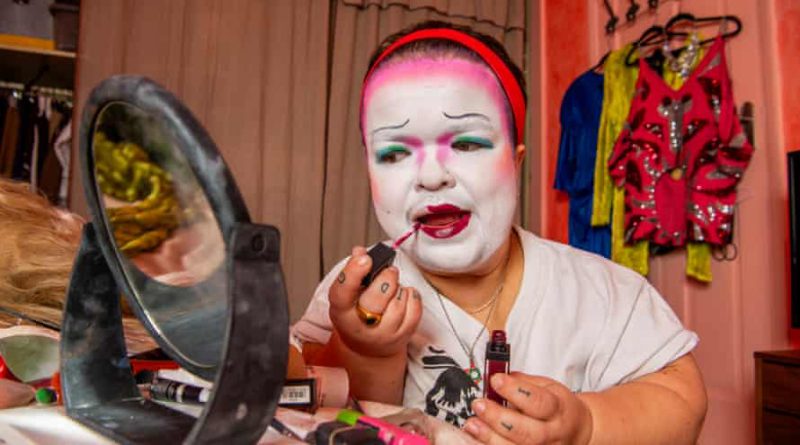
Performer Challenges Stereotypes and Accessibility Through Drag and Personal Narrative
“I’ve been radicalised by the existence I have and the way I’m treated.”
A London-based performer known by the stage persona Midgitte Bardot is using drag, writing and live performance to examine social attitudes toward dwarfism, gender identity and public scrutiny, drawing on personal experience to inform their work on prominent cultural stages.
The artist, who identifies as a non-binary trans drag performer with dwarfism, has gained recognition for combining provocative performance with autobiographical storytelling.
Appearing in fishnets and theatrical costume as Midgitte Bardot, they have developed a reputation for performances that challenge audience expectations and address issues of identity, representation and social perception.
Their work gained wider attention through participation in Sound of the Underground, a queer cabaret revue created by Travis Alabanza. In one performance, the artist delivered a blues-rock number while elevated on stage equipment, incorporating visual and thematic elements that drew a strong audience response at the Royal Court Theatre.
The performer has since returned to the stage with a new production, Shooting From Below, presented at the Southbank Centre. The show marks their first major appearance following spinal surgery undertaken after a condition that risked paralysis.
According to the performer, spinal complications are relatively common among individuals with dwarfism, and their own condition involves curvature in the lower spine.
The production centres on a fictional narrative in which the stage character addresses an audience directly, framing the performance around themes of historical marginalisation and contemporary objectification.
The performer cites examples, including accounts of individuals with dwarfism being treated as novelty figures in social settings, to illustrate ongoing patterns of exclusion and commodification.In interviews, the artist has described frequent public interactions that they say reflect intrusive curiosity and harassment.
They report being stared at, filmed without consent and subjected to personal questions in public spaces, including inquiries about their body, family background and personal relationships. Such encounters, they say, occur regularly in everyday settings such as streets and public transport.
The performer notes that these experiences have shaped both their artistic direction and personal outlook. While they emphasise that such behaviour does not represent the majority of interactions, they argue that it reflects broader social attitudes toward visible difference.
They also describe concerns about being followed after initiating casual conversations in public, which they say has influenced how they navigate social situations.Their work engages with historical representations of dwarfism in entertainment, which they describe as marked by exploitation and limited roles.
They reference examples from film and popular culture in which individuals with dwarfism have been depicted as symbolic or comedic figures, often reinforcing stereotypes. According to the performer, opportunities in the arts sector can be accessible but frequently involve forms of representation that they consider reductive.
The performer also references historical accounts, including the case of a family of performers with dwarfism who survived detention during the Holocaust after being selected for medical experimentation by Nazi physician Joseph Mengele.
They cite this example to illustrate what they describe as a contradictory dynamic in which individuals with dwarfism have been both marginalised and subjected to intense scrutiny.Midgitte Bardot, as a stage persona, is intended to challenge these dynamics by reclaiming language and reframing identity through performance.
The artist says the name deliberately references a historically derogatory term, recontextualised to assert control over its meaning. Through humour and narrative, the performances incorporate personal experiences, including instances of rejection and discrimination, into structured theatrical material.
The artist describes their approach as rooted in self-acceptance and visibility. They say their earlier life was shaped by attempts to conform, but that their current work reflects a conscious decision to foreground difference as a central element of their identity.
They also link this perspective to their understanding of gender, noting that their experiences have informed their identification as non-binary.Born in Gloucester and raised in Cheltenham, the performer recalls early experiences of being perceived as different from peers, which led them to begin writing at a young age.
They continued to develop this practice academically, studying creative writing at Liverpool John Moores University, where they graduated with top honours.During their university years, they began participating in literary and performance events, including hosting open mic nights.
Their transition into drag performance followed encouragement from peers, including a fellow performer known as Auntie Climax. The Midgitte Bardot persona gained local recognition in Liverpool, leading the artist to relocate to London in 2021 to pursue broader opportunities within the performance circuit.
The performer says their understanding of gender identity evolved alongside their work in drag. They describe observing differences in how they and others were perceived in public, particularly in relation to attention and scrutiny, which contributed to their self-identification as non-binary trans.
They also emphasise the importance of directly addressing harassment, rather than ignoring it. According to the performer, confronting such behaviour can deter repeat incidents and challenge assumptions about vulnerability.
They argue that advising individuals with dwarfism to avoid confrontation may reinforce perceptions of weakness.Looking ahead, the performer says they hope their current production will resonate with other individuals with dwarfism and contribute to the development of a more supportive community.
They note that their experiences performing in major venues are often marked by isolation, as they are frequently the only person with their physical characteristics on stage.
Their work continues to explore how visibility, performance and narrative can be used to address social attitudes, with a focus on expanding representation and creating space for more diverse perspectives within the arts.