What Stops Muslim Leaders from Becoming National Leaders in India

Leadership in India is ultimately not about who you speak for, but about who listens to you.
India is not a country where leadership is inherited; it is earned. Seven decades of electoral history show that Indian voters consistently reward leaders who speak the language of national aspiration rather than narrow community protection.
From the previous leaders’ developmental nationalism to Narendra Modi’s emphasis on growth and national confidence, successful leaders have framed their politics around collective futures, not sectional anxieties. It is within this political reality that Muslim leadership in India has encountered its most enduring limitation.
The Arithmetic of Democracy
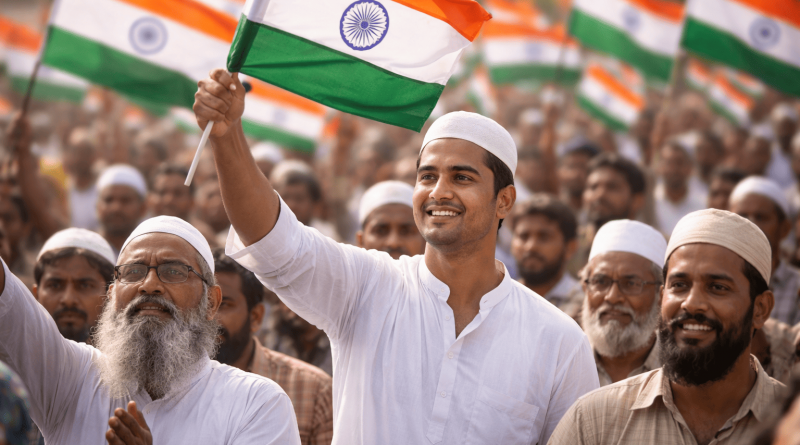
Indian Muslims constitute approximately 14.2 percent of the population, according to Census 2011 data. While this makes them the country’s largest religious minority, it also underlines a fundamental truth of Indian democracy: no national election can be won on the strength of a single community.
Parliamentary majorities are built through cross-community coalitions, broad ideological appeal, and narratives that transcend identity. Leadership, therefore, cannot afford to be sectional by design.
Any political vision perceived as speaking primarily for one community—regardless of how genuine or justified its concerns may be—inevitably encounters a ceiling. This is not a reflection of prejudice alone but of electoral mathematics.
The Indian voter, across caste, class, and religion, has historically gravitated toward leaders who articulate shared aspirations such as economic mobility, dignity, infrastructure, and national pride. Community-specific representation may protect interests, but it rarely generates mass leadership capable of shaping the national imagination.
Representation Versus Statesmanship
Post-independence Muslim political leadership has often positioned itself as the custodian of Muslim concerns rather than as an architect of India’s future. The distinction between representation and statesmanship is subtle but decisive. Representation negotiates safeguards; statesmanship defines direction. One speaks defensively, the other expansively.
Political history illustrates this divide clearly. Leaders who foregrounded poverty alleviation, education, industrial growth, and national self-confidence built constituencies that cut across social lines.
By contrast, leadership that focused primarily on identity, protection, and grievance tended to remain confined to predictable vote banks. This pattern has repeated itself across decades and regions. It is not discrimination; it is how democratic incentives operate.
This approach has also shaped narrative choices. Instead of projecting ambition and confidence, Muslim leadership has often highlighted marginalization and deprivation.
While socio-economic challenges are real—documented extensively by the Sachar Committee Report (2006)—politics that continually emphasizes backwardness can unintentionally lower expectations rather than raise confidence. No community in India has produced national leaders by centering weakness; they have done so by projecting strength.
Economic Contribution Without Political Narrative
One of the most underutilized facts in Indian political discourse is the economic role of Indian Muslims. Data from the National Sample Survey Office and various industry studies show disproportionate Muslim participation in small enterprises, handicrafts, transport, retail trade, and urban informal economies.
From leather and textiles to logistics and street-level commerce, Muslim entrepreneurship forms a vital, if under-recognized, component of India’s economic ecosystem.
Yet political leadership has rarely translated this entrepreneurial presence into a forward-looking economic narrative. Instead of framing Muslims as contributors to growth and innovation, leadership discourse has remained stuck in the language of welfare and compensation.
Welfare has its place, but welfare politics alone rarely produces transformational leaders. As survey data from the Centre for the Study of Developing Societies repeatedly indicates, Indian youth voters are increasingly driven by aspirations of mobility, skills, and opportunity rather than entitlement alone.
Silence and the Cost of Invisibility
Another uncomfortable reality is the relative absence of Muslim political voices from major national debates on economic reform, technological change, national security, climate policy, or India’s global role. When leadership intervenes only on identity-linked issues, it risks being perceived as reactive rather than visionary. In Indian politics, silence is not neutrality; it is invisibility.
The core truth is straightforward. India has never rejected a leader because of religion. It has rejected leaders who fail to expand their vision beyond religion.
A Muslim leader who champions education over appeasement, growth over dependency, constitutional values over communal rhetoric, and confidence over victimhood will not be seen merely as a Muslim leader. They will be seen as an Indian leader.
Leadership in India is ultimately not about who you speak for, but about who listens to you. When Muslim political leadership begins to speak in a language in which every Indian can locate their future, the question will no longer be why such leaders have not emerged—but why it took so long.
Disclaimer: Views expressed by writers in this section are their own and do not reflect Milli Chronicle’s point-of-view.