Ceasefire Urged as U.S.-Iran Talks in Islamabad End Without Breakthrough
Islamabad — Pakistan urged the United States and Iran on Sunday to uphold a fragile ceasefire after 21-hour negotiations in Islamabad ended without agreement, with both sides blaming each other for failing to resolve a conflict that has killed thousands and disrupted global energy markets.
Pakistan’s Foreign Minister Ishaq Dar said it was “imperative” that both parties maintain their ceasefire commitments, adding that Islamabad would continue facilitating dialogue between Washington and Tehran following the inconclusive talks.
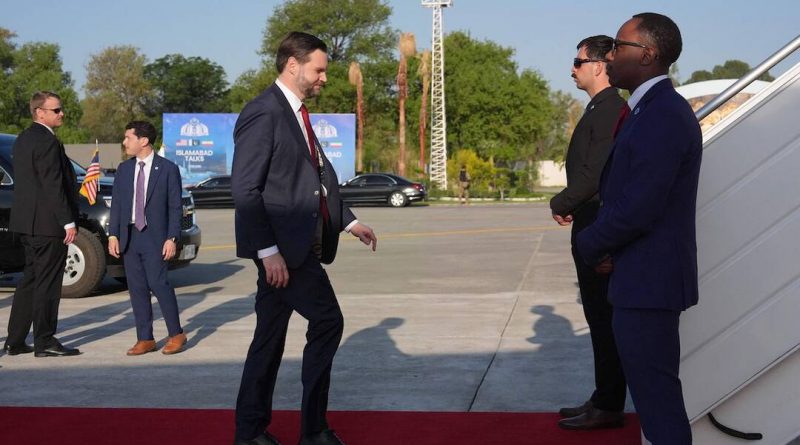
U.S. Vice President JD Vance, who led the American delegation, said the absence of a deal was “bad news for Iran much more than it’s bad news for the United States,” reiterating Washington’s demand for a firm commitment from Tehran not to pursue nuclear weapons capability.
He said the United States had made its “red lines” clear, including preventing Iran from acquiring both nuclear weapons and the means to rapidly develop them.
Iranian officials rejected the U.S. position, with state-linked Tasnim news agency reporting that “excessive” American demands had hindered progress. Tehran signaled that discussions would continue, with technical teams expected to exchange documents in follow-up engagements.
Iran’s parliamentary speaker Mohammad Baqer Qalibaf said the U.S. had failed to build trust during the talks despite what he described as “forward-looking” proposals from the Iranian side. He emphasized longstanding skepticism rooted in past negotiations, saying Washington must demonstrate credibility before progress can be made.
Iran’s foreign ministry also downplayed the outcome, stating that no agreement had been expected in a single session and expressing confidence that diplomatic contacts would continue with Pakistan and other regional actors.
Former Iranian foreign minister Mohammad Javad Zarif attributed the breakdown to what he called U.S. attempts to “dictate” terms, warning that negotiations with Iran would not succeed under unilateral conditions.
The Islamabad meeting marked the highest-level direct engagement between the United States and Iran in more than a decade and the most senior talks since the 1979 Islamic Revolution.
The discussions were aimed at halting a conflict that began over six weeks ago and has driven up global oil prices while threatening key maritime routes.Central to the negotiations was the Strait of Hormuz, a critical chokepoint for roughly one-fifth of global energy supplies.
The U.S. military said it was preparing to ensure safe navigation through the waterway, including mine-clearing operations, while Iranian state media denied any U.S. naval transit in the area.
Tehran has demanded control over the strait, war reparations, and broader ceasefire arrangements extending to regional theaters including Lebanon. U.S. officials have focused on securing freedom of navigation and curbing Iran’s nuclear enrichment capabilities.
The talks took place under tight security in Islamabad, where thousands of paramilitary forces were deployed. Pakistani officials described fluctuating tensions during the discussions, with “mood swings” and intermittent progress reported by sources familiar with the negotiations.
The Iranian delegation, which arrived dressed in black to mourn those killed in the conflict, also raised concerns about a U.S. airstrike on a school near a military compound, an incident the Pentagon has said is under investigation.
Despite the impasse, analysts noted the seniority and size of the Iranian delegation as an indication of Tehran’s willingness to engage, even as deep mistrust continues to define the diplomatic landscape.