
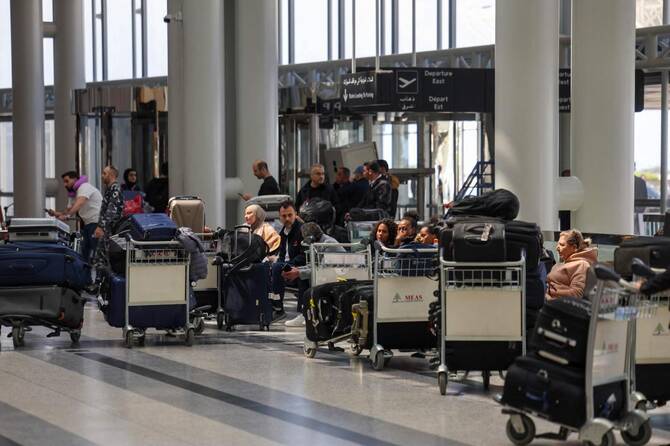
Flights Continue at Beirut Airport Amid Israeli Strikes
Beirut — Commercial flights continued to operate from Beirut–Rafic Hariri International Airport despite ongoing Israeli airstrikes on the Lebanese capital’s southern suburbs, as authorities said the facility remains open following security assessments.
Smoke from a nearby strike lingered as a plane operated by Middle East Airlines took off, underscoring the airport’s continued operations during the latest escalation between Israel and Hezbollah.
The airport, Lebanon’s only international passenger hub, sits on the Mediterranean coast adjacent to Beirut’s southern suburbs, an area heavily targeted by Israeli strikes since Hezbollah launched rockets at Israel last month, drawing the country into the broader regional conflict.
Mohammed Aziz, head of Lebanon’s civil aviation authority, said the airport has remained operational throughout the crisis, based on risk assessments informed largely by the U.S. embassy.
He added that authorities received assurances this week that the airport itself would not be targeted, following an Israeli evacuation warning covering areas near the facility.
Israel has not carried out that threat, which followed a wave of strikes that killed more than 350 people across Lebanon, including in central Beirut and its southern outskirts.
Passenger traffic has dropped to less than half of normal levels, with most international airlines suspending service. Middle East Airlines has maintained a reduced schedule, including a limited number of daily flights to Turkey.At the airport, usually crowded departure halls were sparsely populated, with only a handful of travelers waiting amid heightened security.
Some passengers said their main concern was potential cancellations rather than safety risks.A pilot with the national carrier said commercial flights continue to operate alongside Israeli military aircraft by using designated air corridors. “We have very specific air routes,” he said, adding that aircraft positions are visible through active transponders, reducing the risk of accidental conflict.
He said Israeli military aircraft typically operate at higher altitudes and are detectable on radar systems used by civilian planes.Coordination mechanisms are in place to prevent incidents, with U.S. officials acting as intermediaries, according to aviation sources.
Lebanese authorities are also sharing flight movement data with certain diplomatic missions, a Western source said.Airport chief operating officer Jalal Haidar said he was confident in the safety of the facility, surrounding areas and airspace, adding that operations have continued with minimal disruption, aside from occasional landing delays.
He said the airport is using the reduced traffic to carry out renovations, aiming to expand capacity beyond its annual average of eight million passengers.“We are prepared to remain open and operational,” Haidar said, adding that maintaining connectivity is critical for Lebanon during the conflict.
