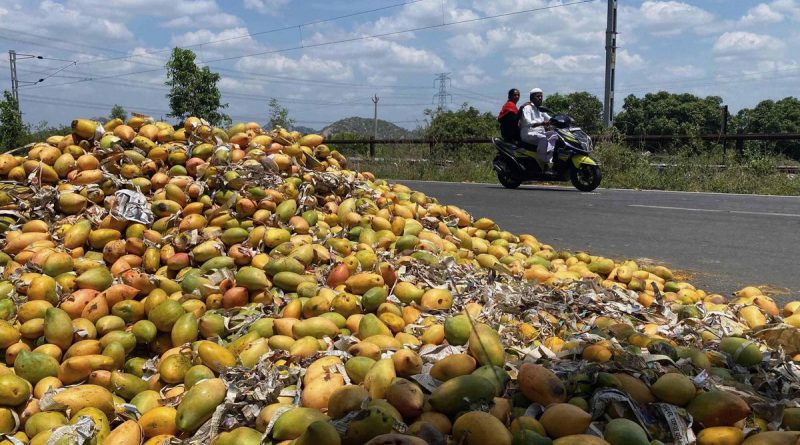
Chittoor Mango Industry Faces Severe Strain as Poor Yields and Gulf Trade Disruptions Hit Pulp Sector
“The money flow has turned zero due to the West Asia tensions.”
Chittoor district’s mango-based economy, one of India’s largest centres for pulp production, is facing significant uncertainty this season as poor crop yields and disruptions linked to West Asia tensions threaten both farmers and processors ahead of the key procurement period.
Industry representatives estimate that mango output this year may fall to nearly 40% of normal production across approximately one lakh hectares of cultivation, raising concerns for a region heavily dependent on the ‘Totapuri’ variety, which supports a large processing industry and thousands of farming households.
Chittoor is a major supplier of Totapuri mangoes, a variety primarily used for pulp manufacturing. The district feeds nearly two dozen active pulp industries and records annual production exceeding 10 lakh tonnes in a normal season, making it a critical driver of the local rural economy and export-linked food processing activity.
Stakeholders say the current season has been affected by a combination of climatic disruptions, including early flowering followed by unusually early summer conditions that damaged fruit development. The situation has been compounded by uncertainty in export markets following the ongoing West Asia crisis, which has disrupted shipments and delayed fresh procurement decisions by processors.
Veteran mango trader N.C. Ramachandra Reddy said orchards across the district showed strong flowering from January, but the pattern was uneven and failed to translate into stable fruit formation.“Though the mango gardens witnessed a very healthy and early flowering from January onwards, it was not uniform.
This year’s summer set in from early March, which caused the flowering to wither, affecting the prospects of yields,” Reddy said.He noted that in several mandals, premature fruit drop began from mid-March, significantly reducing expectations for the harvest.“In several mandals, the baby mangoes started falling to the ground from mid-March.
Our clear expectation is that the yield will not cross 40% at any point this year,” he said.The export-linked pulp processing sector is facing a parallel challenge as shipments already sent to Gulf markets remain uncertain due to instability in West Asia.
Industry officials say the region’s dependence on overseas demand, particularly from Gulf countries, has created immediate liquidity concerns for exporters and processors.All India Food Processors Association South Zone chairperson Kattamanchi Govardhan Bobby said pulp stocks valued at more than ₹1,500 crore from factories in Chittoor and parts of Tamil Nadu had been shipped shortly before the escalation of tensions in West Asia.
He said some exporters had recently incurred substantial additional logistics costs while moving consignments through the Strait of Hormuz, a key maritime trade route critical for Gulf-bound shipments.“As per the information available to the association, the pulp stocks worth over ₹1,500 crore from various factories in Chittoor and parts of Tamil Nadu were shipped a couple of weeks prior to the West Asia crisis,” Bobby said.
“Some exporters from our region had recently paid a hefty charge running into 4 million USD at the Strait of Hormuz. It’s a very scary situation for the exporters.”According to industry representatives, the uncertainty surrounding payments for these shipments has effectively halted working capital circulation, making processors reluctant to begin fresh procurement for the current season.
“The money flow has turned zero due to the West Asia tensions. As of now, we will not be able to say anything about the fresh procurement of mangoes for the current season, but only around mid-May,” Bobby said.The delay in procurement has increased anxiety among farmers, many of whom rely on seasonal mango sales as their primary annual income.
With the normal procurement cycle expected to begin in May, uncertainty over factory buying has added pressure during an already weak production year.Farmer groups have also raised concerns over delayed payments from the previous season, alleging that some pulp industries are yet to clear dues pending from 2025.
They argue that references to Gulf shipment disruptions should not be used to postpone procurement commitments to local growers.Chittoor District Mango Producers Association representative Kothur Babu said several farmers remain financially strained because of unpaid balances from last year’s supply.“It is unfortunate that some pulp industries in Chittoor district are yet to clear the 2025 pending dues to the farmers, and even the district authorities are biased towards them,” Babu said.
He said that despite the adverse weather conditions, farmers were still expecting a reasonable harvest and urged the government to ensure procurement begins according to schedule.“Despite adverse climatic conditions this year, the farmers are hopeful of a reasonable yield, and the government should intervene to start procurement as per the original schedule, which is from May,” he said.
Babu also questioned whether the West Asia crisis alone justified procurement delays, calling the argument insufficient from the farmers’ perspective.“Talk about the West Asia crisis and stranded shipments is merely a lame excuse,” he said.The uncertainty highlights the vulnerability of Chittoor’s mango economy to both climate volatility and international trade disruptions.
With production losses already likely and export-linked processors waiting for clarity on stranded shipments, the coming weeks will be critical for determining the financial outcome of the season for both growers and industry.
For a district where mango cultivation underpins both farm incomes and industrial employment, delays in procurement decisions could have broader ripple effects across the regional economy, particularly if lower yields are matched by slower factory intake and prolonged payment cycles.
Industry participants say clarity is expected only by mid-May, when processors assess export recoveries and determine the scale of fresh buying for the 2026 season.