British School Crossing Patrol Workers Face Rising Abuse and Dangerous Driving Amid Surge in Road Rage
“We’re not out to get anyone. We just want you to slow down.”
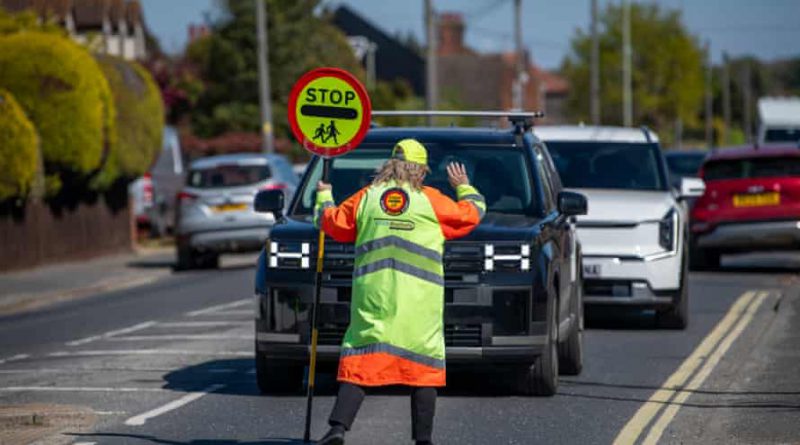
School crossing patrol workers across Britain are increasingly facing aggressive driving, verbal abuse and dangerous road incidents while helping children cross streets safely, prompting several local authorities to equip staff with body-worn cameras.
The workers, commonly known in Britain as “lollipop people” because of the circular stop signs they carry, say motorists have become noticeably more hostile in recent years, with some drivers speeding through crossings, making threats or ignoring instructions altogether.In Ipswich, eastern England, 61-year-old crossing patrol worker Lynne Gorrara said some motorists have driven toward her at speeds she estimated at up to 50 miles per hour while children were waiting to cross the road.
“When you know they’re not going to stop, you’ve got to make sure you’ve got everybody else out of the way,” Gorrara said while supervising an afternoon school crossing on a busy residential road.Suffolk County Council recently introduced body-worn cameras for crossing patrol workers as part of a safety initiative designed to document dangerous or abusive driver behavior.
Officials say the problem is not isolated to Ipswich and reflects wider increases in aggressive driving across England and Wales.According to Home Office data, police recorded more than 3.5 million motoring offences in England and Wales during 2024, the highest figure since records began. Separately, figures compiled through freedom of information requests and reported by British media showed police references to “road rage” and “aggressive driving” incidents increased significantly over recent years.
Mike Brooks, who oversees road safety initiatives for Suffolk County Council, said misunderstanding of crossing patrol workers’ legal authority often contributes to confrontations with motorists.Under British law, crossing patrol workers are authorized to stop traffic for all pedestrians, not only schoolchildren. Brooks said some drivers become confrontational when crossings are halted for adults.
“It usually takes the form of a driver saying: ‘You shouldn’t be stopping me because there are no children here,’” Brooks said.The council’s public awareness campaign, titled “Lollipops Aren’t Just for Children,” aims to clarify those legal powers while discouraging abuse directed at patrol workers.Several other councils, including authorities in Greater Manchester and Essex, have also introduced body cameras for crossing patrol staff.
Some footage reportedly has been used by police to issue warnings or penalties to motorists.Michelle Whinney, who has worked as a patrol officer in Suffolk for 12 years, said driver behavior has deteriorated noticeably over the past four to five years.She described motorists shouting insults, making obscene gestures and physically expressing anger while waiting at crossings.
“We only stop you for a second,” Whinney said.Road safety officials and analysts say several factors may be contributing to the increase in tensions. Britain’s vehicle population has expanded steadily over the past decade, with approximately 42 million vehicles registered on UK roads in 2025, according to transport data.
At the same time, local debates around traffic management policies, including low-traffic neighborhoods and road restrictions in urban areas, have heightened tensions between some motorists and local authorities.
Crossing patrol manager Andy Patmore said school crossing workers increasingly experience treatment similar to other public-facing road enforcement personnel, including parking wardens, who have reported threats, assaults and verbal harassment.Patmore said drivers attempted to pass through crossings multiple times during short patrol shifts despite visible stop signs and children present near the roadway.
“Nobody should go to work and receive abuse,” Brooks said.Parents collecting children from schools said the patrol workers provide reassurance in increasingly busy traffic conditions.Abby Hart, whose children attend a nearby primary school in Ipswich, said she had personally witnessed close calls involving drivers unwilling to stop.
“Knowing there’s someone here to help the kids safely cross just makes sense,” Hart said.The role of school crossing patrol workers has existed in Britain for nearly nine decades. The country’s first officially recognized “lollipop person,” Mary Hunt, began assisting schoolchildren across roads in Bath in 1937.
Her grandson, Colin Hunt, said dangerous driving and hostility toward crossing patrols were already problems during her service, although he described current conditions as significantly more concerning.Following World War II, local councils across Britain expanded school crossing patrol programs, particularly in densely populated urban areas. However, the number of crossing patrol workers has declined sharply over the past two decades.
After passage of the Transport Act 2000, local councils were no longer legally required to maintain crossing patrol services. Subsequent budget pressures and austerity measures accelerated reductions in staffing levels.British media reported in 2025 that councils now employ roughly half as many crossing patrol workers as they did a decade earlier. Some local authorities have proposed hiring freezes or service cuts as part of wider budget-saving programs.
At the same time, child road safety data has worsened. Department for Transport figures show the number of children under 16 killed or seriously injured on English roads increased by 17% between the periods 2017–2019 and 2022–2024.Psychoanalyst Josh Cohen said road rage often reflects feelings of frustration, humiliation and perceived competition for control in public spaces.
“People use the road to try to exert power over the other person,” Cohen said.He also argued that social media platforms can intensify public anger by amplifying confrontational narratives and turning public workers into symbolic targets of frustration.
Despite the abuse, many crossing patrol workers say the role remains deeply rewarding because of their connection to local communities and schoolchildren.
Gorrara, who recently lost her husband, said the work gives her daily purpose and motivation despite the risks associated with standing in traffic.
“I just love it,” she said.