Why Iran Released Black Hostages Early During the 1979 U.S. Embassy Crisis
“I was handcuffed, under armed guard and taken out of the embassy to the airport.”
When Iranian student militants seized the United States embassy in Tehran in November 1979, taking 66 Americans hostage, the crisis quickly evolved into one of the defining geopolitical confrontations of the late Cold War.
Yet among the most politically consequential decisions made during the 444-day standoff was Iran’s release of 13 hostages only 16 days after the embassy takeover, including 10 Black Americans and three white women.
The decision reflected a calculated effort by Iran’s revolutionary leadership to frame its conflict with Washington not as a dispute with the American people broadly, but as a struggle against U.S. imperialism and racial inequality. Iranian officials publicly argued at the time that Black Americans and women were themselves victims of oppression inside the United States and therefore should not be held responsible for American foreign policy.
Among those released was former U.S. Air Force Staff Sgt. James Hughes, then a 30-year-old communications specialist stationed at the embassy. Hughes, now 76, recalled that the release was not voluntary and occurred under armed supervision after days of uncertainty inside the embassy compound.“I was handcuffed, under armed guard and taken out of the embassy to the airport,” Hughes said in remarks reflecting on the episode decades later.
“It wasn’t like I walked out of my own free will.”The embassy seizure began on Nov. 4, 1979, after Iranian students stormed the compound amid mounting anti-American sentiment following the Islamic Revolution that toppled Shah Mohammad Reza Pahlavi earlier that year.
The United States had long backed the Shah, whose rule was associated with political repression and close alignment with Western strategic and oil interests.The immediate trigger for the embassy occupation was Washington’s decision to admit the Shah into the United States for medical treatment after he fled Iran. Revolutionary supporters viewed the move as evidence that Washington was preparing to restore him to power.
Iran’s new leadership under Ayatollah Ruhollah Khomeini quickly transformed the hostage crisis into a broader ideological confrontation with the United States, which revolutionary leaders described as an imperial power responsible for decades of political interference across the Middle East.
Within that framework, Iranian officials sought to distinguish between the U.S. government and minority groups inside America. State media and revolutionary leaders frequently highlighted racial discrimination in the United States, drawing parallels between anti-colonial struggles abroad and the civil rights movement inside America.
Hughes, who grew up in segregated New Orleans during the Jim Crow era, said his life experiences shaped how he understood the political messaging surrounding the release. Before joining the Air Force, Hughes attended segregated schools and experienced institutional racism firsthand in the American South.
The release of Black hostages aligned with broader efforts by the Iranian revolutionary government to cultivate symbolic ties with Black political movements and anti-imperialist activists globally. During the late 1970s and early 1980s, some African American activists viewed the Iranian Revolution as part of a wider challenge to Western dominance and authoritarian political systems backed by the United States.
Political scientist Benjamin R. Young said the Islamic Republic initially attracted support from diverse ideological currents, including anti-colonial and anti-imperialist movements.“The Islamic Republic in 1979 and even into the early 80s was kind of a Rorschach test,” Young said, describing how various activist groups projected their own political aspirations onto the revolution.
Iranian officials reinforced that messaging throughout the 1980s. In 1980, Iranian demonstrations were organized in solidarity with Black Americans after unrest erupted in Miami following the acquittal of police officers in the death of an unarmed Black man. In 1984, Iran issued a commemorative postage stamp honoring Malcolm X years before the United States issued its own official postal tribute.
Iran also attempted to position itself rhetorically as a defender of oppressed minorities globally. During overseas visits in the 1980s, future Iranian Supreme Leader Ali Khamenei promoted initiatives focused on racism and apartheid, although many such efforts remained largely symbolic.
Historians and analysts, however, note that Iran’s outreach to Black American causes often coincided with periods of intense geopolitical confrontation with Washington. Scholars argue that rival powers historically have used racial tensions inside the United States to counter American criticism of their own human rights records.
During the Cold War, both the Soviet Union and Communist China highlighted segregation and racial violence in the United States in propaganda campaigns aimed at undermining Washington’s international image. Analysts say Iran adopted a similar strategy after the 1979 revolution.
At the same time, reactions among Black Americans to Iran’s actions were far from uniform. Some activists and religious leaders expressed solidarity with aspects of Iran’s anti-Western rhetoric, while others rejected attempts to portray the Islamic Republic as a legitimate ally in racial justice struggles.
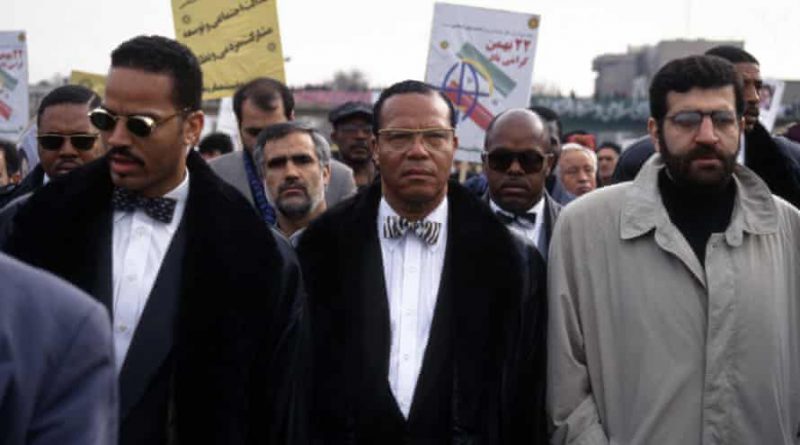
Louis Farrakhan, leader of the Nation of Islam, became one of the most prominent Black American figures to publicly support the Iranian government during later decades. But mainstream civil rights organizations often took different positions.
During the hostage crisis itself, Vernon Jordan, then president of the National Urban League, argued that Black hostages should have remained in captivity until all Americans were released, saying separate treatment risked dividing Americans along racial lines.Some of the freed hostages later faced criticism inside the United States.
Hughes said he received hostile mail accusing him of abandoning fellow captives despite having no control over the decision.The remaining 52 Americans stayed in captivity for another 14 months until negotiations mediated by Algerian diplomats produced the 1981 Algiers Accords.
The final hostages were released on Jan. 20, 1981, coinciding with the inauguration of President Ronald Reagan.The differing treatment between the two hostage groups continued long after the crisis ended. Public celebrations and ticker-tape parades in Washington and New York focused largely on the 52 hostages held for the full 444 days.
Congress later approved compensation packages for the long-term hostages, with payments reaching millions of dollars per person under legislation passed decades later. Those released after 16 days, including Hughes, were excluded from those restitution measures.
Hughes also said recognition from the military arrived unevenly. Although Congress authorized prisoner-of-war medals for Iran hostages in 2003, Hughes said his own medal was delivered to his home years later without ceremony before state military officials later organized a formal recognition event.
Today, renewed tensions between Washington and Tehran have revived public discussion about the political symbolism of the early hostage release.
Analysts say the decision remains one of the clearest examples of how the Iranian revolutionary government attempted to exploit racial divisions inside the United States as part of a broader anti-American strategy during the opening years of the Islamic Republic.